MICROBIAL CALCIFICATION IN SUBSURFACE ENVIRONMENTS
MICROBIAL CALCIFICATION IN SUBSURFACE ENVIRONMENTS. Sookie S. Bang Department of Chemistry and Chemical Engineering South Dakota School of Mines and Technology. Microbial Calcification. Microorganisms Soil bacteria (Urease-positive) Phototrophs Occurs in


MICROBIAL CALCIFICATION IN SUBSURFACE ENVIRONMENTS
E N D
Presentation Transcript
MICROBIAL CALCIFICATION IN SUBSURFACE ENVIRONMENTS Sookie S. Bang Department of Chemistry and Chemical Engineering South Dakota School of Mines and Technology
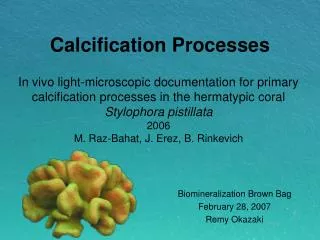
Microbial Calcification • Microorganisms • Soil bacteria (Urease-positive) • Phototrophs • Occurs in • Terrestrial environments: alkaline soil e.g., plugging of porous media • Aquatic environments: marine and freshwaters e.g., whitings, calcareous mats
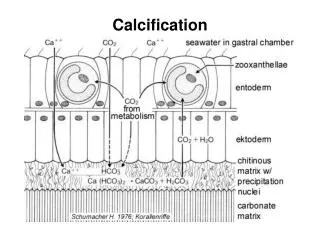
Calcification Ca2+ + HCO3- CaCO3 + H+
Microbial Urease • Intracellular Enzyme • Urea hydrolysis UREASE NH2-CO-NH2 + H2O —— 2NH3 + CO2 NH3 + H+ NH4+ (pH ) • Microorganisms: Eubacteria-Bacillus pasteurii, Proteus vulgaris, Pseudomonas spp., etc.
CaCO3 Precipitation Experiments • Microorganism: Bacillus pasteurii ATCC11859 • Medium: 3 g Nutrient broth, 20 g Urea, 2.8 g CaCl2, and 2.12 g NaHCO3, pH 7.8 – 8.0
Microbiologically InducedCalcite Precipitation (MICP) At higher pH : in medium containing Urea, CaCl2 and NaHCO3 Ca2+ + Cell Cell–Ca2+ Cl- + HCO3- + NH3 NH4Cl + CO32- Cell–Ca2+ + CO32- Cell-CaCO3
Calcification in Aquatic Environments • Photosynthetic microorganisms: Ca2+ + HCO3- CaCO3 + H+ H+ + HCO3- CH2O + O2 • Ureolytic microorganisms: Ca2+ + HCO3- CaCO3 + H+ NH3 + H+ NH4+
Potential Applications of MICP • Microbial plugging in porous media: (NSF/CMS-9412942) • Remediation of cracks and fissures in granite and concrete • Subsurface stabilization in highways with urease enzyme • Dust control for surface soils • Carbon sink in ecosystems
Potential Applications of MICP • Microbial plugging in porous media • Remediation of cracks and fissures in granite and concrete: (NSF/CMS-9412942; CMS-9802127 ) • Subsurface stabilization in highways with urease enzyme • Dust control for surface soils • Carbon sink in ecosystems
Potential Applications of MICP • Microbial plugging in porous media • Remediation of cracks and fissures in granite and concrete • Subsurface stabilization in highways with urease enzyme: (NSF/INT-0002608) • Dust control for surface soils • Carbon sink in ecosystems
Potential Applications of MICP • Microbial plugging in porous media • Remediation of cracks and fissures in granite and concrete • Subsurface stabilization in highways with urease enzyme • Dust control for surface soils • Carbon sink in ecosystems
Potential Applications of MICP • Microbial plugging in porous media • Remediation of cracks and fissures in granite and concrete • Subsurface stabilization in highways with urease enzyme • Dust control for surface soils • Carbon sink in ecosystems
Proposed Research Experiments at NeSS • Identification of diversity in microorganisms that participate in CaCO3 precipitation: • DNA extraction / PCR amplification / phylogenetic analysis • MICP in subsurface environments: • Effects of pressure, temperature, and CO2 concentration on CaCO3 precipitation kinetics • Measurement of CO2 sequestration rates: • CO2 flux using the eddy covariance methods
Hypotheses/Possibilities • CaCO3 at Homestake has percolated from the surface. • Surface soil microbial populations may have been introduced to the subsurface. • Ecological interactions among microbes in the subsurface result in phyogenetic diversity. • Subsurface environmental factors will influence kinetics of CaCO3precipitation and CO2 flux.
Significance of Proposed Research • Phylogenetic diversity of microbial communities involved in subsurface calcification • Effects of MICP on subsurface hydrology • Application of MICP in subsurface bioremediation • Evaluation of the range of carbon sequestration in deep subsurface