Graphing Linear Equations
This lesson engages students in understanding linear equations through various exercises. It starts by exploring the concept of slope, identifying undefined slopes, and calculating slopes from two points. Students will learn to solve linear equations with two variables and understand how solutions to these equations form ordered pairs. Additionally, examples demonstrate how to verify if pairs satisfy given equations and graphically represent these linear relationships on the coordinate plane. Students will complete exercises to reinforce their understanding.

Graphing Linear Equations
E N D
Presentation Transcript
Starting with an x/y table Graphing Linear Equations
Warm-up 1. Find the slope by counting 2. Determine the slope of the line formed by ( -3, 14) and (-3,-9) Answer: m = undefined Answer: m = -1/2
How do you solve this equation? 2x – 3 = 17 + 3 +3 2 2 2x = 20 x = 10 What is a major difference between the equation above and 2x – y = 17? Because the equations now have 2 variables, the solutions will come in pairs…ordered pairs (x, y)
Let’s see how to determine if an ordered pair IS a solution… Each linear equation will have an infinite amount of solutions that come in pairs. (x,y)
EXAMPLE 1: ON GRAPHIC ORGANIZER Determine if each ordered pair is a solution to the equation y = 4x – 1. A. (3,11) (x, y) y = 4x – 1 Use the substitution property to plug in the values of x and y. 11 = 4(3) - 1 11 = 12 - 1 Conclusion: Yes, (3, 11) is a solution because it falls on the line, y = 4x - 1 11 = 11
EXAMPLE 1: ON GRAPHIC ORGANIZER Determine if each ordered pair is a solution to the equation y = 4x – 1. B. (10,3) (x, y) y = 4x – 1 Use the substitution property to plug in the values of x and y. 3 = 4(10) - 1 3 = 40 - 1 Conclusion: No, (10, 3) is a not a solution. It does not fall on the line, y = 4x - 1 3 = 39
EXAMPLE 1: ON GRAPHIC ORGANIZER Determine if each ordered pair is a solution to the equation y = 4x – 1. C. (11, 43) Try this one on your own! Conclusion: Yes, ( 11, 43) is a solution. It falls on the line, y = 4x – 1.
What do all the solutions to a linear equation look like? They form a line in the coordinate plane!
Example 2: Graph 4x – 3y = 6 1st: Solve the equation for y 4x – 3y = 6 -4x - 4x – 3y = -4x + 6 -3 -3 y = 4/3x -2
Example 2: Graph 4x – 3y = 6 X is independent. Choose any number for x and plug it into the equation 2 (3,2) In this problem, it’s smart to choose multiples of 3 since you must multiply by 4/3. 0 -2 (0,-2) -3 -6 (-3,-6) 6 6 (6,6)
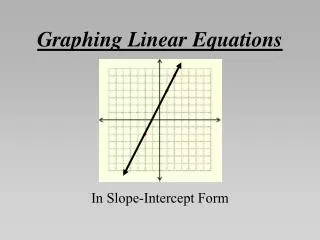
Plot your four points • These are only 4 solutions. Since there are an infinite amount of solutions, draw a line through the points. Every point that falls on the line is a solution. Label your line Make sure your line has arrows!
Example 3: Graph x + 2 = 0 • This equation doesn’t have a y. Therefore, isolate x . Choose any values for y • x + 2 = 0 • - 2 -2 • x = -2 • -4 • 0 • 1 • 5 X is fixed at -2
Example 3: Graph & Label line Rule of thumb: Draw your line as big as your coordinate plane. No little , itty -bitty lines in a huge plane! x= -2
Example 4: Graph y = -3 • Do this on your own! (click for answer) y = -3
Begin Homework • Graph paper is located in my supply closet. (Double cabinets closest to the classroom door.) • Page 351 Oral exercises #1-12, • Page 357 #29-36 all • If you have a graphing calculator, bring it to class tomorrow.