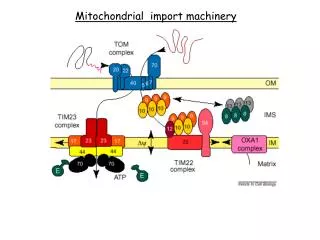
Mitochondrial and Peroxisomal Import Mechanisms: Understanding Transport and Biogenesis
110 likes | 225 Vues
This article explores the intricate machinery responsible for mitochondrial and peroxisomal import processes. It details the translocation mechanisms across the inner mitochondrial membrane and the common translocons involved in peroxisomal import, such as PTS1 and PTS2. Key factors like Pex5p, Pex7p, and Pex14p are discussed, along with implications for peroxisomal biogenesis disorders, including Zellweger syndrome. Additionally, the dynamic nature of mitochondria, their need for faithful distribution during cell division, and their DNA autonomy are also covered.


Mitochondrial and Peroxisomal Import Mechanisms: Understanding Transport and Biogenesis
E N D
Presentation Transcript
Peroxisomal import occurs through a common translocon PTS1 PTS2 Pex5p Pex7p Pex14p Pex17p + addtl. factors Pex13p PTS1: C-term (S/C/A) (K/R/H) L PTS2: bipartite N-term (R/K) (L/V/I) XXXXX (H/Q) (L/A)
Peroxisomal import occurs through a common translocon PTS1 PTS2 Pex5p Pex7p Pex14p Pex17p + addtl. factors Pex13p Peroxisomal biogenesis disorders (e.g. Zellweger syndrome) can affect peroxisomal transport and maintenance
Peroxisomal import occurs posttranslational “extended shuttling” versus “simple shuttling” transport
PMP1 PMP2 Pex19p ? “cytoplasmic chaperone” Pex3p “docking factor”
Mitochondria are highly dynamic and undergo constant fusion and fission cycles
Organelle inheritance Organelles must be faithfully and equally distributed - organelles cannot be generated de novo - mitochondria contain own DNA - etc. Organelles can be distributed stochastically or ordered