Understanding Processor Basics: A Dive into MIPS Architecture and Operation
This course material provides a comprehensive overview of processor fundamentals, focusing on the MIPS architecture. It delves into the building blocks of computers, including the Arithmetic Logic Unit (ALU), memory systems (SRAM and DRAM), and the instruction handling processes. Students will explore the MIPS register file structure, instruction types, and the single-cycle processor approach. Additionally, the material covers the distinctions between the von Neumann and Harvard architectures, offering insights into how programs are executed at a low-level and the translation from high-level programming languages to machine language.

Understanding Processor Basics: A Dive into MIPS Architecture and Operation
E N D
Presentation Transcript
Processor CS 3410, Spring 2014 Computer Science Cornell University See P&H Chapter: 2,4.1-4.4, Appendices A and B
Administration • Partner finding assignment on CMS • Office hours over break
Goal for Today • Understanding the basics of a processor We now have enough building blocks to build machines that can perform non-trivial computational tasks • Putting it all together: • Arithmetic Logic Unit (ALU)—Lab0 & 1, Lecture 2 & 3 • Register File—Lecture 4 and 5 • Memory—Lecture 5 • SRAM: cache • DRAM: main memory • Instruction types • Instruction datapaths
MIPS Register File memory registerfile inst alu +4 +4 addr =? PC din dout control cmp offset memory new pc target imm extend A Single cycle processor
MIPS Register file • MIPS register file • 32 registers, 32-bits each (with r0 wired to zero) • Write port indexed via RW • Writes occur on falling edgebut only if WE is high • Read ports indexed via RA, RB Dual-Read-PortSingle-Write-Port 32 x 32 Register File QA 32 DW 32 QB 32 WE RW RA RB 1 5 5 5
MIPS Register file • MIPS register file • 32 registers, 32-bits each (with r0 wired to zero) • Write port indexed via RW • Writes occur on falling edgebut only if WE is high • Read ports indexed via RA, RB A 32 W 32 B 32 WE RW RA RB 1 5 5 5
MIPS Register file • Registers • Numbered from 0 to 31 • Each register can be referred by number or name • $0, $1, $2, $3 … $31 • Or, by convention, each register has a name • $16 - $23 $s0 - $s7 • $8 - $15 $t0 - $t7 • $0 is always $zero • P&H
MIPS Memory memory registerfile inst alu +4 +4 addr =? PC din dout control cmp offset memory new pc target imm extend A Single cycle processor
MIPS Memory Dout Din • MIPS Memory • 32-bit address • 32-bit data(but byte addressed) • Enable + 2 bit memory control (mc) 00: read word (4 byte aligned) 01: write byte 10: write halfword (2 byte aligned) 11: write word (4 byte aligned) memory 32 32 2 32 addr mc E 0x05
Putting it all together: Basic Processor memory registerfile inst alu +4 +4 addr =? PC din dout control cmp offset memory new pc target imm extend A Single cycle processor
To make a computer Need a program Stored program computer Architectures von Neumann architecture Harvard (modified) architecture
Putting it all together: Basic Processor • Let’s build a MIPS CPU • …but using (modified) Harvard architecture CPU DataMemory Registers 00100000001 00100000010 00010000100 ... Control data, address, control ALU ProgramMemory 10100010000 10110000011 00100010101 ...
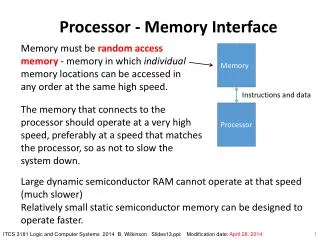
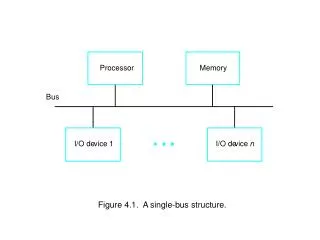
Takeaway • A processor executes instructions • Processor has some internal state in storage elements (registers) • A memory holds instructions and data • (modified) Harvard architecture: separate insts and data • von Neumann architecture: combined inst and data • A bus connects the two We now have enough building blocks to build machines that can perform non-trivial computational tasks
Next Goal • How to program and execute instructions on a MIPS processor?
Levels of Interpretation: Instructions • Programs written in a • High Level Language • C, Java, Python, Ruby, … • Loops, control flow, variables for (i = 0; i< 10; i++)printf(“go cucs”); • Need translation to a lower- • level computer understandable • format • Assembly is human readable machine language • Processors operate on Machine Language main:addir2, r0, 10 addir1, r0, 0 loop:slt r3, r1, r2 ... op=addi r0 r2 10 00100000000000100000000000001010 00100000000000010000000000000000 00000000001000100001100000101010 op=reg r1 r2 r3 func=slt • Machine Implementation ALU, Control, Register File, …
Levels of Interpretation: Instructions • High Level Language • C, Java, Python, Ruby, … • Loops, control flow, variables for (i = 0; i< 10; i++)printf(“go cucs”); Assembly Language • No symbols (except labels) • One operation per statement main:addir2, r0, 10 addir1, r0, 0 loop:slt r3, r1, r2 ... op=addi r0 r2 10 • Machine Language • Binary-encoded assembly • Labels become addresses 00100000000000100000000000001010 00100000000000010000000000000000 00000000001000100001100000101010 op=reg r1 r2 r3 func=slt • Machine Implementation ALU, Control, Register File, …
Instruction Usage • Instructions are stored in memory, encoded in binary • A basic processor • fetches • decodes • executes one instruction at a time op=addi r0 r2 10 00100000000000100000000000001010 00100000000000010000000000000000 00000000001000100001100000101010 addr data cur inst pc adder decode execute regs
MIPS Design Principles • Simplicity favors regularity • 32 bit instructions • Smaller is faster • Small register file • Make the common case fast • Include support for constants • Good design demands good compromises • Support for different type of interpretations/classes
Instruction Types • Arithmetic • add, subtract, shift left, shift right, multiply, divide • Memory • load value from memory to a register • store value to memory from a register • Control flow • unconditional jumps • conditional jumps (branches) • jump and link (subroutine call) • Many other instructions are possible • vector add/sub/mul/div, string operations • manipulate coprocessor • I/O
Instruction Set Architecture • The types of operations permissible in machine language define the ISA • MIPS: load/store, arithmetic, control flow, … • VAX: load/store, arithmetic, control flow, strings, … • Cray: vector operations, … • Two classes of ISAs • Reduced Instruction Set Computers (RISC) • Complex Instruction Set Computers (CISC) • We’ll study the MIPS ISA in this course
Instruction Set Architecture • Instruction Set Architecture (ISA) • Different CPU architecture specifies different set of instructions. Intel x86, IBM PowerPC, Sun Sparc, MIPS, etc. • MIPS (RISC) • ≈ 200 instructions, 32 bits each, 3 formats • all operands in registers • ≈ 1 addressing mode: Mem[reg + imm] • x86: Complex Instruction Set Computer (ClSC) • > 1000 instructions, 1 to 15 bytes each • operands in special registers, general purpose registers, memory, on stack, … • can be 1, 2, 4, 8 bytes, signed or unsigned • 10s of addressing modes • e.g. Mem[segment + reg + reg*scale + offset]
Instructions • Load/store architecture • Data must be in registers to be operated on • Keeps hardware simple • Emphasis on efficient implementation • Integer data types: • byte: 8 bits • half-words: 16 bits • words: 32 bits • MIPS supports signed and unsigned data types
MIPS instruction formats • All MIPS instructions are 32 bits long, has 3 formats • R-type • I-type • J-type
MIPS Design Principles • Simplicity favors regularity • 32 bit instructions • Smaller is faster • Small register file • Make the common case fast • Include support for constants • Good design demands good compromises • Support for different type of interpretations/classes of instructions
Takeaway • A MIPS processor and ISA (instruction set architecture) is an example of a Reduced Instruction Set Computers (RISC) where simplicity is key, thus enabling us to build it!!
Next Goal • How are instructions executed? • What is the general datapathto execute an instruction?
Instruction Usage • Instructions are stored in memory, encoded in binary • A basic processor • fetches • decodes • executes one instruction at a time op=addi r0 r2 10 00100000000000100000000000001010 00100000000000010000000000000000 00000000001000100001100000101010 addr data cur inst pc adder decode execute regs
Five Stages of MIPS Datapath Prog. Mem Data Mem Reg.File inst ALU 5 5 5 +4 PC control Decode Execute Fetch Memory WB A Single cycle processor
Five Stages of MIPS datapath • Basic CPU execution loop • Instruction Fetch • Instruction Decode • Execution (ALU) • Memory Access • Register Writeback • Instruction types/format • Arithmetic/Register: addu $s0, $s2, $s3 • Arithmetic/Immediate: slti $s0, $s2, 4 • Memory: lw $s0, 20($s3) • Control/Jump: j 0xdeadbeef
Stages of datapath (1/5) • Stage 1: Instruction Fetch • Fetch 32-bit instruction from memory • Instruction cache or memory • Increment PC accordingly • +4, byte addressing • +N +4 Prog. Mem inst PC
Stages of datapath (1/5) Prog. Mem Data Mem Reg.File inst ALU 5 5 5 +4 PC control Fetch Decode Execute Memory WB A Single cycle processor
Stages of datapath (2/5) • Stage 2: Instruction Decode • Gather data from the instruction • Read opcode to determine instruction type and field length • Read in data from register file • E.g. for addu, read two registers • E.g. for addi, read one register • E.g. for jal, read no registers Reg.File 5 5 5 control
Stages of datapath (2/5) • All MIPS instructions are 32 bits long, has 3 formats • R-type • I-type • J-type
Stages of datapath (2/5) Prog. Mem Data Mem Reg.File inst ALU 5 5 5 +4 PC control Fetch Decode Execute Memory WB A Single cycle processor
Stages of datapath (3/5) • Stage 3: Execution (ALU) • Useful work is done here (+, -, *, /), shift, logic operation, comparison (slt). • Load/Store? • lw $t2, 32($t3) • Compute the address of the memory ALU
Stages of datapath (3/5) Prog. Mem Data Mem Reg.File inst ALU 5 5 5 +4 PC control Fetch Decode Execute Memory WB A Single cycle processor
Stages of datapath (4/5) • Stage 4: Memory access • Used by load and store instructions only • Other instructions will skip this stage If lw Data from memory Target addr from ALU Data Mem If sw Data to store from reg to mem R/W
Stages of datapath (4/5) Prog. Mem Data Mem Reg.File inst ALU 5 5 5 +4 PC control Fetch Decode Execute Memory WB A Single cycle processor
Stages of datapath (5/5) • Stage 5: • For instructions that need to write value to register • Examples: arithmetic, logic, shift, etc., load • Branches, jump?? WriteBack from ALU or Memory Reg.File PC New instruction address If branch or jump
Stages of datapath (5/5) Prog. Mem Data Mem Reg.File inst ALU 5 5 5 +4 PC control Fetch Decode Execute Memory WB
Full Datapath Prog. Mem Data Mem Reg.File inst ALU 5 5 5 +4 PC control Fetch Decode Execute Memory WB
Takeaway • The datapath for a MIPS processor has five stages: • Instruction Fetch • Instruction Decode • Execution (ALU) • Memory Access • Register Writeback • This five stage datapath is used to execute all MIPS instructions
Next Goal • Specific datapaths for MIPS Instructions
MIPS Instruction Types • Arithmetic/Logical • R-type: result and two source registers, shift amount • I-type: 16-bit immediate with sign/zero extension • Memory Access • load/store between registers and memory • word, half-word and byte operations • Control flow • conditional branches: pc-relative addresses • jumps: fixed offsets, register absolute
MIPS instruction formats • All MIPS instructions are 32 bits long, has 3 formats • R-type • I-type • J-type
Arithmetic Instructions 00000001000001100010000000100110 R-Type ex: r4 = r8 r6 # XOR r4, r8, r6
Arithmetic and Logic r8 Prog. Mem Reg.File inst ALU r4 r6 xor 5 5 5 +4 PC xor control Fetch Decode Execute Memory WB skip
Arithmetic Instructions: Shift 00000000000001000100000110000000 R-Type ex: r8 = r4 * 64 # SLL r8, r4, 6 r8 = r4 << 6
Shift Prog. Mem Reg.File inst ALU r8 r4 shamt = 6 sll 5 5 5 PC sll +4 control shamt