Understanding Protein Synthesis: From Genes to Functional Proteins
This comprehensive overview explores the key aspects of protein synthesis, including its history, the structure of proteins, and the journey from gene to functional protein. We delve into the central dogma of molecular biology, examining transcription and translation processes, the roles of various organelles, and the impact of mutations. The contributions of notable scientists like Fourcroy, Sanger, and Pauling are highlighted, showcasing the evolution of our understanding of proteins. Visual aids illustrate crucial concepts, making complex mechanisms easier to grasp for students and enthusiasts alike.

Understanding Protein Synthesis: From Genes to Functional Proteins
E N D
Presentation Transcript
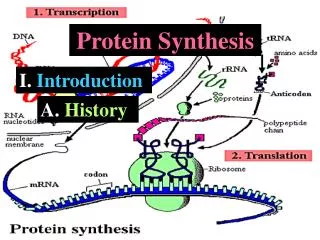
Protein Synthesis I.Introduction A.History
1.Protein Structure a.A. Fourcroy – recognized protein as a class of biological molecules b.J. Mulder – Identified proteins as all having the same formula c.F.Sanger– sequenced insulin d.T.Svedberg – proposed that proteins had conformation e.Armour Hot Dog Co.– purified pure bovine pancreatic ribonuclease A
2.From Gene to Protein a.J. von Liebig – started physiological chemistry b.E. Buchner – started Bio-chemistry c.W.Rontgen– discovered value of x-rays, led toX-ray crystallography d.L.Pauling – discovered H-bonding in protein e.G.Beadle&E. Tatum– relationship of gene to protein
1.Central Dogma a. DNARNAProtein(Product) Figure 17.3
2.Triplet Code Figure 17.4
3.Code Dictionary a. Special Codes Figure 17.5
II.Transcription A.Definition B.Process
1. Overview Figure 17.7
1. Overview & Players Figure 17.7
2. Initiation == transcription factors, attach, unwind, & orient RNA polymerase Figure 10.13 Figure 17.8
4. Termination == factorsrecognize and release the RNA polymerase
5. Modification == pre-mRNA to mRNA Figure 17.10
5. Modification == pre-mRNA to mRNA Figure 17.11
5. Modification == pre-mRNA to mRNA Figure 17.12
III.Translation A.Definition B.Process
1. Overview & Players Figure 17.13
tRNA Figure 17.14
rRNA & mRNA Figure 17.16
2. Initiation Figure 17.17
3. Elongation Figure 17.18
4. Termination Figure 17.20 Figure 17.19
5. Modification Figure 17.21
IV.Gene Expression A.Strategies B.Organelles
1. Intracellular What/Which organelle(s) are involved in building proteins which are to be used by the cell? Ribosomes! 2. Extracellular What/Which organelle(s) are involved in building proteins which are to be put into vacuoles for shipping or retention? Ribosomes, rER, and Golgi!
VI.Mutations A.Definition B.Point
1. Base Pair Substitutions Figure 17.23
2. Frame Shift Figure 17.25