Magneto coupled actuators
This project focuses on developing magneto coupled actuators for underwater robotics, enabling manipulators to operate effectively in wet environments without the need for dynamic waterproofing. By utilizing static waterproofing methods, these actuators can engage with diverse parts and circuits while eliminating the risks associated with mixing electricity and water. Our goal is to create a multi-axis manipulator that maximizes movement and minimizes maintenance costs, ensuring robust performance in harsh conditions. This innovative approach opens the door to further applications in underwater and other challenging environments.
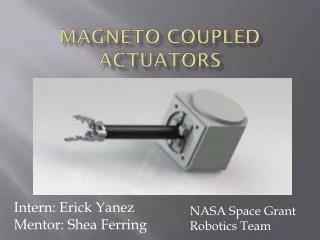

Magneto coupled actuators
E N D
Presentation Transcript
Magneto coupled actuators Intern: Erick Yanez Mentor: Shea Ferring NASA Space Grant Robotics Team
Manipulators • Manipulators are the platform through which a robot interacts with its environment
Manipulators • Inside those manipulators and the robots there exist a plethora of different parts and circuits.
Electricity Problem • Mixing electricity and water usually doesn't end well. • Hence precautions must be taken when dealing with environments that contain water.
Underwater Robotics • The ROVs (Remotely Controlled Vehicle )from the robotics team do not only have to interact with water, they are surrounded by it
Underwater Robotics • All of the circuits and motors on the ROVs must be water-proof. • Utilizing methods of static and dynamic sealing and pre-waterproof components. Scotch cast Pre-waterproofed servo O-ring seal
Underwater Manipulators • Problem: Dynamic seals are very difficult, are more costly, and can require more maintenance than static seals • Solution: Develop a method of dynamic movement that is water-proof but does not require dynamic sealing or water-proof motors.
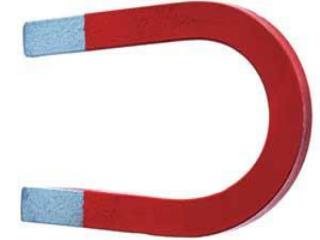
Magneto Coupled Actuators • A magneto coupled actuator can utilize virtually any actuator without the need of traditional dynamic water-proofing. • Utilizing only static-water proofing methods and magnetism!
Multi-Axis Magneto Coupled Manipulator • The end goal of my internship is to develop a multi axis manipulator utilizing the magneto couple actuators • The first section of the manipulator will be wrist type movement which will allow the claw to rotate about its center of mass.
Magneto Coupled Actuators • To keep the servos and circuits happy and dry they are situated in a specially designed container.
Magneto coupled actuators • Servo turns the inner magnetic ring Servo Magnetic ring
Magneto Coupled Actuators • Inner ring of magnets is coupled with outer set of magnets.
Magneto Coupled Actuators • The external holder with its corresponding magnetic ring sits inside its designated area and is covered. External holder Cover
Magneto Coupled Actuators • As the servo rotates the inner magnetic ring, the external magnetic ring follows its counter-part and rotates the claw attached to it.
Magnetic Coupling Actuators • The magnetic rings continuously attract one another, applying torque to the solid surface. • (solid works video of inner magnets moving)
Slippage • Current model is designed for low torque output as slippage can occur at higher speeds • Slippage is when the magnetic force between the two magnets is no longer strong enough to hold then together and the magnets slip out of place
Slippage • System is designed to realign if slippage does occur • As each magnets connection to one another is not important • Continuous rotation servos and magnet placement allows for simple self alignment
Benefits • Being statically sealed means the actuator robustness depends on material used to construct shell. • Capable of continuously rotating • Virtually any servo or motor can be used as a control source
Further Applications • Current model is for rotational wrist movement • A modified version of the holder section of the system could be used for • Linear movement • Lead screw assemblies
Manipulators • Magnetic coupling actuators can be developed to power most if not all types of motions desired in underwater manipulators and other harsh environments.