Download
1 / 53
530 likes | 627 Vues
Explore chemical equilibrium, equilibrium constant, thermodynamics, Le Chatelier’s Principle, and more in the realm of chemistry. Understand concepts like enthalpy, entropy, Gibbs free energy, and how to predict equilibrium shifts.

E N D
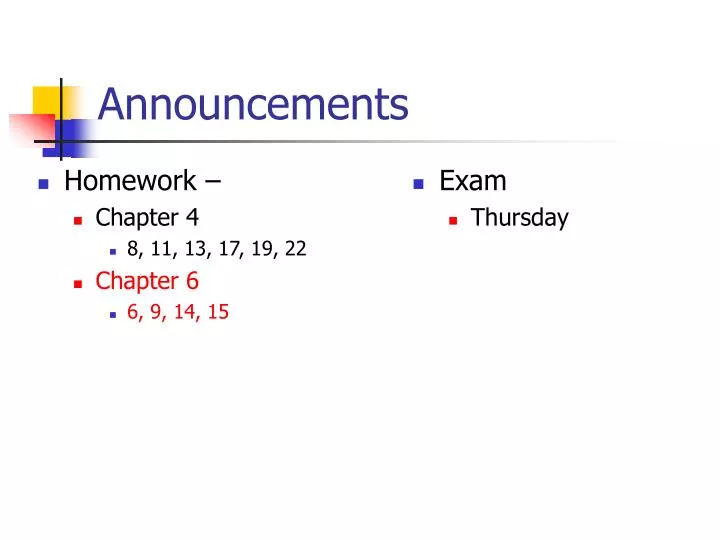
Homework – Chapter 4 8, 11, 13, 17, 19, 22 Chapter 6 6, 9, 14, 15 Exam Thursday Announcements
4-8 • Meaning of Confidence interval? • Is an interval around the experimental mean that most likely contains the true mean (m).
Homework 4.11
Question 4-13. 4-13. A trainee in a medical lab will be released to work on her own when her results agree with those of an experienced worker at the 95% confidence interval. Results for a blood urea nitrogen analysis are shown …. • What does abbreviation dL refer to? dL = deciliter = 0.1 L = 100 mL b) Should the trainee work alone?
Comparison of Means with Student’s t Is there a significant difference? First you must ask, is there a significant difference in their standard deviations? f-test YES NO
4-13. dL = deciliter = 0.1 L = 100 mL Ftable = 6.26 No difference Find spooled and t
ttable = 2.262 No significant difference between two workers … Therefore trainee should be “Released”
Homework 4-17. If you measure a quantity four times and the standard deviation is 1.0 % of the average, can you be 90 % confident that the true value is within 1.2% of the measured average Yes
Homework 4-19. Hydrocarbons in the cab of an automobile … Do the results differ at 95% CL? 99% CL? Ftable ~ 1.84 No Difference Find spooled and t
Homework The table gives t for 60 degrees of freedom, which is close to 62. ttable = 1.671 and 2.000 at the 90 and 95% CL, respectively. The difference IS significant at both confidence levels.
4-22. Q-test, Is 216 rejectable? • 192, 216, 202, 195, 204 Qtable = 0.64 Retain the “outlier” 216
Chapter 6 Chemical Equilibrium
Chemical Equilibrium • Equilibrium Constant • Equilibrium and Thermodynamics • Enthalpy • Entropy • Free Energy • Le Chatelier’s Principle • Solubility product (Ksp) • Common Ion Effect • Separation by precipitation • Complex formation
NH3 + H2O NH4+ + OH- Find the Equilibrium constant for the following reaction NH4+ NH3 + H+ Example The equilibrium constant for the reaction H2O H+ + OH- Kw = 1.0 x 10⁻¹⁴ KNH3 = 1.8 x 10⁻⁵ K3 = ?
Equilibrium and Thermodynamics A brief review …
Equilibrium and Thermodynamics enthalpy => H enthalpy change =>DH exothermic vs. endothermic entropy => S free energy Gibbs free energy => G Gibbs free energy change =>DG
Equilibrium and Thermodynamics DGo =DHo - TDSo DGo= -RT ln (K) K = e-(DGo/RT)
Equilibrium and Thermodynamics • The case of HCl HCl H+ + Cl- K=? DHo = -74.83 x 10³ J/mol DS0 = -130.4 kJ/mol DGo =DHo - TDSo DGo = (-74.83 kJ/mol) – (298.15 K) (-130.4 kJ/mol) DGo = -35.97 kJ/mol
Equilibrium and Thermodynamics • The case of HCl HCl H+ + Cl- K=? DGo = (-74.83 kJ/mol) – (298.15 K) (-130.4 kJ/mol) DGo = -35.97 kJ/mol
Predicting the direction in which an equilibrium will initially move LeChatelier’s Principle and Reaction Quotient
Le Chatelier's Principle • If a stress, such as a change in concentration, pressure, temperature, etc., is applied to a system at equilibrium, the equilibrium will shift in such a way as to lessen the effect of the stress. • Stresses – • Adding or removing reactants or products • Changing system equilibrium temperature • Changing pressure (depends on how the change is accomplished
Equilibrium moves Right Consider 6CO2 (g) + 6 H2O(g) C6H12O6(s) + 6O2(g) Predict in which direction the equilibrium moves as a result of the following stress: Increasing [CO2]
Equilibrium moves Left Consider 6CO2 (g) + 6 H2O(g) C6H12O6(s) + 6O2(g) Predict in which direction the equilibrium moves as a result of the following stress: Increasing [O2]
Equilibrium moves Left Consider 6CO2 (g) + 6 H2O(g) C6H12O6(s) + 6O2(g) Predict in which direction the equilibrium moves as a result of the following stress: Decreasing [H2O]
Consider 6CO2 (g) + 6 H2O(g) C6H12O6(s) + 6O2(g) NO CHANGE Predict in which direction the equilibrium moves as a result of the following stress: Removing C6H12O6(s) K does not depend on concentration of solid C6H12O6
Equilibrium moves Right Consider 6CO2 (g) + 6 H2O(g) C6H12O6(s) + 6O2(g) Predict in which direction the equilibrium moves as a result of the following stress: Compressing the system System shifts towards the direction which occupies the smallest volume. Fewest moles of gas.
Equilibrium moves Right Consider 6CO2 (g) + 6 H2O(g) C6H12O6(s) + 6O2(g) DH = + 2816 kJ Predict in which direction the equilibrium moves as a result of the following stress: Increasing system temperature System is endothermic … heat must go into the system (think of it as a reactant)
Consider this CoCl2 (g) Co (g) + Cl2(g) When [COCl2] is 3.5 x 10⁻³ M, [CO] is 1.1 x 10⁻⁵ M, and [Cl2] is 3.25 x 10⁻⁶M is the system at equilibrium? Q= Reaction quotient K=2.19 x 10⁻¹⁰
Compare Q and K Q = 1.02 x 10⁻⁸ K = 2.19 x 10⁻¹⁰ System is not at equilibrium, if it were the ratio would be 2.19x10⁻¹⁰ When Q>K TOO MUCH PRODUCT TO BE AT EQUILIRBIUM Equilibrium moves to the left Q<K TOO MUCH REACTANT TO BE AT EQUILIRBIUM Equilibrium moves to the Right Q=K System is at Equilibrium
Solubility Product Introduction to Ksp
Solubility Product solubility-product the product of the solubilities solubility-product constant => Ksp constant that is equal to the solubilities of the ions produced when a substance dissolves
Solubility Product In General: AxBy<=>xA+y + yB-x [A+y]x[B-x]y K = ------------ [AxBy] [AxBy] K = Ksp = [A+y]x[B-x]y
Solubility Product For silver sulfate Ag2SO4 (s)<=>2 Ag+(aq) + SO4-2(aq) Ksp = [Ag+]2[SO4-2]
Solubility of a Precipitatein Pure Water EXAMPLE: How many grams of AgCl (fw = 143.32) can be dissolved in 100. mL of water at 25oC? AgCl <=> Ag+ + Cl- Ksp = [Ag+][Cl-] = 1.82 X 10⁻¹⁰ (Appen. F) let x = molar solubility = [Ag+] = [Cl-]
EXAMPLE: How many grams of AgCl (fw = 143.32) can be dissolved in 100. mL of water at 25oC? AgCl(s) Ag+ (aq) + Cl- (aq) (x)(x) = Ksp = [Ag+][Cl-] = 1.82 X 10⁻¹⁰ x = 1.35 X 10⁻⁵M
EXAMPLE: How many grams of AgCl (fw = 143.32) can be dissolved in 100. mL of water at 25oC? • How many grams is that in 100 ml? # grams = (M.W.) (Volume) (Molarity) = 143.32 g mol-1 (.100 L) (1.35 x 10⁻⁵ mol L-1) = 1.93X10⁻⁴ g = 0.193 mg x = 1.35 X 10⁻⁵M
The Common Ion Effect common ion effect • a salt will be less soluble if one of its constituent ions is already present in the solution
The Common Ion Effect EXAMPLE: Calculate the molar solubility of Ag2CO3 in a solution that is 0.0200 M in Na2CO3. Ag2CO3<=>2 Ag+ + CO3-2 Ksp = [Ag+]2[CO3-2] = 8.1 X 10⁻¹²
EXAMPLE: Calculate the molar solubility of Ag2CO3 in a solution that is 0.0200 M in Na2CO3. Ag2CO3<=>2 Ag+ + CO3-2 Ksp = [Ag+]2[CO3-2] = 8.1 X 10⁻¹² Ksp=(2x)2(0.0200M + x) = 8.1 X 10⁻¹² 4x2(0.0200M + x) = 8.1 X 10⁻¹²
EXAMPLE: Calculate the molar solubility of Ag2CO3 in a solution that is 0.0200 M in Na2CO3. 4x2(0.0200M + x) = 8.1 X 10⁻¹² no exact solution to a 3rd order equation, need to make some approximation first, assume the X is very small compared to 0.0200 M 4X2(0.0200M) = 8.1 X 10⁻¹² 4X2(0.0200M) = 8.1 X 10⁻¹² X= 1.0 X 10⁻⁵ M
EXAMPLE: Calculate the molar solubility of Ag2CO3 in a solution that is 0.0200 M in Na2CO3. X = 1.0 X 10⁻⁵ M (1.3 X 10⁻⁴ M in pure water) Second check assumption [CO3-2] = 0.0200 M + X~0.0200 M 0.0200 M + 0.00001M ~ 0.0200M Assumption is ok!
Separation by Precipitation Completeseparation can mean a lot … we should define complete. Complete means that the concentration of the less soluble material has decreased to 1 X 10⁻⁶M or lower before the more soluble material begins to precipitate
Fe(OH)3(s) Fe3+ + 3OH- Mg(OH)2(s) Mg2+ + 2OH- Separation by Precipitation EXAMPLE:Can Fe+3 and Mg+2 be separated quantitatively as hydroxides from a solution that is 0.10 M in each cation? If the separation is possible, what range of OH- concentrations is permissible. Two competing reactions
EXAMPLE: Separate Iron and Magnesium? Ksp = [Fe+3][OH-]3 = 2 X 10-39 Ksp = [Mg+2][OH-]2 = 7.1 X 10⁻¹² Assume quantitative separation requires that the concentration of the less soluble material to have decreased to < 1 X 10⁻⁶M before the more soluble material begins to precipitate.
EXAMPLE: Separate Iron and Magnesium? Ksp = [Fe+3][OH-]3 = 2 X 10-39 Ksp = [Mg+2][OH-]2 = 7.1 X 10⁻¹² Assume [Fe+3] = 1.0 X 10⁻⁶M What will be the [OH-] required to reduce the [Fe+3] to [Fe+3] = 1.0 X 10⁻⁶M ? Ksp = [Fe+3][OH-]3 = 2 X 10-39
EXAMPLE: Separate Iron and Magnesium? Ksp = [Fe+3][OH-]3 = 2 X 10-39 (1.0 X 10⁻⁶M)*[OH-]3 = 2 X 10-39
Add OH- Mg2+ Mg2+ Fe3+ Fe3+ Fe3+ Fe3+ Mg2+ Mg2+ Mg2+ Mg2+ Fe3+ Fe3+ Mg2+ Fe3+ Mg2+ Fe3+ Fe3+ Fe3+ Mg2+ Mg2+ Mg2+ Fe3+ Fe3+
Mg2+ Mg2+ Mg2+ Mg2+ Mg2+ @ equilibrium Mg2+ Fe3+ What is the [OH-] when this happens ^ Mg2+ Mg2+ Is this [OH-] (that is in solution) great enough to start precipitating Mg2+? Mg2+ Mg2+ Mg2+ Fe(OH)3(s)