Innovative TriBeam Tomography for Analyzing Cu-W Biphasic Structures in Functional Devices
10 likes | 154 Vues
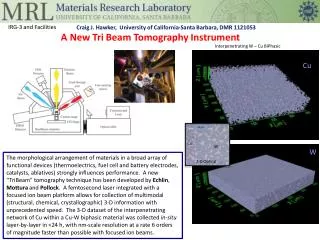
A groundbreaking TriBeam tomography technique developed at UC Santa Barbara enables high-speed, high-resolution 3-D imaging of Cu-W biphasic structures integral to various functional devices, such as thermoelectrics and fuel cells. This method combines a femtosecond laser with a focused ion beam, allowing for in-situ, layer-by-layer collection of multimodal data (structural, chemical, and crystallographic) in under 24 hours. The unprecedented speed—six orders of magnitude faster than traditional methods—reveals the intricate morphological arrangement of materials essential for optimizing performance.


Innovative TriBeam Tomography for Analyzing Cu-W Biphasic Structures in Functional Devices
E N D
Presentation Transcript
Cu IRG-3 and Facilities Craig J. Hawker, University of California-Santa Barbara, DMR 1121053 A New Tri Beam Tomography Instrument Interpenetrating W – Cu BiPhasic Structure Cu W 50 mm W The morphological arrangement of materials in a broad array of functional devices (thermoelectrics, fuel cell and battery electrodes, catalysts, ablatives) strongly influences performance. A new “TriBeam” tomography technique has been developed by Echlin, Motturaand Pollock. A femtosecond laser integrated with a focused ion beam platform allows for collection of multimodal (structural, chemical, crystallographic) 3-D information with unprecedented speed. The 3-D dataset of the interpenetrating network of Cu within a Cu-W biphasic material was collected in-situ layer-by-layer in <24 h, with nm-scale resolution at a rate 6 orders of magnitude faster than possible with focused ion beams. 2-D Optical View