
SlideServe
Menu
Préférences
© SlideServe · v2026

Planning The Electrical System

irina avatar
20 diapositives · 428 Views · Mar 22, 2014

Planning The Electrical System. Safe means for the entrance of electrical supply into a building Means of disconnecting all electrical power in a building Means of limiting to a safe level the maximum amount of electrical current that can enter a building
Planning The Electrical System - slide 1
01 / 20Planning The Electrical System
1 / 17

Télécharger la présentation

Planning The Electrical System
Une image / un lien ci-dessous est fourni (tel quel) pour télécharger la présentation

Politique de téléchargement : le contenu du site vous est fourni TEL QUEL pour votre information et votre usage personnel ; il ne peut être vendu, concédé sous licence ni partagé sur d’autres sites sans l’accord de son auteur.Le contenu vous est fourni TEL QUEL, pour votre information et votre usage personnel uniquement. Téléchargez la présentation en cliquant sur ce lien. Lors du téléchargement, si vous ne parvenez pas à télécharger une présentation, l’éditeur a peut-être supprimé le fichier de son serveur.Pendant le téléchargement, si vous ne parvenez pas à obtenir une présentation, le fichier a peut-être été supprimé par l’éditeur.

F I N

Plus de contenu associé

Transcription de la présentation
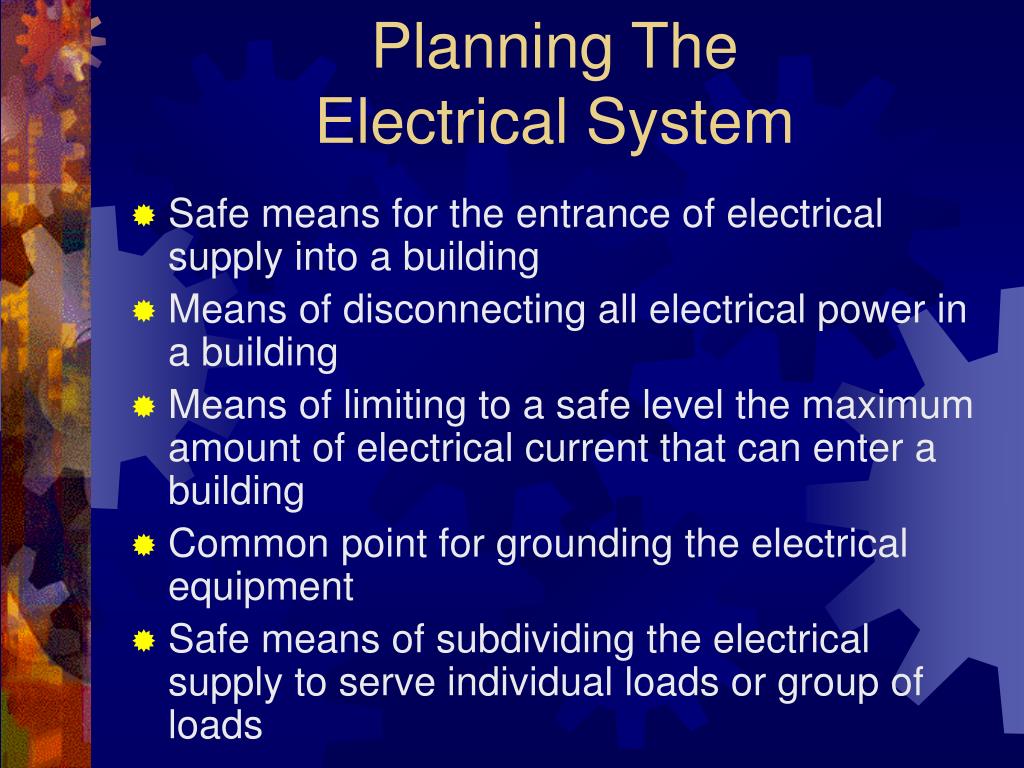
  1. Planning The Electrical System • Safe means for the entrance of electrical supply into a building • Means of disconnecting all electrical power in a building • Means of limiting to a safe level the maximum amount of electrical current that can enter a building • Common point for grounding the electrical equipment • Safe means of subdividing the electrical supply to serve individual loads or group of loads

  2. Types of Service Entrance Panels • Circuit Breaker Type • Fuse Type

  3. Circuit Breaker Type Service Entrance Panel • When breaker trips, it may be reset after the problem has been corrected • Circuit breakers are easy to switch off • Circuit breakers are available in sizes to protect any circuit • Circuit breakers will take a short periods of overload without tripping • Circuit breakers cannot be tampered with • A larger size circuit breaker cannot be installed accidentally

  4. Fuse Type Service Entrance Panel • Cost less to purchase • Less convenient to use • When fuses “blows”, It must be replaced unless equipped with a special reset-type fuses

  5. Determining the size Service Entrance Switch • Size of dwelling • Appliances • Large Appliances (Ranges, Dryer, Water Heater, ect.) • 2 Small Appliance loads Circuits • Laundry Load Circuit • General Lighting load Circuit

  6. One Family Dwelling • 2000 square feet • Appliances • Range – 240 Volts • Dryer – 240 Volts • Water Heater –240 Volts • 2 Small Appliance Load Circuits – 120V • Laundry Load Circuits – 120V • General Lighting Load Circuit – 120V

  7. Computed Load for Dwelling • General Lighting load: • 2000 sq. ft. X 3 volt-Amperes = 6000VA • 6000VA divided by 120 Volts = 50 Amps

  8. Laundry Circuits • At least one laundry circuit is required by NEC • Must be 20 amp • The circuit may not serve any lighting outlets or outlets in any other room in the house • 3 circuits X 1,500 Watts = 4500 Watts • 4,500 Watts divide by 120 Volts = 37.5 A

  9. Major Appliances • Refrigerator 350 Watts • Freezer 350 Watts • Dryer 7,000 Watts • Dish Washer 700 Watts • Range/Oven 11,050 Watts • Water Heater 4,500 Watts Total 24,050 Watts Well Pump 2,000 Watts

  10. Heating and Cooling • 100% of the nameplate rating of Central Heating and Air Unit • 65% of the nameplate rating of central electric space heating, including supplemental heating elements • 65% of the name plate rating of electrical space heating if less than four separately controlled units • 40% of the nameplate ratings of electric space heating of four or more separately controlled units 9,600 Watt Central AC/Heat Pump

  11. Loads except Heating and Cooling • Small Appliance Load 4,500 Watts • General Purpose Load 6,000 Watts • Fixed Appliance Load 24,050 Watts • Other Items (Well Pump) 2,000 Watts Total Load 36,550 Watts

  12. Calculate Total Load • Heating/cooling Load @100% 9,000 Watts • First 10 KW of other Load @100% 10,000 Watts • Remainder of other Load @40% 10,620 Watts 36,500 – 10,000 = 26,550 Watts 26,550 X 40% = 10,620 Watts Total Load 30,220 Watts

  13. Total Amperage Requirement Total Load divided by 240 volts 30,220 Watts divided by 240 Volts = 125.9 Amps

  14. SERVICE ENTRANCE SWITCH SIZE Farm Shop

  15. Computing Farm Shop Load • 1200 sq. ft. Farm Shop • 1 - 240 Volt, 50 amp Welder 50 A • 1 – 230 Volt, 5 hp Air Compressor 28 A • 1 – 230 Volt, 2 hp Bench Grinder 12 A • 1 – 230 Volt, 3 hp Radial Arm Saw 17 A • 1 – 230 Volt, 3 hp Tilting Arbor Saw 17 A • 1 – 115 Volt, ¾ hp Drill Press (13.8) • 1 – 115 Volt, 1/3 hp Exhaust Fan (7.2) • 6 – Additional 120 Volt Outlet (6 X 1.5 A = 9 A) • 3 – Lighting Circuits with 15 outlets = 22.5 A

  16. Converting 115 Volt items to 240 Volts • Drill Press 13.8 Amps • Exhaust Fan 7.2 Amps • Additional Outlets 9.0 Amps • Lighting Outlet 22.5 Amps Total Amperage 52.5 Amps

  17. To Convert 115 Volts to 240 Volts • 52.5 Amps X120 Volts = 6300 VA • 6,300 VA divided by 240 Volts or ½ of 52.5 amps= 26.25 A

  18. Total Service Load • Welder 50 Amp • Air Compressor 28 Amp • Bench Grinder 12 Amp • Radial Arm Saw 17 amp • Tilting Arbor Saw 17 amp • Converted 115 Volt items 26.25 Amp Total Load 150.25 Amp

  19. Load without diversity • Loads most likely to operate at one time to produce the heaviest loads are: • Welder 50 Amps • Exhaust Fan 3.60 Amps • Half of Lighting 11.25 Amps Total 64.85 Amps Largest Motor is 5 hp; 28 amps X 125% = 35 Amps

  20. Computing Total Demand • Not less than the first 60 amps of all loads • 100% of largest demand load 64.85 Amps • 50% of the next 60 amps 30 Amps • 25% of remainder of other load 150.25 Amps – 124.85 Amps= 25.45 25% of 25.4 = 6.36 Amps Total Demand 101.21 Amps