Reinforcement Learning
This overview elucidates the core concepts of Model-Based Reinforcement Learning (RL), highlighting the fundamental mechanisms where agents interact with their environment through actions, rewards, and states. It explores the critical challenges such as credit assignment and the balance between exploration and exploitation. Key strategies for exploring action selection and ensuring optimal policy development are presented, including the importance of learning the Markov Decision Process (MDP). The discussion emphasizes the need for accurate exploration to avoid suboptimal learning outcomes and achieve effective long-term performance.

Reinforcement Learning
E N D
Presentation Transcript
Reinforcement Learning Based on slides by AviPfeffer and David Parkes
Mechanism State Closed Loop Interactions Environment Reward Agent Sensors Actuators Percepts Actions
Reinforcement Learning • When mechanism(=model) is unknown • When mechanism is known, but model is too hard to solve
Basic Idea • Select an action using some sort of action selection process • If it leads to a reward, reinforce taking that action in future • If it leads to a punishment, avoid taking that action in future
But It’s Not So Simple • Rewards and punishments may be delayed • credit assignment problem: how do you figure out which actions were responsible? • How do you choose an action? • exploration versus exploitation • What if the state space is very large so you can’t visit all states?
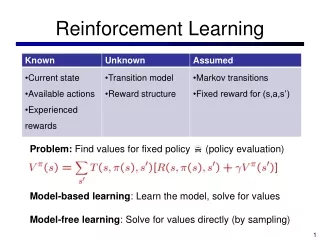
Model-Based Reinforcement Learning • Mechanism is an MDP • Approach: • learn the MDP • solve it to determine the optimal policy • Works when model is unknown, but it is not too large to store and solve
Learning the MDP • We need to learn the parameters of the reward and transition models • We assume the agent plays every action in every state a number of times • Let Rai= total reward received for playing a in state i • Let Nai = number of times played a in state i • Let Naij = number of times j was reached when played a in state i • R(i,a) = Rai/Nai • Taij = Naij / Nai
Note • Learning and solving the MDP need not be a one-off thing • Instead, we can repeatedly solve the MDP to get better and better policies • How often should we solve the MDP? • depends how expensive it is compared to acting in the world
Model-Based Reinforcement Learning Algorithm Let 0 be arbitrary k 0 Experience Repeat k k + 1 Begin in state i For a while: Choose action a based on k-1 Receive reward r and transition to j Experience Experience < i, a, r, j > i j Learn MDP M from Experience Solve M to obtain k
Credit Assignment • How does model-based RL deal with the credit assignment problem? • By learning the MDP, the agent knows which states lead to which other states • Solving the MDP ensures that the agent plans ahead and takes the long run effects of actions into account • So the problem is solved optimally
Action Selection • The line in the algorithm Choose action a based on k-1 is not specific • How do we choose the action?
Action Selection • The line in the algorithm Choose action a based on k-1 is not specific • How do we choose the action? • Obvious answer: the policy tells us the action to perform • But is that always what we want to do?
Exploration versus Exploitation • Exploit: use your learning results to play the action that maximizes your expected utility, relative to the model you have learned • Explore: play an action that will help you learn the model better
Questions • When to explore • How to explore • simple answer: play an action you haven’t played much yet in the current state • more sophisticated: play an action that will probably lead you to part of the space you haven’t explored much • How to exploit • we know the answer to this: follow the learned policy
Conditions for Optimality To ensure that the optimal policy will eventually be reached, we need to ensure that • Every action is taken in every state infinitely often in the long run • The probability of exploitation tends to 1
Possible Exploration Strategies: 1 • Explore until time T, then exploit • Why is this bad?
Possible Exploration Strategies: 1 • Explore until time T, then exploit • Why is this bad? • We may not explore long enough to get an accurate model • As a result, the optimal policy will not be reached
Possible Exploration Strategies: 1 • Explore until time T, then exploit • Why is this bad? • We may not explore long enough to get an accurate model • As a result, the optimal policy will not be reached • But it works well if we’re planning to learn the MDP once, then solve it, then play according to the learned policy
Possible Exploration Strategies: 1 • Explore until time T, then exploit • Why is this bad? • We may not explore long enough to get an accurate model • As a result, the optimal policy will not be reached • But it works well if we’re planning to learn the MDP once, then solve it, then play according to the learned policy • Works well for learning from simulation and performing in the real world
Possible Exploration Strategies: 2 • Explore with a fixed probability of p • Why is this bad?
Possible Exploration Strategies: 2 • Explore with a fixed probability of p • Why is this bad? • Does not fully exploit when learning has converged to optimal policy
Possible Exploration Strategies: 2 • Explore with a fixed probability of p • Why is this bad? • Does not fully exploit when learning has converged to optimal policy • When could this approach be useful?
Possible Exploration Strategies: 2 • Explore with a fixed probability of p • Why is this bad? • Does not fully exploit when learning has converged to optimal policy • When could this approach be useful? • If world is changing gradually
Boltzmann Exploration • In state i, choose action a with probability • T is a temperature • High temperature: more exploration • T should be cooled down to reduce amount of exploration over time • Sensitive to cooling schedule
Guarantee • If: • every action is taken in every state infinitely often • probability of exploration tends to zero • Then: • Model-based reinforcement learning will converge to the optimal policy with probability 1
Pros and Cons • Pro: • makes maximal use of experience • solves model optimally given experience • Con: • assumes model is small enough to solve • requires expensive solution procedure
R-Max • Assume R(s,a)=R-max (the maximal possible reward • Called optimism bias • Assume any transition probability • Solve and act optimally • When Nai> c, update R(i,a) • After each update, resolve • If you choose c properly, converges to the optimal policy
Monte Carlo Sampling • If we want to estimate y = Ex~D[f(x)] we can • Generate random samples x1,…,xN from D • Estimate • Guaranteed to converge to correct estimate with sufficient samples • Requires keeping count of # of samples • Alternative, update average: • Generate random samples x1,…,xN from D • Estimate
Estimating the Value of a Policy • Fix a policy • When starting in state i, taking action a according to , getting reward r and transitioning to j, we get a sample of • So we can update V(i) (1-)V(i) + (r + V(j)) • But where does V(j) comes from? • Guess (this is called bootstrapping)
Temporal Difference Algorithm For each state i: V(i) 0 Begin in state i Repeat: Apply action a based on current policy Receive reward r and transition to j i j
Credit Assignment • By linking values to those of the next state, rewards and punishments are eventually propagated backwards • We wait until end of game and then propagate backwards in reverse order
But how do learn to act • To improve our policy, we need to have an idea of how good it is to use a different policy • TD learns the value function • Similar to the value determination step of policy iteration, but without a model • To improve, we need an estimate of the Q function:
TD for Control: SARSA Initialize Q(s,a) arbitrarily Repeat (for each episode): Initialize s Choose a from s using policy derived from Q(e.g., ε-greedy) Repeat (for each step of episode): Take action a, observe r, Choose a’from s’using policy derived from Q(e.g., ε-greedy) s s’, aa’ until s is terminal
Off-Policy vs. On-Policy • On-policy learning: learn only the value of actions used in the current policy. SARSA is an example of an on-policy method. Of course, learning of the value of the policy is combined with gradual change of the policy • Off-policy learning: can learn the value of a policy/action different than the one used – separating learning from control. Q-learning is an example. It learns about the optimal policy by using a different policy (e.g., e-greedy policy).
Q Learning • Don’t learn the model, learn the Q function directly • Works particularly well when model is too large to store, to solve or to learn • size of model: O(|States|2) • cost of solution by policy iteration: O(|States|3) • size of Q function: O(|Actions|*|States|)
Learning the Q Values • We don’t know Tai and we don’t want to learn it
Learning the Q Values • We don’t know Tai and we don’t want to learn it • If only we knew that our future Q values were accurate… • …every time we played a in state i and transitioned to j, receiving reward r, we would get a sample of R(i,a)+maxbQ(j,b)
Learning the Q Values • We don’t know Tai and we don’t want to learn it • If only we knew that our future Q values were accurate… • …every time we played a in state i and transitioned to j, receiving reward r, we would get a sample of R(i,a)+maxbQ(j,b) • So we pretend that they are accurate • (after all, they get more and more accurate)
Q Learning Update Rule • On transitioning from i to j, taking action a, receiving reward r, update
Q Learning Update Rule • On transitioning from i to j, taking action a, receiving reward r, update • is the learning rate • Large : • learning is quicker • but may not converge • is often decreased over the course of learning
Q Learning Algorithm For each state i and action a: Q(i,a) 0 Begin in state i Repeat: Choose action a based on the Qvalues for state i for all actions Receive reward r and transition to j i j
Choosing Which Action to Take • Once you have learned the Q function, you can use it to determine the policy • in state i, choose action a that has highest estimated Q(i,a) • But we need to combine exploitation with exploration • same methods as before
Guarantee • If: • every action is taken in every state infinitely often • is sufficiently small • Then Q learning will converge to the optimal Q values with probability 1 • If also: • probability of exploration tends to zero • Then Q learning will converge to the optimal policy with probability 1
Credit Assignment • By linking Q values to those of the next state, rewards and punishments are eventually propagated backwards • But may take a long time • Idea: wait until end of game and then propagate backwards in reverse order
Q-learning ( = 1) S2 a,b S3 a,b S4 a,b S5 a 0 0 1 0 S1 0 a,b a,b a,b S6 S7 S8 S9 b 0 0 -1 After playing aaaa: After playing bbbb: Q(S4,a) = 1 Q(S2,a) = 1 Q(S8,a) = 0 Q(S6,a) = 0 Q(S4,b) = 0 Q(S2,b) = 0 Q(S8,b) = -1 Q(S6,b) = 0 Q(S3,a) = 1 Q(S1,a) = 1 Q(S7,a) = 0 Q(S1,a) = 1 Q(S3,b) = 0 Q(S1,b) = 0 Q(S7,b) = 0 Q(S1,b) = 0
Bottom Line • Q learning makes optimistic assumption about the future • Rewards will be propagated back in linear time, but punishments may take exponential time to be propagated • But eventually, Q learning will converge to optimal policy