The Moon
Discover the fascinating journey of the Moon, Earth's only natural satellite, in this engaging presentation. Learn about its distance from Earth (approximately 384,000 km), its movements, phases, and the phenomena of lunar and solar eclipses. Understand the Moon's rotation, revolution, and how it consistently showcases the same face to us. This resource is perfect for educators and students interested in space science and the dynamics of our Solar System. Access additional teaching materials at www.worldofteaching.com.

The Moon
E N D
Presentation Transcript
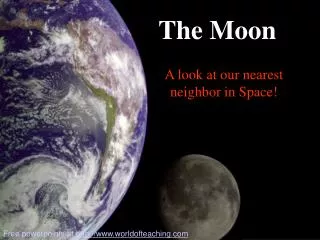
The Moon A look at our nearest neighbor in Space! Free powerpoints at http://www.worldofteaching.com
What is the Moon? • A natural satellite • One of more than 96 moons in our Solar System • The only moon of the planet Earth
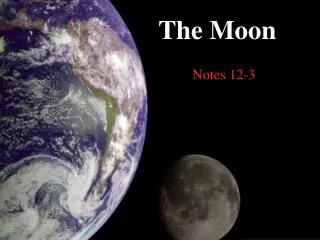
Location, location, location! • About 384,000 km (240,000 miles) from Earth • 3,468 km (2,155 miles) in diameter (about ¼ the size of Earth)
Movements of the Moon • Revolution – Moon orbits the Earth every 27 1/3 days • Rotation – Moon turns on its axis every 27 days • Same side of Moon always faces Earth • The moon rises and sets 50 minutes later each day • The moon rises in the east and sets in the west
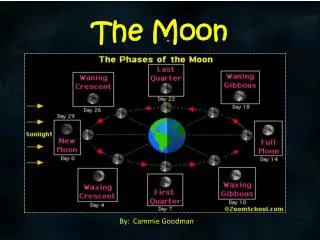
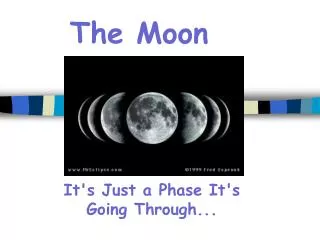
It’s Just a Phase • Moonlight is reflected sunlight • Half the moon’s surface is always reflecting light • From Earth we see different amounts of the Moon’s lit surface • The amount seen is called a “phase”
FOUR MAIN SHAPES FULL CRESCENT Four Basic Shapes GIBBOUS QUARTER
Waxing and Waning • Waxing • The moon appears to be getting larger • Waning • The moon appears to be getting smaller
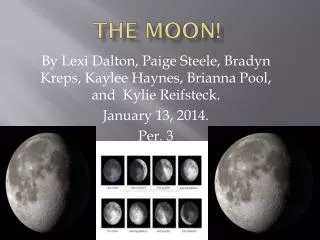
Waxing and Waning • New moon • Waxing Crescent moon • First Quarter moon • Waxing Gibbous moon • Full moon • Waning Gibbous moon • Third Quarter moon • Waning Crescent moon • New moon
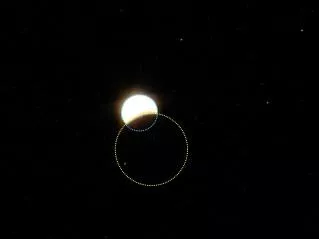
Lunar Eclipses • Moon moves into Earth’s shadow – this shadow darkens the Moon • Umbra • Penumbra • About 2-3 per year • Last up to 4 hours
Solar Eclipses • Moon moves between Earth and Sun • Moon casts a shadow on part of the Earth • Total eclipses rare – only once every 360 years from one location!
Name this phase! Full Moon
Name this phase! First Quarter
Name this phase! Waxing Crescent
Name this phase! Waning Gibbous
Name this phase! Third Quarter
Name this phase! Waxing Gibbous
Name this phase! Waning Crescent
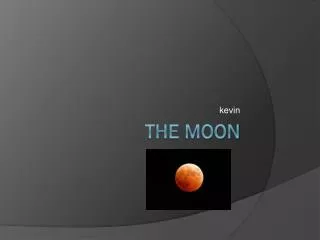
What might be happening in this image? Lunar Eclipse
Name this phase! Full Moon
Name this phase! New Moon
Does the moon rise or set in the west? It sets in the west.
Name this phase! Waning Gibbous
Name this phase! Waning Crescent
Name this phase! Waning Gibbous
Photo resources • http://www.nasm.si.edu/apollo/AS15/a15images.htm • http://nssdc.gsfc.nasa.gov/photo_gallery/photogallery-moon.html#apollo • http://clementine.cnes.fr/index.en.html • http://cass.jsc.nasa.gov/pub/research/clemen/clemen.html • http://spaceflightnow.com/news/n0108/15mooncreate/ • http://seds.lpl.arizona.edu/nineplanets/nineplanets/pxmoon.html
More photo resources • http://www.nrl.navy.mil/clementine/clemovies/clemovies_index.html • http://www.solarviews.com/eng/moon.htm • http://news.bbc.co.uk/1/hi/sci/tech/620649.stm • http://skyandtelescope.com/observing/objects/eclipses/article_99_1.asp • http://lunar.arc.nasa.gov/results/ice/eureka.htm • http://www.space.com/scienceastronomy/solarsystem/moon_nss_020604.html
This powerpoint was kindly donated to www.worldofteaching.com http://www.worldofteaching.com is home to over a thousand powerpoints submitted by teachers. This is a completely free site and requires no registration. Please visit and I hope it will help in your teaching.