Download
1 / 15
160 likes | 430 Vues
Discover the fascinating features of the Moon, first observed closely by Galileo in 1609. The Moon's surface is marked by craters, mountains, and maria, with extreme temperatures and no atmosphere. Learn about its unique motions: it rotates and revolves around the Earth once every 27.3 days, causing the same side to always face us. Understand the phases of the Moon, shaped by its position relative to Earth and the Sun, with a full cycle taking about 29.5 days. Explore vocabulary like waxing, waning, and gibbous that describe its phases.

E N D
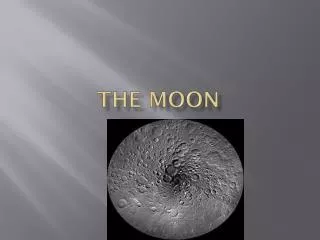
Moons Surface • First seen up close with a telescope by Galileo in 1609 • Covered with craters, mountains, and maria • Dry and airless (no atmosphere like us) • Temperatures range from -180°C to 130°C
Moon Motions • Rotates once on its axis every 27.3 days • Revolves around the Earth once every 27.3 days • Day and a year are the same length of time on the moon! • The same side of the moon always faces Earth • As the moon revolves around the Earth, the relative positions of the Earth, moon, and sun cause the phases of the moon, eclipses, and tides.
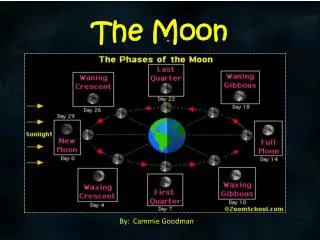
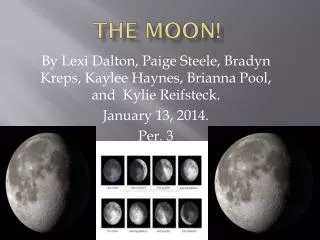
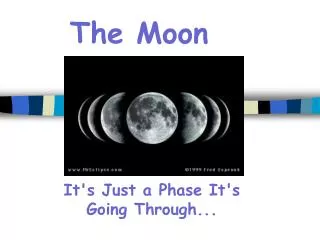
Moon Phases • Different shapes of the moon • Determined by how much of the sunlit side of the moon can be seen from Earth. • One side of the moon is always lit up. • 8 phases • Takes about one month (29.5 days) to go through all of the phases.
Moon Phase Vocabulary • Illuminated-lit up • Crescent- less than half lit up • Gibbous- more than half lit up • Waning-getting less lit up • Waxing-getting more lit up • 1st Quarter-half lit up on right (1st base) • 3rd Quarter-half lit up on left (3rd base)