The Moon
250 likes | 388 Vues
Discover the origins and features of the Moon, from its birth as part of Earth to the lunar landscape of craters and maria. Explore the phases, movements, and celestial phenomena like eclipses. Learn about historical lunar exploration and the potential for future missions.


The Moon
E N D
Presentation Transcript
The Moon Notes 12-3
What is the Moon? • A natural satellite • The only moon of the planet Earth
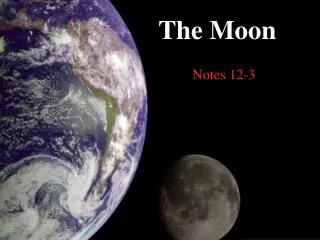
Location, location, location! • About 384,000 km (240,000 miles) from Earth • 3,476 km (2,155 miles) in diameter (about ¼ the size of Earth)
The Moon’s Size • The moon is 3,476 km in diameter, a little less than the distance across the United States.
Birth of the Moon • First Stage • Moon originally was once part of the Earth. • Scientists believe a very large body hit the Earth early in its development, throwing a huge amount of debris into orbit. • Debris eventually was influence by Earth’s gravity and formed the moon we have today.
Second Stage • After forming a sphere, the surface of the moon was covered by molten rock. • Eventually, this mix of rock separated. • Third Stage • The outer surface of the moon cooled, forming a crust. • Craters started to form from the constant bombardment by meteoroids. • Meteoroids decreased • Moon cooled completely • Moon changed little in 3 billion years
The Moon’s Surface • No atmosphere • No liquid water • Extreme temperatures • Daytime = 130C (265°F) • Nighttime = -190C (-310 F) • 1/6 Earth’s gravity
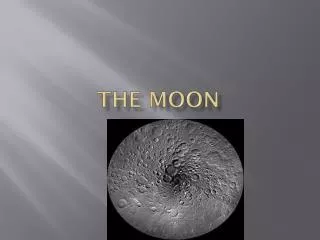
The Moon’s Surface • Features on the moon’s surface include maria, craters, and highlands.
Highlands • Mountains up to 7500 m (25,000 ft) tall • Light colored features
Craters • Bowl shaped depressions • Up to 2500 km (1,553 miles) across • Most formed by meteorite impact on the Moon • Some formed by volcanic action inside the Moon
Maria • Originally thought to be “seas” by early astronomers • Darkest parts of moon • Hardened rock formed from huge lava flows 3-4 billion years ago
Craters Maria
Movements of the Moon • Orbit is an ellipse, not circular • Revolution – Moon orbits the Earth every 27 1/3 days • Same side of Moon always faces Earth
Far Side of the Moon • First seen by Luna 3 Russian space probe in 1959 • Surface features different from near side • More craters • Very few maria • Thicker crust
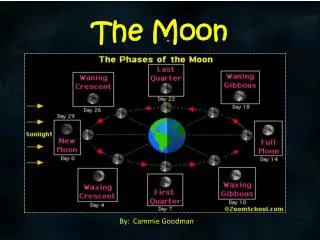
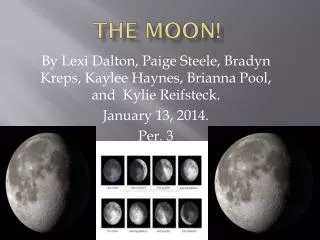
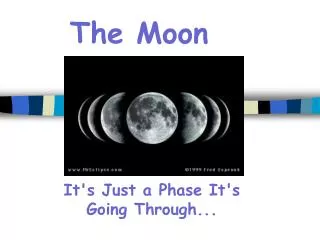
It’s Just a Phase • Moonlight is reflected sunlight • Half the moon’s surface is always reflecting light • From Earth we see different amounts of the Moon’s lit surface • The amount seen is called a “phase”
Waxing and Waning • New moon • Waxing Crescent moon • First Quarter moon • Waxing Gibbous moon • Full moon • Waning Gibbous moon • Third Quarter moon • Waning Crescent moon • New moon
FOUR MAIN SHAPES FULL CRESCENT Four Basic Shapes GIBBOUS QUARTER
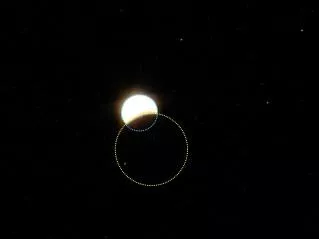
Lunar Eclipses • Moon moves into Earth’s shadow – this shadow darkens the Moon • About 2-3 per year • Last up to 4 hours • Only during full moon
Lunar Eclipse • During a lunar eclipse, Earth blocks sunlight fromreaching the moon’s surface.
Solar Eclipses • New Moon moves between Earth and Sun • Moon casts a shadow on part of the Earth • Total eclipses rare – only once every 360 years from one location!
Solar Eclipse • A solar eclipse occurs when the moon passes directly between Earth and the sun, blocking sunlight from Earth.
Annular Solar Eclipse May 20, 2012 • http://youtu.be/w806rVCEh50
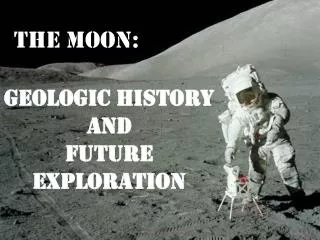
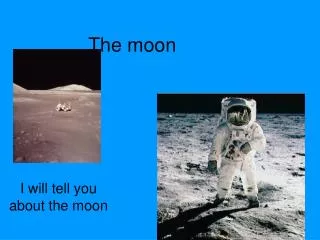
Exploring the Moon • 1950s to 1960s - probes • Neil Armstrong First man on the Moon – July 20, 1969 • Six Apollo missions (1969-1972) • 12 Americans have walked on the moon • Possibly send people to moon again in 2018
Extra Credit for Astronomy Test: • Go to the website nasa.gov • Find a topic that you are interested in and print out the information. Write a ½ page summary of the information that you find, and ½ page of why you find this topic interesting and what other questions do you have regarding the topic. • 5 points • Due Wednesday