Bakeshop Ingredients: Flour, Sweeteners, Fats & More
700 likes | 722 Vues
Explore the importance and varieties of flour, sweeteners, fats, and dairy products in baking. Learn how these ingredients impact the texture, flavor, and structure of baked goods.


Bakeshop Ingredients: Flour, Sweeteners, Fats & More
E N D
Presentation Transcript
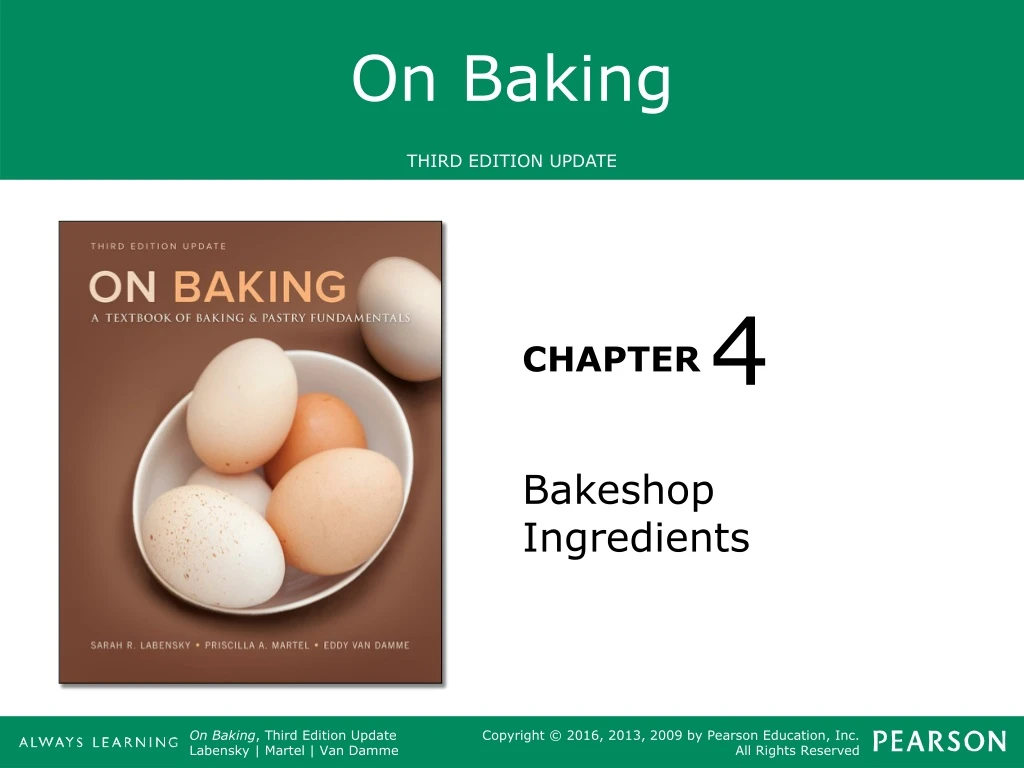
4 Bakeshop Ingredients
Chapter Objectives • After studying this chapter, you will be able to: • identify the types of flours and discuss the importance of gluten. • identify different types of sweeteners. • identify different types of fats. • understand milk and dairy products. continued on next slide
Chapter Objectives • After studying this chapter, you will be able to: • identify and understand the importance of eggs in baking. • identify and understand the importance of thickeners in baking. • identify a variety of fruits. continued on next slide
Chapter Objectives • After studying this chapter, you will be able to: • understand how to purchase and store fruits appropriate for your needs. • understand the function of bakeshop flavoring ingredients.
Flours • Produced when grain kernels are ground to powder • Grains are grasses that bear edible seeds. • Wheat flour is the most important ingredient in the bakeshop.
Function of Flours in the Bakeshop • Provide bulk and structure to baked goods • Thicken liquids in items such as custards and pie fillings • Prevent foods from sticking
Producing Wheat Flour • Milling reduces wheat kernels to its component parts. • Bran • Endosperm • Germ
Composition of Wheat Flour • Consist of five nutrients: • Fat (<1%) • Minerals (<1%) • Moisture (<15%) • Starches (63-77%) • Proteins (6-18%) • Enzymes, proteins in flour, are important for flour performance in yeast bread. continued on next slide
Composition of Wheat Flour • Gums • primarily pentosans • another component of the carbohydrates in flour • 2-3% • absorb up to 10 times their weight in water
Types of Flour • Among the primary types of wheat flour: • Cake flour • Pastry flour • All-purpose flour • Artisan bread flour • Bread flour continued on next slide
Types of Flour • Among the primary types of wheat flour: • Whole-wheat • High-gluten flour • Durum flour • Vital wheat gluten
Specialty Flours • Among the types of flour used in the bake shop are the following specialty flours: • Whole-wheat flour • Wheat germ • Vital wheat gluten
Nonwheat or Composite Flours • Rye flour • Cornmeal • Oats • Rice flour
Sugars and Sweeteners • Carbohydrates that: • provide flavor and color to baked goods • tenderize products by weakening gluten strands • provide food for yeasts • serve as preservatives • act as creaming or foaming agents to assist with leavening
Sugars • Classified as either: • Simple or single • Complex or double
Forms of Sugars and Sweeteners • Turbinado • Sanding • Granulated • Brown • Superfine or castor • Powdered or confectioner's • Fructose
Liquid Sweeteners • Achieve the same benefit as sugar except for leavening • May be hygrocospic (water-attracting)
Forms of Liquid Sweeteners • Corn syrup • Glucose • Invert sugar • Honey • Malt • Maple syrup • Molasses
Sugar Syrups • Sugar can be incorporated in its dry form or when liquefied into a syrup. continued on next slide
Sugar Syrups • Sugar syrups take two forms: • Simple syrups • Mixtures of sugar and water • Cooked syrups • Made of melted sugar cooked until it reaches a specific temperature • The syrup's density (concentration) is dictated by the purpose.
Fats • Butter, lard, margarine, shortening and oil. • With proper mixing, fat particles are evenly distributed, causing fat and liquid to emulsify.
Function of Fats • Provide flavor and color to baked goods • Add moisture and richness • Assist with leavening • Help extend a product's shelf life • Shorten gluten strands, producing tender baked goods
Types of Fats • Butter • Fatty substance produced by agitating cream • Contains at least 80% milkfat • May or may not contain salt continued on next slide
Types of Fats • Butter • Many forms • Salted butter • European-style butter • Whipped butter • Clarified butter continued on next slide
Types of Fats • Lard is rendered pork fat. • Margarine is manufactured from animal or vegetable oil. • Oil may be extracted from a variety of plants. • Unlike butter or solid fats, oil blends thoroughly into a mixture.
Fats are Shortenings • Any fat is a shortening and tenderizes the product. • Hydrogenation process hardens liquid fats. • Consumption of excess trans fats, a byproduct of hydrogenation, is a risk factor for diseases.
Milk and Dairy Products • Provide texture, flavor, volume and color to baked goods • Add nutritional value • Contribute to browning as well as softness in the crust and structure of baked items
Milk Safety • Highly perishable, milk is an excellent breeding ground for bacteria. • Pasteurization destroys pathogenic bacteria.
Forms of Milk • Whole • Evaporated • Sweetened condensed • Dry milk powder
Cream • Cream is rich milk containing at least 18% fat. • Half-and-half • Light cream, coffee cream and table cream • Whipping cream • Heavy cream • Clotted cream
Cultured Dairy Products • Cultured dairy products are produced by adding specific bacteria to fluid dairy products. • Buttermilk • Sour cream • Crème fraîche • Yogurt
Cheese • Cheese is milk protein coagulated and then separated (whey from curd). • One of the oldest and most widely known foods to man, cheese comes in various forms.
Fresh Cheese • Fresh cheeses used in the bakeshop include: • Cream cheese • Farmer's, baker's and quark • Mascarpone • Ricotta
Eggs • Flavor, leaven and thicken items • Bind ingredients in batters, coatings and doughs • Enrich and tenderize yeast breads • Extend the shelf life of some baked goods
Parts of an Egg • Yolk is the bright yellow portion containing most of the minerals and vitamins and all the fat. • Albumen, or egg white, is clear, containing half the protein. • Chalazae cords anchor the yolk in place.
Egg Safety • Eggs are TCS foods. • Cook products containing whole eggs above 145°F (63°C). • Chill products containing eggs over an ice bath and keep at 40°F (4°C) or below. • Use pasteurized eggs in products that will not be cooked such as meringue or ice cream base.
Thickeners • Absorb moisture to thicken liquids • Starch, pectin or vegetable gums • Trap liquids in a protein structure • Gelatin • Starches, gelatin and vegetable gums are thickening agents.
Starches • Cornstarch • Waxy maise • Arrowroot • Tapioca
Gelatin • Gelatin is a thickener derived from collagen. • Granulated • Sheet or leaf
Gums • Vegetable gums bind water to thicken liquids. • Pectin
Fruits • Add flavor, moisture, texture, body and taste to baked goods • Are organs developed from the ovary of a flowering plant containing one or more seeds • Are a perfect snack food and a key ingredient in the pastry chef's pantry
Hybrids and Varieties • Hybrids • Crossbreeding fruits from different species • A unique product results • Varieties • Breeding fruits from the same species • Results in a fruit with the best qualities of both parent fruit
Berries • Small, juicy fruits that grow on vines and bushes worldwide
Berries • Thin-skinned with many tiny seeds, they must ripen on the vine: • Blackberries • Blueberries • Cranberries • Currants • Raspberries • Strawberries