Unveiling Earthquakes: Forces Beneath the Surface
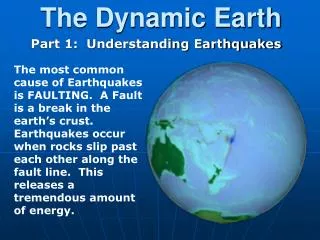
Explore the dynamic Earth and the phenomenon of earthquakes, the release of energy when stress builds up between rocks along faults and plate boundaries. Learn about earthquake terms, fault types, and how seismic waves cause rock movement. Discover the different fault types - normal, reverse, and strike-slip - each associated with specific geological conditions. Delve into the fascinating mechanics of earthquakes and how they shape our planet's landscape.

Unveiling Earthquakes: Forces Beneath the Surface
E N D
Presentation Transcript
http://www.youtube.com/watch?v=-z8zdoFLZME http://www.youtube.com/watch?v=rn3oAvmZY8k
Earthquake • Release of energy when pressure and/or stress is built up between rocks • Usually occurs along faults and plate boundaries • Causes the area of rock to snap when energy is rapidly released in all directions along seismic waves
Earthquake Terms • FOCUS – actual location of where the earthquakeoriginates • EPICENTER – Surface directly abovefocus
FAULT - Zone of weakness or break in earth’s crust Types of Faults Normal Fault Reverse Fault Strike-Slip Fault
Faults • Normal fault • Found in areas under tension • Where sections of the landscape are pulling apart (divergent) Called Fault Block Mountains
Faults (cont.) • Reverse fault • Found in areas under compression • Zones of convergence Like the Himalaya Mountains
Faults (cont.) • Strike-slip faults • More horizontal movement than vertical movement Like the San Andreas fault in California