SlideServe
Menu
Préférences
© SlideServe · v2026

Understanding Chemical Balancing with Beady Balance Activity

jasper avatar
6 diapositives · 215 Views · Aug 04, 2014

In the Beady Balance activity, students will collaboratively explore the principles of chemical balancing through hands-on learning. By working with a partner, participants will analyze chemical equations, identify whether they are balanced, and understand the law of conservation of mass. The session includes a starter question to assess prior knowledge, practice with examples, and an exit ticket using the glucose formula (C6H12O6) to reinforce understanding. Engage in a fun and interactive way to master balancing chemical equations!
Understanding Chemical Balancing with Beady Balance Activity - slide 1
01 / 6Understanding Chemical Balancing with Beady Balance Activity
1 / 17

Télécharger la présentation

Understanding Chemical Balancing with Beady Balance Activity
Une image / un lien ci-dessous est fourni (tel quel) pour télécharger la présentation

Politique de téléchargement : le contenu du site vous est fourni TEL QUEL pour votre information et votre usage personnel ; il ne peut être vendu, concédé sous licence ni partagé sur d’autres sites sans l’accord de son auteur.Le contenu vous est fourni TEL QUEL, pour votre information et votre usage personnel uniquement. Téléchargez la présentation en cliquant sur ce lien. Lors du téléchargement, si vous ne parvenez pas à télécharger une présentation, l’éditeur a peut-être supprimé le fichier de son serveur.Pendant le téléchargement, si vous ne parvenez pas à obtenir une présentation, le fichier a peut-être été supprimé par l’éditeur.

F I N

Plus de contenu associé

Transcription de la présentation
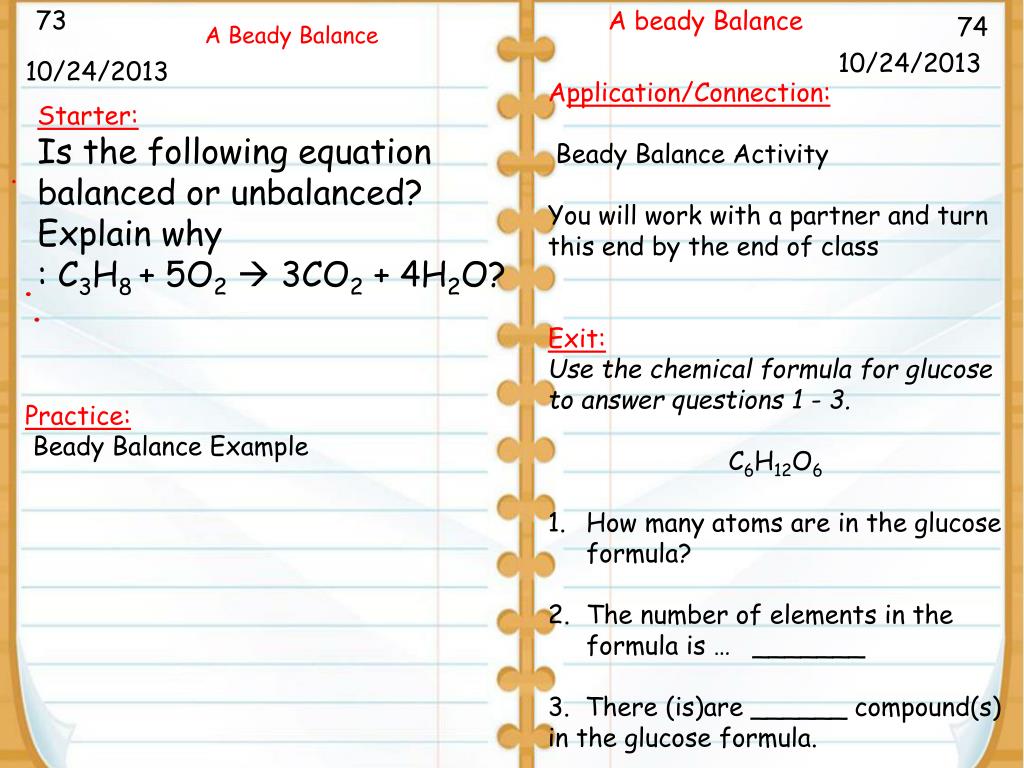
  1. 73 A beady Balance 74 A Beady Balance 9/26/11 10/24/2013 10/24/2013 . • Application/Connection: • Beady Balance Activity • You will work with a partner and turn this end by the end of class • Exit: • Use the chemical formula for glucose to answer questions 1 - 3. • C6H12O6 • How many atoms are in the glucose formula? • The number of elements in the formula is … _______ • 3. There (is)are ______ compound(s) in the glucose formula. . Starter: Is the following equation balanced or unbalanced? Explain why : C3H8 + 5O2 3CO2 + 4H2O? . Practice: Beady Balance Example

  2. October 24, 2013AGENDA8.5 F.I will be able to recognize whether a chemical equation containing coefficients is balanced or not and how that relates to the law of conservation of mass by reading, and writing while completing notes and activity. 1 Starter 2. Practice 3. Activity 4. Exit

  3. Table of Contents Date Lecture/ Activity/ Lab Page 9/25 Metal, Nonmetals, and Metalloids 41-42 9/26 Where’s Al? 43-44 9/27 Element Wanted Poster 45-46 9/30 Bohr Model Challenge 47-48 10/1 Periodic Table Notes/Puzzles 49-50 10/2 Periodic Table Chart 51-52 10/3 Test Review 53-54 10/8 Test Corrections 55-56 10/9 Molecules, Compounds, and Elements 57-58 10/10 Build a Molecule Activity 59-60 10/15 Counting Atoms 61-62 10/16 Counting Atoms with Coefficients 63-64 10/17 Writing Chemical Formulas 65-66 10/18 Physical and Chemical Changes/Properties Notes 67-68 10/21 Chemical Equations and the Conservation of Mass 69-70 10/22 Balancing Equations 71-72 10/24 Beady Balance 73-74

  4. Practice Look at the equation. Using the key, place the color beads on the table that matches each element. Decide if the equation is balanced or not. Na + Cl2  NaCl Unbalanced

  5. + => Al O Cu H Fe Cl S + => + => 2 Cu + 2 HCl => 2 CuCl + H2 => + 10. + => 11. 12. + => + 13. 14. 15. Application/Connection 2 Al2O3 + 4 Al 3O2 =

  6. 73 A beady Balance 74 A Beady Balance 9/26/11 10/24/2013 10/24/2013 . • Application/Connection: • Beady Balance Activity • You will work with a partner and turn this end by the end of class • Exit: • Use the chemical formula for glucose to answer questions 1 - 3. • C6H12O6 • How many atoms are in the glucose formula? • The number of elements in the formula is … _______ • 3. There (is)are ______ compound(s) in the glucose formula. . Starter: Is the following equation balanced or unbalanced? Explain why : C3H8 + 5O2 3CO2 + 4H2O? . Practice: Beady Balance Example