Estimating Fish Movement Parameters in Skipjack Tuna Using Advection-Diffusion-Reaction Models
This study focuses on advection-diffusion-reaction models for estimating parameters of fish movement using tagging data, particularly for Skipjack Tuna (Katsuwonus pelamis). It summarizes methods from two examples: a grid point model estimating movement parameters based on nearly 90,000 releases and 5,000 recaptures, and a grid line model analyzing the effects of Fish Aggregating Devices (FADs) and islands in the Solomon Islands. Results indicate effective parameter estimates, offering insights into tuna movement dynamics critical for fisheries management.

Estimating Fish Movement Parameters in Skipjack Tuna Using Advection-Diffusion-Reaction Models
E N D
Presentation Transcript
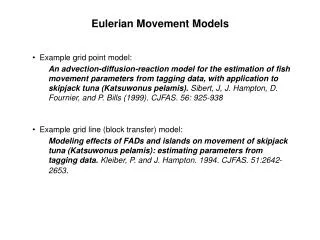
Eulerian Movement Models • Example grid point model: • An advection-diffusion-reaction model for the estimation of fish movement parameters from tagging data, with application to skipjack tuna (Katsuwonuspelamis).Sibert, J, J. Hampton, D. Fournier, and P. Bills (1999). CJFAS. 56: 925-938 • Example grid line (block transfer) model: • Modeling effects of FADs and islands on movement of skipjack tuna (Katsuwonuspelamis): estimating parameters from tagging data. Kleiber, P. and J. Hampton. 1994. CJFAS. 51:2642-2653.
Grid point model Estimating Skipjack Movement Parameters • The Data: • ~90k releases and ~5k recaptures by pole-and-line and purse seine fishing fleets The Universe:
Continuous form: Discrete form: Grid points Diffusion terms Advection terms Reaction term Parameters Alternating direction, implicit time steps
Observation model Poisson likelihood Movement parameter estimates
Grid line model Modeling effects of FADs and Islands on Skipjack Movement Solomon Islands • Many FADs • Two fleets • 7730 tag releases • 914 returns • 1/2 degree square grid
Movement by block transfer transfer coefficients:
FAD effect Island effects b FAD factor a no. FADs Model Parameters
ADI -- Alternating Direction, Implicit time steps Index time differently in alternating steps step A: step B: (i.e. ) terms on the left Example: step A (NS implicit). Collect i-1,j i,j i+1,j
ADI -- alternating direction, implicit time steps add neighboring equations and arrange i-1,j i,j i+1,j
ADI -- alternating direction, implicit time steps makes tri-diagonal system i-1,j i,j i+1,j
Objective function Two alternatives: • individual tag release sets • separate model run for each set • Multinomial likelihood • tag release sets combined • single model run includes all sets • Poisson likelihood
Model Performance Return rate Mean distance moved Returns per month Mean distance (nm) Months at large Months at large
Results parameter estimates radius of FAD action • D = 3.2 nm2/mo • FF= 0.36 • M = 0.15 mo-1 0.49 1.3 FADs ≈ 10 nm