Enhancing Memory: Techniques and Processes Explained
Discover methods to improve memory retention and recall, from encoding and storage to retrieval. Learn mnemonic strategies, understand memory decay, and explore how memories are constructed and influenced.

Enhancing Memory: Techniques and Processes Explained
E N D
Presentation Transcript
Memory How can you increase your memory?
How do you process information? • Encoding - Getting information in • Storage - Retaining information • Retrieval - Getting information out Encoding Storage Retrieval
How can you get it into your brain? • Types of encoding • Visual - Images are more easily remembered than abstract concepts • Acoustic - Sounds (hearing the word) • Songs • Semantic - Meaning - (for words) • Self-reference effect • You remember items that refer to yourself Liberty
What is the best way to study? • Spaced repetition • Spacing Effect • Ebbinghaus’s retention curve • We retain information better when study time is spaced out • The amount remembered depends on the time spent learning • Spaced study beats cramming - E.g. 12 - 5 minutesegments beat one hour of study
Why does repetition help you remember? • Brain (synaptic) changes • Long-term potentiation (LTP) • Stimulating neurons increased efficiency • Sending neuron released its neurotransmitter more easily • Receptor sights may increase. • May explain why experience and repetition can increase memory.
Why can you instantly remember something? • Flashbulb memories • 9-11 • Space Shuttle Challenger • Car accident
What is the Serial Position Effect? • We remember the first and last items better than ones in the middle. • E.g. Grocery list
How can you remember better ?Mnemonics - Encoding Imagery • Mnemonics (Greek for memory) • Method of Loci • Chunking • License plate • Phone # • 1-800-HOLIDAY • Words • Association • E.g. Grocery list
“Peg word” system Numbers into pictures 1 = Bun 2 = Shoe 3 = Tree 4 = Door 5 = Hive 6 = Sticks 7 = Heaven 8 = Gate 9 = Swine 10 = Hen Attach items to be remembered to the pictures Mnemonics (cont.)
Do you remember? • What types of encoding are there to help you remember? • What two things did we learn from the Ebbinghaus retention curve to help you remember? • What are flashbulb memories? • If you list your advantages on a resume, where do you put your most important ones you want remembered? • How could you use the peg word system?
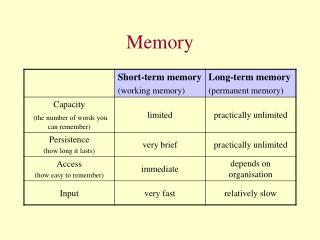
Storage - Retaining information Iconic (sensory) memory - Movie frames Tenths of a second Short term memory - Phone # Few minutes Long term memory - Experiences Years
Long term memories Test Trip to Egypt Bike riding Something was fun
What things help you remember? • Retrieval cues • Priming • Memories are held by a web of associations - identify one strand and it leads to others • Associations • E.g. Wedding song • Retrieval cues can be sights, sounds, smells and tastes
What causes you to forget? • Encoding failure • You did not learn it • Names are forgotten because they were never encoded. • Storage decay • Penny example
What interferes with memory? • Retrieval Failure • You can not remember it • Proactive (forward-acting) interference • Earlier learning reduces later learning • Retroactive (backward-acting) interference • Later learning reduces earlier learning
Do you remember? • How does priming relate to retrieval cues? • What causes you to forget? • What is proactive and retroactive memory interference?
Memory Construction Do you remember things that never happened?
Misinformation effect • Given misinformation about an event someone experienced, they misremember the event. • E.g. After repeatedly hearing false detailed accounts of something that happened to you, you begin to mistakenly “remember” that these events actually occurred.
Source amnesia (Source misattribution) • You remember something as real, but forget the source of the memory (e.g. a movie). • (You forgot that they were told to you)
Repressed or constructed memories • Therapeutic techniques such as guided imagery can easily encourage construction of false memories. • Memories “recovered” under hypnosis or drugs are particularly unreliable.
Do you remember? • If Sally is falsely told, usually repeatedly and in detail, that she was abused as a child; might she begin to remember abuse that never happened? • If someone says, ”I remember this, but I forgot where I heard it”. What happened? • Can guided imagery, hypnosis and drugs be used to recover reliable memories?