
Effective Communication in Health Care: Importance and Strategies
E N D
Presentation Transcript
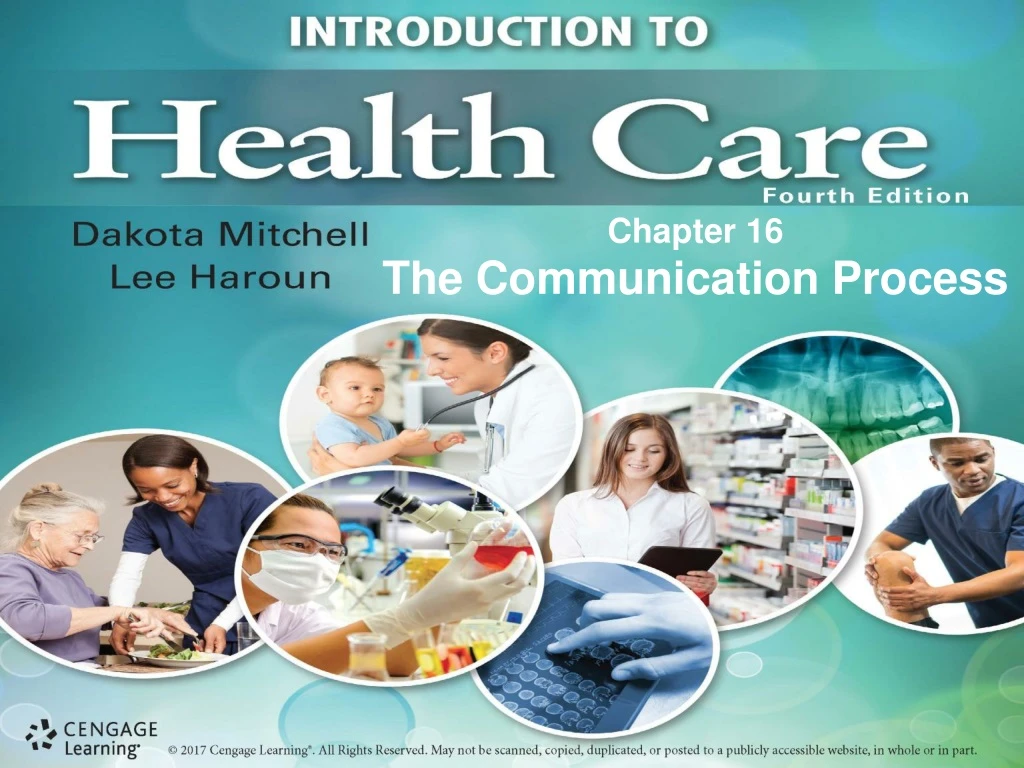
Chapter 16 The Communication Process
Communication • Exchanging messages between sender and receiver • Types: • Oral • Nonverbal • Written • Electronic
Communication in Health Care • Excellence in communication essential in health care • Increase in size of delivery systems • Need for intercommunication • More complex payment systems • Decrease in time spent in hospitals • Importance of patient education
Communication in Health Care • Shift in causes of death to heart disease, cancer, COPD, and stroke • Patient information regarding wellness and healthy lifestyles
Communication and PatientWell-Being • Need for respect and understanding of individual patients and their needs • Impact on speed of patient recovery
Communication and PatientWell-Being • Stressors for patients: • Intimidation of health care setting • Fear and anxiety • Poor communication can lead to fatal errors
Communication Process • Communication • More than talking and listening • Therapeutic communication = effective health care communication • Aimed at meeting needs of patients • Requires developing and applying communication skills
Communication Process • Set communication goals • Create message • Deliver message • Listen to response • Offer feedback and seek clarification • Evaluate encounter • And revise message, if necessary
1. Set Communication Goals • Decide what is to be accomplished • Therapeutic communication usually at deeper level than everyday conversation • Must be clear and accurate
1. Set Communication Goals • Examples of goals: • Gather information from patient • Give instructions to patients • Report information to coworker
1. Set Communication Goals • Goals to include in every patient interaction: • Show sincere concern for patient’s welfare • Establish trust • Enhance patient’s self-esteem
Question • True or False: • Today’s health care services are so technologically advanced that there is little point in allowing patients to participate in making decisions about their health.
Answer • False • Patients should be involved in decision making whenever possible
1. Set Communication Goals • Factors to consider when setting goal: • Patient’s level of understanding • Emotional factors • Physical factors • Urgency of communication
2. Create Message • Create message based on information gathered and communication goal • Avoid medical terminology with patients • Use general language • Rather than slang
2. Create Message • Must be clear and accurate • Organize long messages • Rank items in order of importance • Give overview and then details • Break information into chunks • Messages can be in form of question
2. Create Message • Types of questions: • Closed-ended • Can be answered with one word or phrase • Open-ended • Requires more than one-word answer
2. Create Message • Types of questions: • Probing • Asks for more information • Leading • Question includes possible answer
Question • “What is your date of birth?” is an example of a/an _____ question. • Probing • Open-ended • Closed-ended
Answer • C. Closed-ended • Response to question is one word or short phrase that functions like one word • Therefore closed-ended
Question • True or False: • An appropriate use of a leading question is with patients who are unable to offer complete answers on their own.
Answer • True • Leading question offers part or all of answer • Can be helpful when patients cannot create answer themselves
2. Create Message • When asking questions: • Allow time for response • Take care with leading questions • Because patient may simply agree with you • Reword questions when necessary
2. Create Message • Humor appropriate when used carefully • Helps relieve tension • Can promote open discussion of sensitive issues • Patient jokes to mask fear • Listen carefully • Patient may need help dealing with fear
3. Deliver Message • Address patients directly whenever possible • Young and elderly patients • Use titles to show respect • Ask patients how they wish to be addressed
3. Deliver Message • Take care not to breach confidentiality • Maintain communication with patients who cannot speak to respond
Question • True or False: • Using casual words such as “like” and “you know” in your messages to patients can help them feel more at ease.
Answer • False • Filler words should be avoided • Can be distracting to your message and/or irritating for some listeners
3. Deliver Message: Nonverbal Communication • Delivers up to 70% of meaning of oral message • Nonverbal communication includes the following: • Tone of voice • Touch • Can be reassuring, but use with care
3. Deliver Message: Nonverbal Communication • Nonverbal communication includes the following: • Body language • Gestures can be positive or negative • Smiling • Crossing arms • Rolling eyes
3. Deliver Message: Nonverbal Communication • Nonverbal communication includes the following: • Facial expressions • Avoid showing negative reactions • E.g., impatience, disgust • Physical appearance • Sign of health care professional competence and regard for patients
Question • Leaning toward the speaker when you are listening is usually a sign of: • Aggression • Interest • Difficulty understanding
Answer • B. Interest • Leaning toward speaker • Sign of interest in what speaker is saying
3. Deliver Message: Physical Environment • Can affect delivery of message • Factors to consider: • Light source • Sound distractions • Privacy • Focus on patient • Patient comfort
4. Listen to Response • Listening • Active process • Concentration • Attention • Observation
Question • Which is the most important characteristic of active listening? • Taking notes while listening • Maintaining eye contact with the speaker • Focusing fully on what the speaker is saying
Answer • C. Focusing fully on what the speaker is saying • Active listening may involve other actions, but focusing fully on speaker is the underlying characteristic
4. Listen to Response: Empathy • Empathy • Effort to understand other peoples’ thoughts, feelings, and behaviors • “Walk a mile in my shoes” • Communicate awareness of patient’s feelings
5. Offer Feedback and Seek Clarification • Feedback • Method for receiver to check understanding of what sender says • Types of feedback: • Paraphrasing • Rewording of sender’s message in receiver’s own words
5. Offer Feedback and Seek Clarification • Types of feedback: • Reflecting • Prompting receiver to complete or add to original message • Asking questions • Requesting clarification and additional information • Requesting examples • Asking for examples to clarify and fill in meaning
Question • “I hear you saying you feel better after you’ve done the exercises I taught you last week” is an example of: • Paraphrasing • Reflecting • Asking a leading question
Answer • A. Paraphrasing • Paraphrasing • Stating in own words what you think sender said
6. Evaluate Encounter • Determine if communication goal met • If not met, identify difficulty • Continually evaluate communication throughout encounter
6. Evaluate Encounter: Communication Barriers • Barriers can block effective communication • Examples of barriers: • Cultural differences • Language differences • Defense mechanisms • Physical distractions • Pain
Patients with Special Needs • Terminally ill • May experience loneliness • May want to share fears and concerns • Health care professionals need to come to terms with death as patient outcome
Patients with Special Needs • Those with pain, medication, or disorientation • Identify self and say patient’s name • Speak slowly and maintain eye contact • Use simple, short messages • Repeat as necessary and review content • Use touch, if appropriate • Try to schedule best time for patient
Patients with Special Needs • Those with Alzheimer’s disease and other forms of dementia • Do not confront • Use short sentences • Agree or distract when patient doesn’t make sense • Respond to patient’s feelings • Offer suggestions, not corrections
Patients with Special Needs • Those who are depressed • Invite patients to discuss their feelings • Offer hope But do not tell to cheer up • Allow for silence
Patients with Special Needs • Those who are anxious • Maintain calm • Monitor anxiety level • Keep message simple • Stick to one topic • Use feedback to check understanding
Patients with Special Needs • Hearing impaired • Observe behavior and check for understanding • Ensure face and mouth of speaker are visible • Speak slowly and clearly • Turn off sources of noise • Do not shout • Announce change of subject