
Biotechnology
E N D
Presentation Transcript
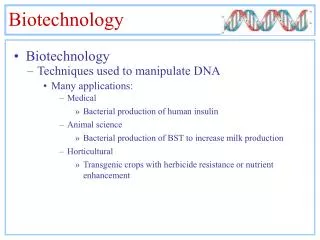
Biotechnology • “Biotechnology means any technological application that uses biological systems, living organisms, or derivatives thereof, to make or modify products or processes for specific use.”
Bacteria with Plasmid 1 = bacteria regular chromosome 2 = plasmids
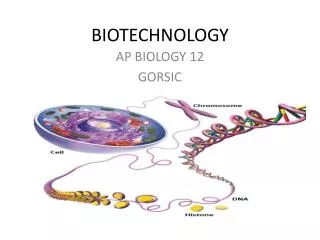
Plasmid • Small circular DNA separate from the larger bacterial chromosome
Why is a plasmid important in biotechnology? • It may be used as a vector, to carry other genes to another cell.
Gene therapy is being used in many ways. For example, to: • Replace missing or defective genes; • Deliver genes that speed the destruction of cancer cells; • Supply genes that cause cancer cells to revert back to normal cells; • Deliver bacterial or viral genes as a form of vaccination; • Provide genes that promote or impede the growth of new tissue; and; • Deliver genes that stimulate the healing of damaged tissue.
R plasmids • This type of plasmids carry genes for enzymes that destroy antibiotics such as penicillin and tetracycline. • So…Bacteria containing R plasmids become resistant to many antibiotics.
Steps for Gene Therapy • 1. Isolate plasmid
Animation • LINK: Isolating Plasmid DNA from Bacteria
3. Gene is inserted into plasmid RECOMBINANT DNA = plasmid + inserted DNA
4. Recombinant DNA plasmid is put into bacterial cell • DNA cloning animation • 5. Cell multiplies with recombinant DNA
Restriction enzyme • (or restriction endonuclease) is an enzyme that cuts double-stranded DNA at a specific location
Different Restriction Enzymes Several hundred different kinds LINK: RECOGNITION SITES OF RECTRICTION ENZYMES
“Sticky Ends” Complementary bases join plasmid an new DNA to form recombinant DNA Restriction site = place where the two fragments join
Ligase Enzyme Joins the sticky ends
Recombinant DNA • Plasmid DNA + other organism DNA • LINK: rDNA
DO LAB ACTIVITY Chocolate Flavored Cherries: An exercise in Recombinant DNA Technology Read intro and do Pre-Activity First
Gel Electrophoresis • Gel Electrophoresis Virtual Lab • Gel Electrophoresis
Ready to Run • DNA flows from – to + end of the gel
DNA Fingerprinting Each person produces a specific pattern of bands of DNA sequence lengths
Examine the results • UV Transilluminator, and the UV light shines up through the gel.
Click and Drag to find the suspect Murder at Rodman Dam • http://www.dnalc.org/ddnalc/resources/shockwave/dnadetective.html
Some Examples of DNA Uses for Forensic Identification • Identify potential suspects whose DNA may match evidence left at crime scenes • Exonerate persons wrongly accused of crimes • Identify crime and catastrophe victims • Establish paternity and other family relationships
More Uses • Detect bacteria (like Salmonella) and other organisms that may pollute air, water, soil, and food • Match organ donors with recipients in transplant programs • Determine pedigree for seed or livestock breeds
More Uses • Authenticate consumables such as caviar and wine • Detect disorders like cancer, cystic fibrosis • Identify endangered and protected species as an aid to wildlife officials (could be used for prosecuting poachers)
OTHER FRAGMENTS: VNTR’s • Variable number of tandem repeats (VNTRs) can be used in a gel electrophoresis to show different patterns
Southern Blot Animation • LINK: Animation Quiz 5 - Southern Blot
Paternity Testing: Call Montel • NICE LINK Paternity Testing
Would any one else have the same pattern as you? • No…unless you are an identical twin.
DNA PROBES • a single-stranded DNAmolecule (like ATTGGAC) used in laboratory experiments to detect the presence of a specific sequence among a mixture of other singled-stranded DNA molecules.
USES of DNA PROBES • Detect infectious diseases • Detect genetic diseases • HLA typing (suitable donor for stem cell blood typing) • Paternity (find the father) • Cancer detection
PCR • Polymerase Chain Reaction- • take a small sample of DNA an amplify it take make a larger amount • Sample does not have to be pure and can be partially degraded.