Understanding Pavlovian Conditioning: Principles and Applications
190 likes | 322 Vues
This guide explores the foundational concepts of Pavlovian conditioning, including unconditioned stimuli (UCS), unconditioned responses (UCR), conditioned stimuli (CS), and conditioned responses (CR). We delve into the significance of contingencies and the Rescorla-Wagner model, illustrating how associative learning occurs. The guide outlines the standard procedures, key assumptions, and mathematical formulations involved in Pavlovian conditioning, making complex theories accessible for students and researchers alike. Gain insights into the implications of conditioning and its application in behavioral sciences.


Understanding Pavlovian Conditioning: Principles and Applications
E N D
Presentation Transcript
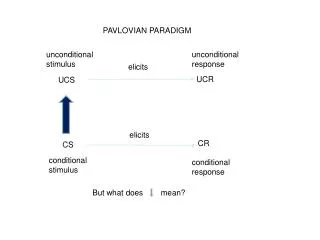
PAVLOVIAN PARADIGM unconditional stimulus unconditional response elicits UCR UCS elicits CR CS conditional stimulus conditional response But what does mean?
Respondent Contingencies • Standard Procedure • P(UCS|CS) = 1 ; P(UCS|~CS) = 0 • Partial Reinforcement • 0 < P(UCS|CS) < 1 ; P(UCS|~CS) = 0 • Random Control • 0 < P(UCS|CS) = P(UCS|~CS) • Inhibitory CS • 0 < P(UCS|CS) < P(UCS|~CS) Pavlovian Conditioning
Contingency Table UCS ~UCS #UCSCS = A # CS = A + B P(UCS|CS) = A / (A+B) CS B A+B A ~CS D C+D C A+C B+D N |AD - BC| (A+B)(C+D)(A+C)(B+D) = Pavlovian Conditioning
Staddon’s Data Pavlovian Conditioning
Contingencies and Staddon’s Data SH ~SH = 20/30 = 2/3 = 10/30 = 1/3 = 10/30 = 1/3 = 20/30 = 2/3 P(S) P(~S) P(SH) P(~SH) 10 20 S 10 012 011 10 ~S 10 0 022 021 30 10 20 Pavlovian Conditioning
Contingencies and Staddon’s Data If S and SH were independent (“random control”): P (SH|S) = P (SH) or P (SH S) = P (SH) P(S) By definition: P (SH|S) = P (SH S) = #(SH and S) P(S) #S = 10/20 = 1/2 But: P (SH) = 10/30 = 1/3 So: P (SH|S) ≠ P (SH). Also, P (SH S) ≠ P (SH) P(S) 10/30 = 1/3 ≠ (1/3)(2/3) = 2/9 Pavlovian Conditioning
= X²1df= │011022 – 012021│ • N (011 + 012)(021 + 022)(011 + 021)(012 +022) Recall X² test for independence in contingency table with observed frequencies 0ij rc i=1 j=1 Where the Eij’s are the Expected Frequencies X²1df = (0ij – Eij) ² Eij For a 2 x 2 Table X²1df = N │011022 – 012021│² (011 + 012)(021 + 022)(011 + 021)(012 +022) Pavlovian Conditioning
For a 2 x 2 Table Χ²1df = N │011022 – 012021│² (011 + 012)(021 + 022)(011 + 021)(012 +022) SH ~SH E11 = (011 + 012)(011 + 021) N E12 = (011 + 012)(012 + 022) N E21 = (021 + 022)(011 + 021) N E22 = (021 + 022)(012 + 022) N S 011 + 012 012 011 021 022 021 + 022 ~S N 012 + 022 011 + 021 Pavlovian Conditioning
X1² = (13.33 – 10)² + (10 - 6.67)² 13.33 6.67 + (10 – 6.67)² + (3.33 -0)² 6.67 3.33 = 7.486 ≈ 7.5 X².95 = 3.84 1df = │(10(0) – (10)(10) │= 100 = 0.5 (20)(10)(20)(10) (20)(10) ² = 0.25 = X1² / 30, so X1² = 7.5 as above. S and Shock are not independent • For Staddon’s Data, the table is: 011 = 10 E11 = 13.33 012 = 10 E12 = 6.67 20 022 = 0 E22 = 3.33 021 = 10 E21 = 6.67 10 30 10 20 Pavlovian Conditioning
cs S = Rcs Rcs+ Rcs cs cs S = 0.0 S = 0.5 Pavlovian Conditioning
P(UCS|CS) = P(UCS|~CS) = P(UCS~CS) = # (UCS~CS) P(~CS) # ~CS [P(CS) > 0] ~CS E UCSCS UCS~CS ~CS = E – CS = Context P(UCS|CS) = 1- P(~UCS|CS) P(UCS|~CS) = 1- P(~UCS|~CS) ~UCS Pavlovian Conditioning
What are some characteristics of a good model? Variables well-described and manipulatable. Accounts for known results and able to predict non-trivial results of new experiments. Dependent variable(s) predicted in at least relative magnitude and direction. Parsimonious (i.e., minimum assumptions for maximum effectiveness).
STEPS IN MODEL BUILDING • IDENTIFICATION: WHAT’S THE QUESTION? • ASSUMPTIONS: WHAT’S IMPORTANT; WHAT’S NOT? • CONSTRUCTION: MATHEMATICAL FORMULATION • ANALYSIS: SOLUTIONS • INTERPRETATION: WHAT DOES IT MEAN? • VALIDATION: DOES IT ACCORD WITH KNOWN DATA? • IMPLEMENTATION: CAN IT PREDICT NEW DATA?
PRINCIPAL THEORETICAL VARIABLE: ASSOCIATIVE STRENGTH, V
ASSUMPTIONS 1. When a CS is presented its associative strength, Vcs, may increase (CS+), decrease (CS-), or remain unchanged. 2. The asymptotic strength () of association depends on the magnitude (I) of the UCS: = f (UCSI). 3. A given UCS can support only a certain level of associative strength, . 4. In a stimulus compound, the total associative strength is the algebraic sum of the associative strength of the components. [ex. T: tone, L: light. VT+L =VT + VL] 5. The change in associative strength, V, on any trial is proportional to the difference between the present associative strength, Vcs, and the asymptotic associative strength, .
Contiguity in R-W Model If P(UCS|CS) = P(UCS|~CS), we really have CS = CS + CTX and ~CS = CTX. Then: P(UCS|CS + CTX) = P(UCS|CTX) V (CS + CTX) = VCS + VCTX (R-W axiom) V CS = V (CS +CTX) = VCS + VCTX but: V CTX = V ~CS so: V (CS + CTX) = V CS + V~CS = 0 No significant conditioning occurs to the CS Pavlovian Conditioning