Understanding Carbohydrates: Key Functions, Structures, and Health Impacts
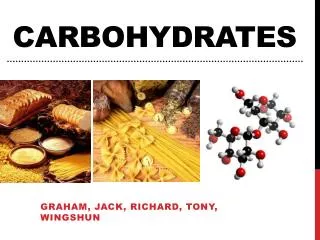
Carbohydrates are the most abundant biological molecules, ranging from simple sugars like glucose to complex forms such as starch. They play crucial roles as energy sources and storage in organisms. Monosaccharides, like glucose and fructose, are the simplest units, while disaccharides and polysaccharides consist of combinations of these. Polysaccharides, including starch, glycogen, and cellulose, serve vital storage and structural functions in plants and animals. Dietary fiber, mainly cellulose, aids digestion and offers various health benefits.

Understanding Carbohydrates: Key Functions, Structures, and Health Impacts
E N D
Presentation Transcript
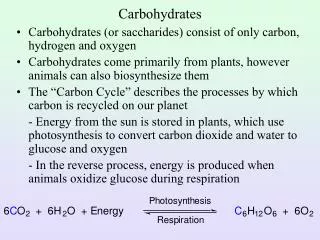
Introduction • most abundant class of biological molecules • range from simple sugars (glucose) to complex carbohydrates (starch) • major functions: (B.3.4) • energy source: glucose converted into ATP • energy storage/reserves: glycogen • precursor for molecules such as DNA
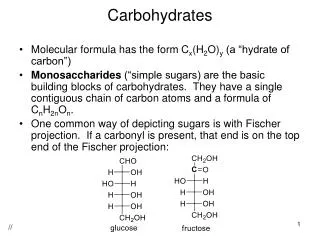
Monosaccharides(B.3.1 and 2) • simplest sugars (single sugars) • empirical formula is (CH2O) • contain a ketone, C=O (fructose) or aldehyde, H-C=O (glucose) • contain at least two hydroxyl groups (-OH) • can be straight chains or cyclic form • two common monosaccharides • both C6H12O6 • glucose • fructose
Glucose on different sides of ring both on same side of ring
Condensation of monosaccharides to form disaccharides and polysaccharides (B.3.3 and B.3.5) • example of a typical condensation reaction • A-OH + B-OH ===> H2O + A-O-B • (2 monosaccharides => water + 1 disaccharide)
requires enzymes • the hydroxyl (-OH) of two monomers are brought together and the H of one and the OH of the other come together to make H2O • the remaining O from one of the monomers bonds the two together in a bond called a glycosidic linkage
Hydrolysis • the reverse of condensation • the decomposition of a substance by the insertion of water molecules between certain of its bonds. • food is digested by hydrolysis
Disaccharides • double sugar (contains 2 monosaccharides) • three common disaccharides: 1. sucrose - common table sugar glucose + fructose 2. lactose - major sugar in milk glucose + galactose 3. maltose - product of starch digestion glucose + glucose
Polysaccharides (3 types) • longer chains of simple sugars made of glucose • serve principally as food storage and structural molecules in plants • 3 Types of Polysaccharides 1. Starches (plants) • polymers of glucose molecules • serve as storage depots of glucose • two forms • amylose- water soluble, straight chains, thousands of glucoses • amylopectin- insoluble, branched chains, up to millions of glucoses
glucose polymer with a(14) linkages, and branches formed by a (16) linkages glucose polymer with onlya(14) linkages.
2. Glycogen (animals) • a short-term storage polysaccharide for animals • highly branched glucose units put together that are broken down to meet energy demands of the body
3. Cellulose (plants) • most abundant polysaccharide on Earth • the major structural material of which plants are made (wood and plant fibers) • insoluble and has great tensile strength because the hydroxyls (-OH) are reversed on successive glucoses compared to other polysaccharides
plant cell walls are among the strongest of biological structures • most organisms can’t break cellulose down into simple sugars because they don’t have the enzyme cellulase which is necessary to hydrolyze the glycosidic linkages
Dietary fiber B.3.6-7 • dietary fiber is plant material that we ingest but are not able to digest • passes through the gut relatively intact, as we do not possess cellulase enzymes capable of hydrolysing it • bacteria in our gut can digest it somewhat • example: cellulose
importance in our diet • helps “bulk” move through the large intestine more eaisly • prevent constipation and diverticulosis (bulges in the colon at weak places leading to pain) • may prevent irritable bowel syndrome (IBS) • may prevent hemorrhoids • may cause a “full feeling” and therefore decrease chance of obesity • may help prevent Crohn’s desease