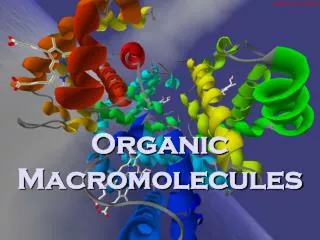
Organic MACROMOLECULES
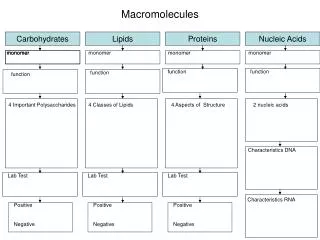
Macromolecules are large and complex structures essential for living organisms, made up of CHONPS (carbon, hydrogen, oxygen, nitrogen, phosphorus, and sulfur) atoms. They include carbohydrates, proteins, lipids, and nucleic acids, formed by linking small units called monomers into long chains known as polymers. Through processes like dehydration synthesis and hydrolysis, we assemble and breakdown these molecules in our bodies. This cycle facilitates the conversion of nutrients into usable forms for cellular functions and is crucial for maintaining life. Explore the fascinating interconnections of digestion and synthesis!

Organic MACROMOLECULES
E N D
Presentation Transcript
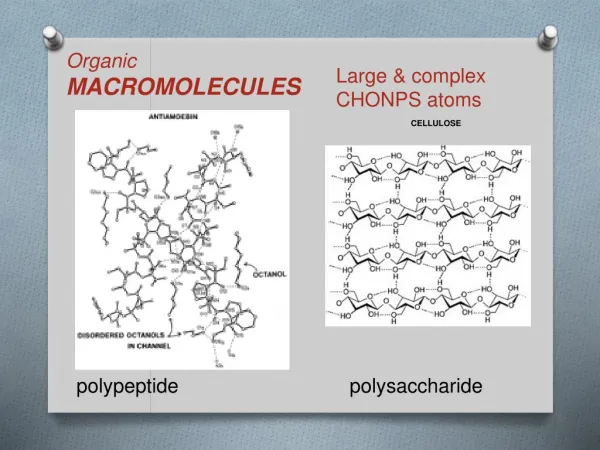
Organic MACROMOLECULES Large & complex CHONPS atoms • CELLULOSE polypeptide polysaccharide
carbohydrates nucleic acids proteins See any patterns? lipids
Macromolecules are made by linking together repeated small molecules each link = monomer chain = polymer Each link is a monomer The chain is a polymer Gr: mono- one poly- many
Ex: chains of simple sugars, like glucose, create complex carbohydrates, like starch monomer = glucose polymer = starch
CHEMICAL DIGESTION Polymer -> monomers • make small enough to diffuse from gut to bloodstream • make raw materials available for assembly into new molecules • aided by enzymes (-ase), gut microbiota
Water breaks the bonds of a polymer HYDROLYSIS polymer add water dimer octet rule satisfied add water http://nhscience.lonestar.edu/biol/dehydrat/dehydrat.html
Building polymers is a DEHYDRATION SYNTHESIS reaction water covalent bonding creating a disaccaride water peptide bonding of amino acids
building a polypeptide Protein synthesized via dehydration water molecule removed
Complementary processes what we eat what our cells need Find that graphic with digestion to monomers, then monomer used to assemble polymers needed by the body! hydrolysis dehydration breaking down digestion synthesize needed molecules raw materials
A macromolecule reflects a hierarchy: CHNOPS Carbon (4 bonds) add H (organic Hydrocarbon) add Functional Group(s) (hydrophyllic) Monomer* (some are isomers) Dehydration rxn (between monomers) Polymer** *glucose, animo acid, nucleotide… **Carbohydrate, Protein, Nucleic Acid, Lipid^ ^2+ subunits, not a monomer
Repeating monomers build polymers: CARBOHYDRATE monosaccharide simple sugar disaccharide complex sugar polysaccharide starch, glycogen cellulose
Repeating monomers build polymers: PROTEIN polypeptide amino acid
Repeating monomers build polymers: NUCLEIC ACID nucleic acid nucleotide
two + subunits: lipids fatty acid glycerol