Download
1 / 23
230 likes | 380 Vues
This guide explores the fascinating world of organic macromolecules, focusing on the types of covalent bonding among carbon, nitrogen, oxygen, and hydrogen. Learn how the number of bonds corresponds to the number of electrons needed to fill outer energy levels. We dive into structural formulas and draw examples such as CH4 and C6H12. Additionally, we examine chemical reactions, the concepts of endergonic and exergonic processes, and the significance of energy in reactions. Understand monomers and polymers, including carbohydrates, lipids, proteins, and nucleic acids, along with their structures and functions.

E N D
Covalent Bonding • For C, N, O, & H… # of bonds = # of e- needed to fill outer energy level • H = 1 • O = 2 • N = 3 • C = 4
H C N O H O-H H C C H H H H H H C N H H H H H H H H H C C C H H H H H H H H H H H H C C H C H C C C C C C C H H C C H H H H H H H H H Structural Formulas • Putting these pieces together, draw a possible structural formula for… • CH4 • CNH5 • C2H6O • C2H4 • C6H12
Chemical Reactions • The rearrangement of atoms CO2 + H2O C6H12O6 + O2 (Reactants) (Products)
ChemicalReactions • Endergonic Reaction • Energy is required • Exergonic Reaction • Energy is released • Activation Energy • Energy req’d to start rxn • Catalyst • Decreases AE • Speeds up rxns Energy Time Products Reactants
Chemical Reactions Review 2 Mg + O2 2 MgO • Was energy mostly released or absorbed? • Is this reaction exergonic or endergonic? • Why doesn’t this reaction occur on its own? 6 CO2 + 6 H2O C6H12O6 + 6 O2 • Is energy mostly released or absorbed? • Is this reaction exergonic or endergonic? • Where does the absorbed energy go?
Macromolecular Structure • Monomer • Single unit of a macromolecule • Monomers join to form polymers • Polymers can be split into monomers
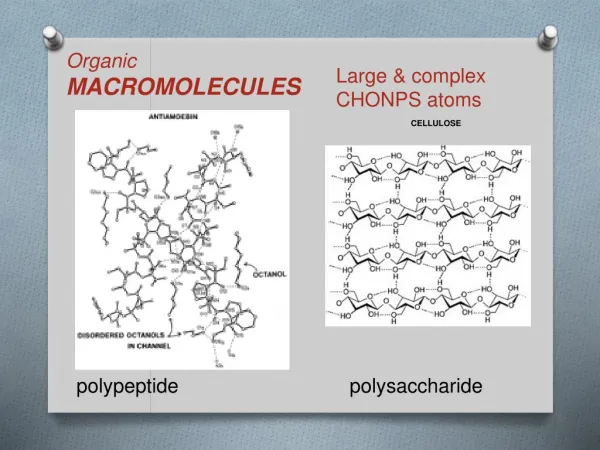
Carbohydrates • C, H, & O in 1:2:1 ratio • Often in rings or linked rings • Monosaccharide (simple sugar) • Carbohydrate monomer • Glucose - Photosynthesis • Fructose - Fruit • Galactose - Milk
Carbohydrates • Polysaccharide (sugars linked together) • Cellulose - Plant cell walls, wood, cotton • Starch - Plant energy storage
Lipids • Lots of C, twice as much H, very little O • Hydrocarbon chains Fatty acid (monomer) • Triglyceride (polymer) • 3 fatty acids linked together • Oil (liquid) - E storage • Fat (solid) - E storage, insulation, padding • Nonpolar • Won’t dissolve in H2O • Polar • Will dissolve in H2O
Lipids • Steroids (four carbon rings) • Cholesterol, venoms, hormones
Radical Group R O H N C C H O H H Proteins • C, H, O, N and sometimes S • Peptide = Amino Acid = Protein Monomer • Over twenty varieties (Differ only in “radical” group)
Proteins • Polymers made of amino acids • Structural examples • Muscle fibers, hair, cytoskeleton • Cell membrane proteins
Proteins • Enzymes • Protein catalysts • Help convert substrates to products
Rate of Rxns • Temperature • As temp ↑, collisions are more frequent (rate ↑) • At high temps, enzyme changes shape (rate ↓) Rate Denaturation Temperature
Rate of Rxns • pH • Different enzymes have different optimal ranges
Rate of Rxns • As [substrate] ↑, Rate ↑ Rate [substrate]
Nucleic Acids • Nucleic Acid Polymers • RNA • Protein synthesis • DNA • Primary genetic info
Photosynthesis Fruit Milk Liquid at room temp Solid at room temp Hydrophilic (polar) end Hydrophobic (nonpolar) end Glucose Fructose Galactose Plant E storage Oil Fat Monomer: Monosaccharide (simple sugar) Polymer: Triglyceride Plant cell walls Wood Cotton Monomer: Fatty Acid Starch Polymer: Polysaccharide Cellulose Steroid Hormone Venom Cholesterol Organic Molecules Amino Group Monomer: Amino Acid (peptide) Carboxyl Group Phosphate Monomer: Nucleotide Radical Group Base Sugar (monosaccharide) Polymer: Nucleic Acid (polynucleotide) Polymer: Protein (polypeptide) Structural Protein DNA RNA Enzyme Ribose Deoxyribose Original genetic info Double strand Protein synthesis Single strand Activity varies Reusable Chemical Tool Acts on specific substrate Carbohydrate C, H, O (1:2:1) Lipid C, H, Less O Nucleic Acid C, H, O, N, P Protein C, H, O, N, S
Biochemistry Review • Name the 4 types of organic molecules. • Which general type applies… A) photosynthesis product C) RNA B) triglyceride D) enzyme • Complete the analogy A) Monomer : Polymer :: Glucose : ____________ B) Rxn : Activation E :: Football game : ________ C) Protein : Sulfur :: Nucleic Acid : ____________ D) Substrate : Enzyme :: Homework : __________
Biochemistry Review • How can one tell the difference between the 4 types of organic molecules based upon structures? • Name the monomer for each of the four types of organic molecules. • Why is the polarity of water significant for living things? • Describe acids and bases in two different ways. • What parts make up a solution?