Understanding Organic Macromolecules: Carbohydrates, Lipids, Proteins, and Nucleic Acids
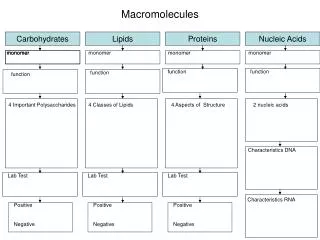
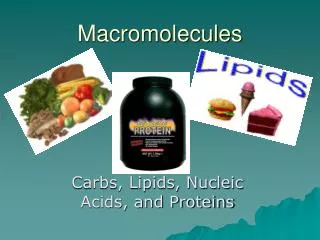
This comprehensive overview explores the four main types of organic macromolecules: carbohydrates, lipids, proteins, and nucleic acids. Carbohydrates serve as immediate fuel and structural components, while lipids provide long-term energy storage and protection. Proteins perform various functions including support and defense, formed from amino acid chains. Nucleic acids (DNA and RNA) store and transmit genetic information. This guide provides insights into the structure, function, and significance of these essential biomolecules in living organisms.

Understanding Organic Macromolecules: Carbohydrates, Lipids, Proteins, and Nucleic Acids
E N D
Presentation Transcript
CARBOHYDRATES • “hydrated carbon” CH2O • FUEL, immediately available • Some are structural (cellulose) but also have lots of C-C and C-H bonds available as fuel (wood) • Sugars, carbs and starches • < 1 % of body mass in humans • 4 calories/gram
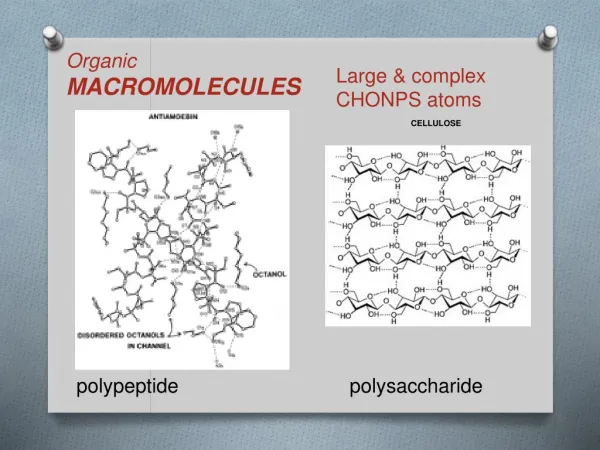
Saccharide = sugar • Monosaccharides • 3 to 7 carbons; fructose, glucose, galactose, glucose, lactose, etc • Used by cells as fuel; Burned in mitochondria to generate ATP • Produced by plants during photosynthesis • Disaccharides • 2 sugars bonded with dehydration synthesis • Sucrose and maltose • Transport form for sugars in plants • Polysaccharides • Complex carbohydrates with 1000’s sugars • Store fuel • STARCH found in seeds (corn) and grains (wheat and rice) and roots/tubers (potatoes) • Also stored as glycogen in animal muscle and liver
LIPIDS • C and H with relatively little O • Fatty acids (lauric acid, butyric acid, oleic acid ,etc) • Sometimes a little N or S • Saturated vs unsaturated vs polyunsaturated • Include fats, oils and waxes • Normally 12 – 20 % of body weight in humans • 9 calories/ gram • Omega 3 fatty acids • Many functions: • IF fuel – its STORED fuel/ LONG term storage • Insulation; thermal and electrical • Cushion especially vital organs • Chemical messengers; hormones and prostaglandins – “cholestrol” • Water proofing; wax on leaves • Cell membranes; phospholipid bilayer
PROTEINS • Form from amino acid chains • N- C bonds called peptide bonds • C, H, N, O and Sulfur • 100s – 1000s of amino acids per protein • 20 different amino acids • FUNTIONS: • Support • Movement • Transport • Buffering • Regulation • Coordination / Control • defense
STRUCTURE AND FUNCTION • Primary structure – linear sequence of amino acids, based on DNA code/ covalent bonds • Secondary structure – side groups start to attract and coil / hydrogen bonds • Tertiary structure – 3D shape forms, cross linking between “loops” / disulfide bonds • Quaternary structure – multiple “subsections” of protein connect to make complete protein
Enzymes • Lower activation energy so reaction happens faster or at lower temperature • Lock and key fit – specific 3D shape • Specificity • Cofactors – ions or molecules that allow enzymes to catalyze reactions. • Vitamins – related to carbs and lipids, these organic compounds are turned into coenzymes. Need as nutrients can’t make
NUCLEIC ACIDS • C, H, N, O, P, S • DNA • Deoxyribonucleic acid; stores information and transmits it to next generation • RNA • Ribonucleic acid; carries information from nucleus to ribosomes • A T C G and U • A is same adenine as in ATP
CHEMISTRY REVIEW • Covalent bonds • Ionic bonds • Hydrogen bonds