Download
1 / 38
380 likes | 513 Vues
Join Mrs. Ka’la Morris, an Early Learning Mentor and Coach, along with the Head Start staff, in this informative session designed to empower parents to actively participate in their child’s learning journey. Discover strategies to promote physical, social-emotional, cognitive, and language development at home through nine focus areas, including literacy and mathematics. Learn practical activities you can implement to foster curiosity, cooperation, and creativity in your child. Together, we can create a supportive learning environment that enhances early childhood development.

E N D
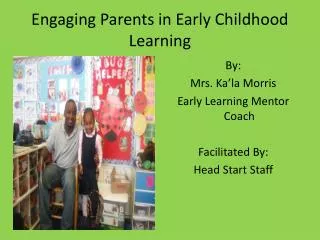
Engaging Parents in Early Childhood Learning By: Mrs. Ka’la Morris Early Learning Mentor Coach Facilitated By: Head Start Staff
Purpose To encourage our parents to actively support student learning by working with students at home to promote student development.
11 Focus Areas • Physical Development & Health • Social & Emotional Development • Approach to Learning • Language Development • Literacy Knowledge & Skills • Mathematics Knowledge & Skills • Science Knowledge & Skills • Creative Arts Expression • Logic & Reasoning • Social Studies Knowledge &Skills • English Language Development
Head Start Child Development and Early Learning Framework Wheel
Physical Health & Development • Demonstrates traveling skills- • Use movement to enhance stories, runs, avoids obstacles and people while moving, rides tricycle using petals, and walks up and down stairs using alternating feet • Demonstrates balancing skills • Hopping on one foot, walking on a low balance beam , and jumps over small objects • Demonstrates gross-motor manipulative skills- • Support activities that encourage throwing and catching skills, increase difficulty by having child to sit down, stand up, or while walking. • Demonstrates fine-motor strength and coordination- • Stringing large beads, pouring water into container, and turns knobs and open doors • Holding drawing or writing tool with three point finger grip
Social &Emotional Development • Regulates own emotions and behaviors • Manages feelings • Follows limits and expectations • Takes care of own needs appropriately • Establishes and sustains positive relationships • Forms relationships with adults • Responds to emotional cues • Interacts with peers • Makes friends • Participates cooperatively and constructively in group situations • Balances needs and rights of self and others • Solves social problems
Approaches to Learning(Cognitive Development) • Initiative and Curiosity • Encourage the use of imagination, flexibility, and inventiveness • Support eagerness to learning • Encourage questions • Persistence and Attentiveness • Support and encourage child’s ability to begin and finish activities. • Cooperation • Encourage cooperative play and modeling or teaching of peers.
Language Development • Listens to and understands increasingly complex language • Use language that is easy for the child to understand, explaining new vocabulary • Talk to the child face-to-face instead of speaking from across the room • Uses language to express thoughts and needs • Speak slowly and model correct grammar • Uses appropriate conversational and other communication skills • Build on the child’s language • Model conversational skills: taking turns, eye contact, speech volume, using polite words
Literacy Knowledge & Skill • Demonstrates phonological awareness • Play verbal rhyming games • Encourage children to listen to the sounds in their environment • Demonstrates knowledge of alphabet • Singing the alphabet song, slowly (L,M,N,O,P) • Teach child the letters in first name • Demonstrates knowledge of print and its uses • Point to signs(STOP) or M in McDonalds • Comprehends and responds to books and other texts • Read child's favorite book and retell story with the child’s assistance • Demonstrates emergent writing skills • Provide child with numerous writing materials • Support name writing
Math Knowledge & Skill • Uses number concepts and operations • Count objects or fingers with your child • Recite rhymes and songs about numbers • Explores and describes spatial relationships and shapes • Review shapes with child • Find shapes in child’s environment • Compares and measures • Compare sizes and shapes with child • Demonstrates knowledge of patterns • Display patterns and provide materials that allow child to expand the pattern
Science Knowledge & Skills • Model observation by showing curiosity of the things in the environment ( leaves changing with the seasons, weather change) • Connect new information with child’s prior knowledge • Provide opportunities for children to care for or observe living things and their life cycles • Use descriptive vocabulary such as: sink, float, melt, frozen. • Mix different materials in water to observe the outcome(TANG , koolaid, tea, hot cocoa, etc.)
Teacher giving students the opportunity to observe the inside of a pumpkin
Creative Arts Expression • Explore visual arts • Provide child with various materials to draw • Allow child to view different artistic media, pictures, paintings, and murals (Children’s Art Museum, Downtown Dothan) • Explore musical concepts and expression • Sing or listen to songs from many cultures • Play a variety of music(jazz, R&B, gospel, country, rock and roll) • Explores dance and movement concepts (IMIL) • Use vocabulary to express body movement (fast, slow, backwards, forwards, etc) • Explore drama through action and language • Allow child space and opportunity to act out stories
Logic & Reasoning The ability to think through problems and apply strategies for solving them. • Reasoning & Problem Solving • Help child to recognize cause and effect relationships. Example: “ The water turned to ice because we placed it in the freezer.” • Seek multiple solutions to a question, task, or problem • Symbolic Representation • Engages in pretend play and acts out roles • Explain the difference between fantasy situations and reality.
English Language Development • Receptive English Language Skills • Participates with movements and gestures while other teachers dance and sing in English • Responds or acknowledges nonverbally to common words or phrases, such as “hello” and “bathroom” • Expressive English Language Skills • Repeats words or phrases to self, such as “bus” while singing the “Wheels on the Bus” or “brush teeth” after lunch. • Request items in English, such as “car”, “book”, or “ball” • Engage in English Literacy Activities • Demonstrates eagerness to participate in songs, and rhymes and stories in English • Points to pictures and says word in English, such as “book”
Student at Play Student in Dramatic Play Center Student Counting
Social Studies Knowledge & Skills Understanding people and how they relate to others and the world around them. • Self, Family, and Community • Understands personal and family structure • Understands the reasons for rules at home, classroom, and for laws in the community • People and the Environment • Recognizes aspects of the environment, such as roads , buildings, trees, gardens, land formations, and bodies of water. • Recognizes that we share the environment • History and Events • Differentiates between past, present, and future • Recognizes events that happened in the past, such as family or personal history • Understands how people live and how they change over time
Resources • The Creative Curriculum for Preschool Volumes 1 - 5 • The Head Start Child Development and Early Learning Framework • The Head Start Preschool Curriculum Objectives • Pictures provided by Head Start Preschool Faculty and Staff