Feudalism
Feudalism. World History I. The Development of Feudalism. After Charlemagne’s death, the Carolingian Empire fell apart. Western Europe was subject to invasions by the Vikings and Magyars in the 9 th and 10 th centuries.

Feudalism
E N D
Presentation Transcript
Feudalism World History I
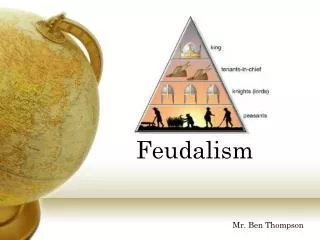
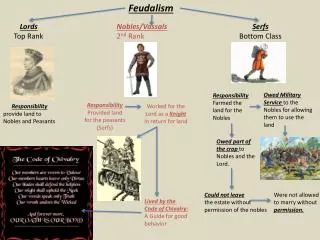
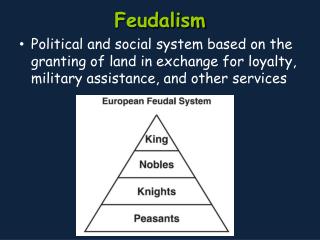
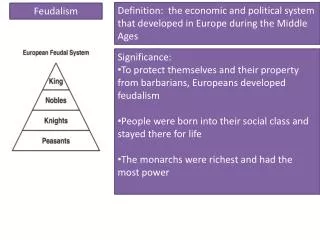
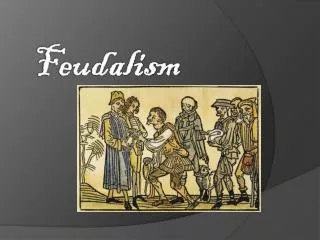
The Development of Feudalism • After Charlemagne’s death, the Carolingian Empire fell apart. • Western Europe was subject to invasions by the Vikings and Magyars in the 9th and 10th centuries. • Rulers found it difficult to protect their lands from invasions, leading to feudalism. • Feudalism was a political and social system where nobles offered land and protection in exchange for service.
Feudalism • The lord was a powerful landowner during this time. • Vassals, knights, and serfs were also very important to feudalism. • A vassal is someone who served the lord in a military capacity. • A knight was a member of a heavily armored cavalry. • A serf was a peasant legally bound to the land who was subject to the lord’s control.
The Feudal Contract • The feudal contract determined the relationship between the lord and his vassal. • It was typically an unwritten set of rules. • The Lord Would: • Grant the vassal land. • - This land was known as a fief. • Protect the vassal by: • Defending him militarily. • Taking his side in a court of law. The Vassal Would: Perform military service. Appear at the lord’s court to give advice if summoned. Make financial payments to the lord.
The Manorial System • Manorialism – part of feudalism, where lords give pieces of land to serfs in exchange for food. • A manor was an agricultural estate run by a lord and worked by peasants. • What was life like for a serf? • Very simple. • Lived in small wooden cottages. • Performed a year-round cycle of labor. • They did not face a life of constant labor. • They practiced Christianity. • Ate bread and drank water.
Nobility in the Middle Ages • Chivalry was a code of ethics that knights were supposed to uphold. • They were expected to defend the Church and defenseless people. • They were also to treat captives as honored guests. • Knights were also expected to fight only for glory, and not for material rewards. • Women mainly remained under the control of men during this time. • Women were responsible for managing the estate since the lord was often away at war or court.