CELLS & TISSUES Chapter 3 – Pgs. 42-59
340 likes | 485 Vues
This chapter delves into the fundamental aspects of cells and tissues, highlighting their diverse sizes, shapes, and functions. Key components include the cell membrane, cytoplasm, and nucleus, each playing crucial roles in cellular activities. The chapter explores various transport mechanisms such as passive transport, osmosis, and active transport, along with the processes of endocytosis and exocytosis. Additionally, it covers cell reproduction through mitosis and meiosis, and the essential processes of DNA and RNA in genetic information transfer, culminating in protein synthesis.


CELLS & TISSUES Chapter 3 – Pgs. 42-59
E N D
Presentation Transcript
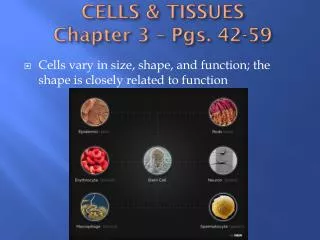
CELLS & TISSUESChapter 3 – Pgs. 42-59 • Cells vary in size, shape, and function; the shape is closely related to function
Composition of CellNucleus, Cytoplasm, Cell Mebrane • Cytoplasmic organelles perform specific function, but the nucleus controls the overall activities of the cell
Cell Membrane (fluid mosaic)Fig. 3-1 • forms outermost boundary • selectively permeable – controls movement of substances into and out of cells • mainly phospholipids but also includes proteins, & carbohydrates • molecules lipid soluble will pass easily; barrier to water soluble substances • proteins function as receptors or form channels
Cytoplasm is the area between nucleus and cell membrane, contains organelles – Fig. 3-2, Table 3-1, ***Know functions of each organelle***
Nucleus • Enclosed in double layered (pores) nuclear envelope that controls the movement of substances between the nucleus& cytoplasm • Nucleolus is a dense body of protein & RNA that functions in the production of ribosomes • Chromatin is composed of loosely coiled fibers of protein and DNA that condenses into the structures known as chromosomes during cell division
Movements through cell membranes Passive transport – no energy required, substances move from an area of high concentration to low concentration (concentration gradient) – Fig. 3-2 • diffusion - scattering of molecules or ions from high concentration to low concentration - responsible for the exchange of oxygen and carbon dioxide within the body - rate of diffusion can be increased by short distance, high concentration of diffusion molecules, low molecular weight, & high temperature • facilitated diffusion – carrier molecules (usually proteins) transport a substance from [high] to [low]
Osmosis – H2O molecules move from [high] to [low] through a selectively permeable membrane – (Clinical Application pg. 54) • isotonic – a solution that neither gains or loses H2O, has the same concentration of solutes as the solution with which it is being compared • hypertonic – a solution that gains H2O because it has a higher concentration of solutes than the solution with which it is being compared • hypotonic – a solution that loses H2O because it has a lower concentration of solutes than the solution with which it is being compared
Filtration – forced – movement of molecules from regions of higher hydrostatic pressure to lower hydrostatic pressure • blood pressure causes filtration of H2O & dissolved substances through porous capillary walls • urine formation – nephrons of kidney
Active Transport – requires energy (ATP) and involves the action of carrier molecules in the cell membrane; moves substance “up the concentration gradient”; from [low] to [high] – Table 3-3
Active Transport – requires energy (ATP) and involves the action of carrier molecules in the cell membrane; moves substance “up the concentration gradient”; from [low] to [high] – Table 3-3 • Permease (pump systems) – protein driven transport systems – Fig. 3-4 • Endocytosis – cells take in large molecules from their surrounding • Phagocytosis – large molecules, ex. – white blood cell engulfing bacteria • Pinocytosis – water and small molecules • Exocytosis – cells release materials
Cell Reproduction & Heredity • Mitosis – a parent cell divides once to produce two genetically identical daughter cells; daughter cells contain the same number of chromosomes as the parent cell; both are diploid in chromosome number (2n) • Meiosis – a parent cell divides twice to produce four cells (gametes) that contain a haploid (n) number of chromosomes; “male” & “female” gametes fuse at fertilization to produce a zygote (2n)
DNA & RNA carry genetic information • DNA – double helix, sugar is deoxyribose adenine (purine) – thymine (pyrimadine) guanine(purine) – cytosine (pyrimadine) • RNA – Single stranded, sugar is ribose, uracil (pyrimadine) replaces thymine • Gene – a segment of a chromosome that is made up of specific base pairs and codes for proteins
Protein Synthesis • transcription – synthesis of RNA using a DNA template • translation – the assembly of amino acids to form a polypeptide chain, in a sequence specified by the order of nucleotide in a molecule of mRNA
Cell Cycle – Interphase and Mitotic Phase (mitosis & cytokinesis) – Fig. 3-6 • Interphase – cell grows and “does its specific job”, chromosomes are replicated (duplicated) during this phase • Mitosis – division of the chromosomes – Table 3-5 **Know** • Cytokinesis – division of the cytoplasm