Modeling Wind Speed as a Random Variable Through a Random Experiment
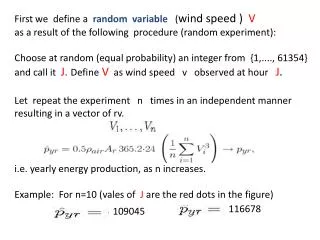
This document outlines a method to define a random variable, specifically wind speed, as a result of a random experiment. The experiment involves randomly selecting an integer from the set {1,...,61354} and assigning it as the hour J, during which the wind speed V is measured. By repeating this process n times, we create a vector of random variables representing yearly energy production. For instance, with n=10, specific values of J correspond to observed wind speeds, depicted as red dots in the accompanying figure.

Modeling Wind Speed as a Random Variable Through a Random Experiment
E N D
Presentation Transcript
First we define a random variable (wind speed ) V as a result of the following procedure (random experiment): Choose at random (equal probability) an integer from {1,...., 61354} and call it J.DefineV as wind speed v observed at hour J. Let repeat the experiment n times in an independent manner resulting in a vector of rv. i.e. yearly energy production, as n increases. Example: For n=10 (vales of J are the red dots in the figure) • 116678 109045