Advancements in Optical Interconnections for Enhanced Circuit Communication
90 likes | 209 Vues
This overview discusses the fundamentals of optical interconnections in circuit communication, emphasizing their reliance on laser sources and optical waveguides made from silicon or specialized polymers. Silicon waveguides are narrower but slower, while polymer waveguides offer wider and faster performance. The comparison highlights power consumption, latency, and bandwidth density, indicating that optical connections outperform traditional electrical connections in latency over long distances. Key challenges include cost, power, and complexity in off-board laser requirements. References to significant research papers are included.


Advancements in Optical Interconnections for Enhanced Circuit Communication
E N D
Presentation Transcript
Optical Interconnections for Circuit Communication Robert Knight
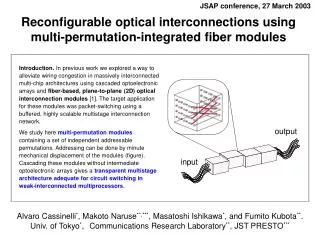
Optical Interconnect Basics • Requires Laser source for all chips • Signals travel on optical waveguides – can be made of Si or special polymers.
Waveguides • Si waveguide • Consumes Si resources • Refractive index ~ 3.5 • Narrower but Slower • Polymer waveguide • Requires additional layer • Refractive index ~ 1.4 • Wider and Faster
Performance Comparison: Power • Traditional Electrical connections consume less power at small distances.
Performance Comparison: Latency • Optical connections are again clearly superior for longer lines. • Offer improved performance for smaller chips.
Limitations • Cost • Power • Off board LASER requirement • 90° angles difficult
References • Guoquing, Chen et. Al. Predictions of CMOS Compatible On-Chip Optical Interconnect. SLIP Conference. April 2, 2005. • Hashim, A. et. Al. Cost-effective 10 Gb/s polymer-based chip-to-chip optical interconnect. IET Optoelectronics. 11th January 2012. • Koo, Kyung-Hoae et. Al. Performance Comparisons Between Carbon Nanotubes, Optical, and Cu for Future High-Performance On-Chip Interconnect Applications. Ieee Transactions On Electron Devices, VOL. 54, NO. 12. December 2007.