Understanding Exponents and Solving Equations: Key Concepts and Examples
This comprehensive guide covers essential topics in exponents, including zero and negative exponent properties, the laws of exponents, and how to simplify expressions involving powers. It also addresses solving linear equations, providing step-by-step examples for clarity. From evaluating expressions with known variables to applying the quotient and product rules, this resource aims to enhance your understanding of mathematics. Perfect for students preparing for quizzes and exams, it offers the knowledge needed to tackle a variety of mathematical problems effectively.

Understanding Exponents and Solving Equations: Key Concepts and Examples
E N D
Presentation Transcript
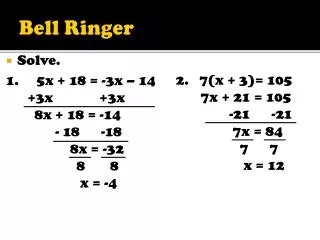
Bell Ringer • Solve. 1. 5x + 18 = -3x – 14 +3x +3x 8x + 18 = -14 - 18 -18 8x = -32 8 8 x = -4 2. 7(x + 3)= 105 7x + 21 = 105 -21 -21 7x = 84 7 7 x = 12
Quiz Results • Since there are still a few who haven’t taken the quiz, I’ll give out the results as soon as they do. • If you want to know your grade, log onto your Gradebook and check it yourself. • Otherwise, you’ll have to wait… • NO, I’m not digging through the papers to tell you your grade.
NCP 503: Work with numerical factors NCP 505: Work with squares and square roots of numbers NCP 506: Work problems involving positive integer exponents* NCP 504: Work with scientific notation NCP 507: Work with cubes and cube roots of numbers NCP 604: Apply rules of exponents Exponents and Radicals
Basic Terminology Exponent 34 = 3•3•3•3 = 81 Its read, “Three to the fourth power.” Base The base is multiplied by itself the same number of times as the exponent calls for.
Important Examples -34 = –(3•3•3•3) = -81 (-3)4 = (-3)•(-3)•(-3)•(-3) = 81 -33 = –(3•3•3) = -27 (-3)3 = (-3)•(-3)•(-3) = -27
Variable Expressions x4 = x • x • x • x y3 = y • y • y Evaluate each expression if x = 2 and y = 5 x4y2 = 400 = (2•2•2•2)•(5•5) 3xy3 = 750 = 3•2•(5•5•5)
Laws of Exponents, Pt. I Zero Exponent PropertyNegative Exponent PropertyProduct of PowersQuotient of Powers
Zero Exponent Property Any number or variable raised to the zero power is 1. x0 = 1 y0 = 1 z0 = 1 70 = 1 -540 = 1 1230 = 1
Negative Exponent Any number raised to a negative exponent is the reciprocal of the number. x-1 = y-1 = 5-1 = x-2 = 3-2 = = 5-3 = = 1 5 1 X 1 y 1 X2 1 53 1 32 1 9 1 . 125
Negative Exponent 3x-3 = 5y-2 = 2x-2y2= 3-2 x4= 5 y2 3 x3 Only x is raised to the -3 power! 2y2 x2 x4 32 x4 9 = Only x is on the bottom.
Product of Powers This property is used to combine 2 or more exponential expressions with the SAME base. Multiplication NOT Addition! 53•52 = (5•5•5)•(5•5) = 55 x4•x3 = (x•x•x•x)•(x•x•x) = x7 If the bases are the same, add the exponent!
Product of Powers Product of powers also work with negative exponents! 1 62•63 1 7776 1 65 = = 6-2•6-3 = 1 x5•x7 1 x12 = x-5•x-7 = n-3•n5 = n-3+5 = n2
Quotient of Powers This property is used when dividing two or more exponential expressions with the same base. x6 x3 = x6-3 = x3 Subtract the exponents! (Top minus the bottom!)
Quotient of Powers 67 65 = 36 = 67-5 = 62 x3 x5 1 x2 = x3-5 = x-2 = OR x3 x5 x ∙ x ∙ x x∙x∙x∙x∙x 1 x2 = =
Power of a Power Power of a Product Power of a Quotient Laws of Exponents, Pt. II
Power of a Power This property is used to write an exponential expression as a single power of the base. (63)4 = 63•63•63•63 = 612 (x5)3 = x5•x5•x5 = x15 When you have an exponent raised to an exponent, multiply the exponents!
Power of a Power Multiply the exponents! = 532 (54)8 = n12 (n3)4 = 36 (3-2)-3 1 x15 = = x-15 (x5)-3
Power of a Product Power of a Product – Distribute the exponent on the outside of the parentheses to all of the terms inside of the parentheses. (xy)3 (2x)5 = x3y3 = 25 ∙ x5 =32x5 (xyz)4 = x4 y4 z4
Power of a Product More examples… (x3y2)3 (3x2)4 = x9y6 = 34 ∙ x8 =81x8 • (3xy)2 • = 32∙ x2 ∙ y2 =9x2y2
Power of a Quotient Power of a Quotient – Distribute the exponent on the outside of the parentheses to the numerator and the denominator of the fraction. ) ( ) ( x y x5 y5 5 =
Power of a Quotient More examples… ) ( ) ( 2 x 8 x3 23 x3 3 = = ) ( ( ) 3 x2y 34 x8y4 4 81 x8y4 = =