Understanding the Central Limit Theorem and Sampling Distribution of the Mean
130 likes | 248 Vues
This lesson focuses on the Central Limit Theorem (CLT), which states that as sample size increases, the sampling distribution of the sample mean approaches a normal distribution, regardless of the population's distribution. The relationship between sample size, population mean, and standard deviation is explored, emphasizing that larger samples reduce the variation of sample means. Exercises involve generating random numbers and analyzing the normality of sample means, alongside practical examples related to manufacturing processes to illustrate these statistical concepts.


Understanding the Central Limit Theorem and Sampling Distribution of the Mean
E N D
Presentation Transcript
LESSON 13: SAMPLING DISTRIBUTION Outline • Central Limit Theorem • Sampling Distribution of Mean
CENTRAL LIMIT THEOREM Central Limit Theorem: If a random sample is drawn from any population, the sampling distribution of the sample mean is approximately normal for a sufficiently large sample size. The larger the sample size, the more closely the sampling distribution of will resemble a normal distribution.
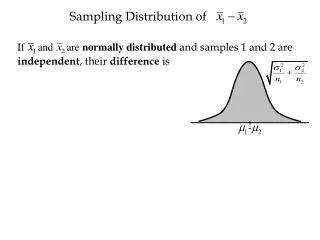
SAMPLING DISTRIBUTION OF THE SAMPLE MEAN • If the sample size increases, the variation of the sample mean decreases. • Where, = Population mean = Population standard deviation = Sample size = Mean of the sample means = Standard deviation of the sample means
SAMPLING DISTRIBUTION OF THE SAMPLE MEAN • Summary: For any general distribution with mean and standard deviation • The distribution of mean of a sample of size can be approximated by a normal distribution with • Exercise: Generate 1000 random numbers uniformly distributed between 0 and 1. Consider 200 samples of size 5 each. Compute the sample means. Check if the histogram of sample means is normally distributed and mean and standard deviation follow the above rules.
SAMPLING DISTRIBUTION OF THE SAMPLE MEAN Example 1: An automatic machine in a manufacturing process requires an important sub-component. The lengths of the sub-component are normally distributed with a mean, =120 cm and standard deviation, =5 cm. What does the central limit theorem say about the sampling distribution of the mean if samples of size 4 are drawn from this population?
SAMPLING DISTRIBUTION OF THE SAMPLE MEAN Example 2: An automatic machine in a manufacturing process requires an important sub-component. The lengths of the sub-component are normally distributed with a mean, =120 cm and standard deviation, =5 cm. Find the probability that one randomly selected unit has a length greater than 123 cm.
SAMPLING DISTRIBUTION OF THE SAMPLE MEAN Example 3: An automatic machine in a manufacturing process requires an important sub-component. The lengths of the sub-component are normally distributed with a mean, =120 cm and standard deviation, =5 cm. Find the probability that, if four units are randomly selected, their mean length exceeds 123 cm.
SAMPLING DISTRIBUTION OF THE SAMPLE MEAN Example 4: An automatic machine in a manufacturing process requires an important sub-component. The lengths of the sub-component are normally distributed with a mean, =120 cm and standard deviation, =5 cm. Find the probability that, if four units are randomly selected, all four have lengths that exceed 123 cm.
CORRECTION FOR SMALL SAMPLE SIZE • For a small, finite population N, the formula for the standard deviation of sampling mean is corrected as follows:
READING AND EXERCISES Lesson 13 Reading: Sections 8-1, 8-2, 8-3, pp. 260-276 Exercises: 9-3,9-4, 9-8, 9-17, 9-19