Understanding Fossils: Insights into Ancient Life and Evolution
This lesson plan explores the significance of fossils in understanding ancient organisms and their environments. Students will learn what paleontologists can uncover from the fossil record, including evidence of animal behavior, size, and evolutionary changes. Key topics include trace fossils, preserved remains, and the processes of fossilization. Activities include watching an educational video related to Earth Day and writing prompts on animal adaptation due to human influence. This engaging agenda encourages critical thinking about geological history and the evolution of life on Earth.

Understanding Fossils: Insights into Ancient Life and Evolution
E N D
Presentation Transcript
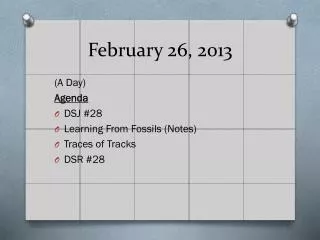
February 26, 2013 (A Day) Agenda • DSJ #28 • Learning From Fossils (Notes) • Traces of Tracks • DSR #28
February 27, 2013 (B Day) Agenda • DSJ #28 • Learning From Fossils (Notes) • Traces of Tracks • DSR #28
DSJ #28 • Science Notebook – 55B • Watch this video “Earth Day” www.teachhub.com/earth-day-video-writing-prompts • Prompt: The polar bear and her cub left Spy Island because of the new oil rig. In 5 sentences or more, write at least 5 other ways animals have had to adapt because of humans.
Learning Objective Students will explain what scientists learn from fossils.
Trace Fossils • Trace fossils provide evidence of the activities of ancient organisms.
Trace Fossils • Trace fossils provide evidence of the activities of ancient organisms. • 10. Examples of trace fossils are footprints, animal trails, and burrows.
Trace Fossils • 11. Trace fossils, such as fossilized footprints, are useful to scientists because they can find answers to questions about an animal’s size and behavior.
Preserved Remains • Some processes preserve the remains of organisms with little or no change.
Preserved Remains • Some processes preserve the remains of organisms with little or no change. • 12. Three ways that organisms have been preserved are:
Preserved Remains • Some processes preserve the remains of organisms with little or no change. • 12. Three ways that organisms have been preserved are: • Trapped in tar
Preserved Remains • Some processes preserve the remains of organisms with little or no change. • 12. Three ways that organisms have been preserved are: • Trapped in tar • Preserved in amber (fossilized tree sap)
Preserved Remains • Some processes preserve the remains of organisms with little or no change. • 12. Three ways that organisms have been preserved are: • Trapped in tar • Preserved in amber (fossilized tree sap) • Being frozen
Learning From Fossils • 13. Scientists who study fossils are called paleontologists.
Learning from Fossils • 14.) All the information that paleontologists have gathered about past life is called the fossil record.
Learning From Fossils • 15. a. b. c. d. • The fossil record provides evidence about the history of life and past environments on Earth. • The fossil record shows that life on Earth has changed over time. • It reveals that simpler organisms have given rise to complex organisms. • It supports the theory of evolution.
Learning From Fossils • 16. Paleontologists use fossils to build up a picture of Earth’s past environments. Fossils can show how an environment has changed. Scientists can use fossils to learn about changes in Earth’s surface. False
Learning From Fossils • Scientists also study fossils to try to determine the rate at which evolution occurs. • 17. One hypothesis, called gradualism proposes that evolution occurs slowly but steadily.
Learning From Fossils • The fossil record, however, is incomplete. There are sometimes long periods when fossils show little or no change.
Learning From Fossils • The fossil record, however, is incomplete. There are sometimes long periods when fossils show little or no change. • 18. The hypothesis of punctuated equilibriaaccounts for the gaps in the fossil record. According to this hypothesis, species evolve quickly during relatively short periods.
Learning From Fossils • 19. Today, most scientists think that evolution can occur gradually at some times and more rapidly at others.
Glue in SNB **Please remember to use only TWO drops of glue!!** If everyone uses only TWO drops, a lot of glue is saved over time…. • 55A – Learning From Fossils (Notes)
Traces of Tracks • Read the paragraph at the top of the page and analyze the picture. • Answer the questions on a separate piece of paper. • You do not have to copy the questions. • Write your answer in complete sentences. • Turn your answers in to the teacher.
DSR #28 • Science Notebook – 55B (Under DSJ #28) • Prompt: What are paleontologists? What can they learn from the fossil record? Why do they study the fossil record?