Understanding Diversity and Citizenship in the U.S.
This overview explores key concepts of diversity, citizenship, and the responsibilities of American citizens. It highlights terms such as "E Pluribus Unum," the Melting Pot Theory, and Multiculturalism (Tossed Salad Theory). It emphasizes the importance of civil rights, participation in democracy, and the conflicts between legal and moral responsibilities. Additionally, it discusses challenges like discrimination and the needs of citizens in a diverse society. Finally, it urges active engagement in community and political life, reinforcing the essence of self-determination.

Understanding Diversity and Citizenship in the U.S.
E N D
Presentation Transcript
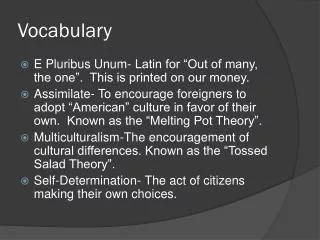
Vocabulary • E Pluribus Unum- Latin for “Out of many, the one”. This is printed on our money. • Assimilate- To encourage foreigners to adopt “American” culture in favor of their own. Known as the “Melting Pot Theory”. • Multiculturalism-The encouragement of cultural differences. Known as the “Tossed Salad Theory”. • Self-Determination- The act of citizens making their own choices.
Warm-up? • What is diversity?
The right to a trail by jury for a criminal defendant is guaranteed under which amendment? • 1st • 6th • 7th • 9th • Voting, volunteering to help with a campaign, and running for county commissioner are all examples of what? • Participation in the judicial system • Participation in the political process • Participation in political protests • Costs of public service
Citizen Responsibilities • In addition to civic responsibilities & duties (voting, taxes) citizens have other obligations that must be met. • All of these responsibilities take time, money and often conflict
Personal Responsibilities • Responsibilities one has to oneself (family, job) • Fiscal Responsibilities • Financially supporting one’s family or saving for college • Legal Responsibilities • Obeying the law • Moral Responsibilities • Following religious beliefs or keeping a promise
Legal vs. Moral Responsibilities • These responsibilities can often conflict • Civil Rights Movement of the 1950’s & 60’s • Black & White citizens had to choose between obeying segregation or opposing racist policies
Diversity • The US is made up of people of many different cultures. • E Pluribus Unum • Latin phrase that means “from many, the one” • Found on many of our nations seals
Conflicting Theories • Melting Pot Theory • US society is best served when people abandon their cultural differences • A more unified society will be created when people assimilate • Become like mainstream US society
Tossed Salad Theory • US society benefits when people keep their cultural identities • Referred to as multiculturalism because it encourages cultural differences rather than assimilation • People who believe in these theories often disagree over issues such as immigration, affirmative action and bilingual education
Problems with Diversity • Racism • Discriminating against people because of their race • Sexism • Unfair treatment based on gender • Ageism • Discrimination based on age • Bias • Feelings for or against something
Negative Stereotypes • Pre-judgments about people based on a person’s race or nationality • Other forms of Discrimination: • Religious differences • Physical appearance • Disabilities
Other Public Problems • Unemployment • Underemployment education • Poverty and homelessness • Substance abuse • Law and order • Disease • Immigration • National Security
Natural Disasters • Pollution • “greenhouse effect” and global warming • Acid Rain • Waste Disposal • Taxation • Graft and political corruption
Needs of Citizens • Many conflicts that arise in the US are because of insufficient resources • Income, heath care and gas • Social Security • Program that pays income to retired people over 65 • “Baby Boomer” and the “graying population” • Baby Boomers are nearing retirement and improvements in medical tech. enable people to live longer
Characteristics of Effective Citizenship • Informed Electorate • Citizens who take the time to learn about issues that are causing problems and are willing to seek solutions. • Voluntary Compliance • Complying with laws of society to maintain order • Community Spirit • Perform community service or donate to a charity • Respecting Others Rights • Respect others individual and property rights • Treating other citizens who choose to live/believe differently practice Tolerance
Benefits/Consequences of Freedom • The ability of citizens to make their own choices is self-determination • Self-determination is a product of Liberty • Citizens are free to make their own economic and political choices • After taxes are paid citizens may choose how to spend and invest their money • Because of this economic freedom citizens are not confined to one socio-economic status • Citizens are also free to join a political party and engage in political activism
Costs of Freedom • Being able to make one’s own choices also means bearing the responsibility of one’s mistakes • Handling economic losses • Ex: Losing $ in the stock market • Political Freedom means taking time to become informed and being responsible for who is elected to office
REFLECTIONS • WHAT ARE SOME EXAMPLES OF PERSONAL RESPONSIBILITIES? • WHAT ARE HISTORICAL EXAMPLES OF CONFLICT CREATED BETWEEN OUR LEGAL AND MORAL RESPONSIBILITIES? • SUMMARIZE THE DIFFERENCE B/W MELTING POT AND TOSSED SALAD THEORIES • WHAT ARE SOME OF THE PROBLEMS WITHIN DIVERSITY? • WHAT ARE EXAMPLES OF PUBLIC PROBLEMS? • HOW HAS THE BABY BOOMER GENERATION AND THE “GRAYING OF AMERICA” IMPACTED SOCIAL SECURITY? • WHAT ARE CHARACTERISTICS OF EFFECTIVE CITIZENSHIP? • WHAT ARE THE BENEFITS AND CONSEQUENCES OF FREEDOM?
Closing? • What is the difference between citizen responsibilities and citizen duties? Give an example of each.