Developing a Wireless Sensor System for NASA’s Thermal Protection Systems
This project addresses the critical need for a wireless sensor system to be integrated into the thermal protection systems (TPS) of NASA's entry vehicles. The absence of sensors in TPS due to wiring complications poses challenges for accurately modeling re-entry conditions. Our solution utilizes a multi-nodal wireless architecture, enabling multiple sensor types on each node. Testing was conducted at the X-Jet Facility, simulating extreme re-entry environments. The developed system offers real-time data monitoring and has undergone multiple revisions for optimization.

Developing a Wireless Sensor System for NASA’s Thermal Protection Systems
E N D
Presentation Transcript
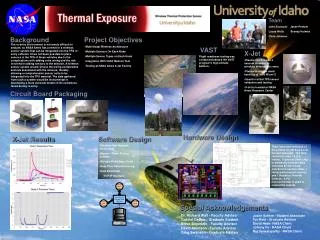
Team Background Project Objectives Special Acknowledgements Hardware Design VAST X-Jet Circuit Board Packaging X-Jet Results Justin Schlee - Student Associate Tye Reid - Graduate Advisor David Hash- NASA Client Johnny Fu - NASA Client Raj Venkatapathy - NASA Client Dr. Richard Wall - Faculty Advisor Gabriel DeRue - Graduate Student Steve Beyerlein - Faculty Advisor David Atkinson - Faculty Advisor Greg Swanson - Graduate Advisor John Sochacki Jesse Pentzer Lucas Wells Brandy Holmes Chris Johnson The re-entry environment is extremely difficult to analyze, so NASA Ames has a need for a wireless sensor system that can be integrated into the TPS of entry vehicles. It has not been possible to place sensors in the TPS of these vehicles due to the complications with adding extra wiring and the risk involved in adding sensors to the mission. A wireless sensor system would remove the wiring complexities and risk associated with the sensors, thereby allowing a comprehensive sensor suite to be integrated into the TPS material. The data gathered from such a system would be instrumental in developing a more accurate model of the conditions faced during re-entry. • Multi-Nodal Wireless Architecture • Multiple Sensors On Each Node • Multiple Sensor Types on Each Node • Integration With VAST Balloon Test • Testing at NASA Ames X-Jet Facility • Plasma Torch inside a vacuum chamber to simulate atmospheric entry • Plasma torch can reach heat flux of 1000 W/cm^2 • Used for initial TPS sensor validation and testing • X-Jet is located at NASA Ames Research Center Flight readiness testing was conducted aboard the VAST program’s high altitude balloon. Software Design • Wireless Star Network Technology • Master – Slave Polling Scheme • Multiple Point Data Check • Real-Time Data Monitoring • Data Download • TCP/IP Interface There were two revisions of the printed circuit board over the last semester. The final revision is only 1.5 X 2 inches. It uses an Xbee chip to wirelessly transmit data collected by the 3 Cold Junction Correction chips, 1 Honeywell pressure sensor, and 1 Resistive Thermal Detector. A PIC microcontroller is used to control the system.