
SlideServe
Menu
Préférences
© SlideServe · v2026

Lecture 14: Einstein Summation Convention

kiri avatar
7 diapositives · 2.1K Views · Jul 05, 2012

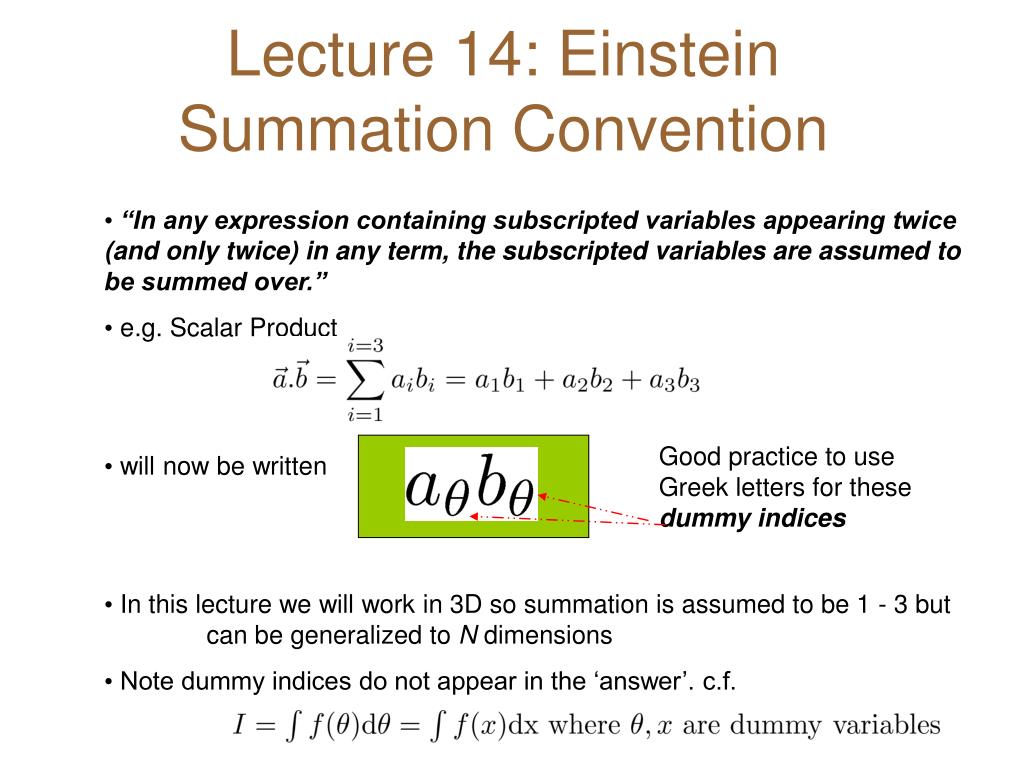
Lecture 14: Einstein Summation Convention . “In any expression containing subscripted variables appearing twice (and only twice) in any term, the subscripted variables are assumed to be summed over.” e.g. Scalar Product will now be written
Lecture 14: Einstein Summation Convention - slide 1
01 / 7Lecture 14: Einstein Summation Convention
1 / 17

Télécharger la présentation

Lecture 14: Einstein Summation Convention
Une image / un lien ci-dessous est fourni (tel quel) pour télécharger la présentation

Politique de téléchargement : le contenu du site vous est fourni TEL QUEL pour votre information et votre usage personnel ; il ne peut être vendu, concédé sous licence ni partagé sur d’autres sites sans l’accord de son auteur.Le contenu vous est fourni TEL QUEL, pour votre information et votre usage personnel uniquement. Téléchargez la présentation en cliquant sur ce lien. Lors du téléchargement, si vous ne parvenez pas à télécharger une présentation, l’éditeur a peut-être supprimé le fichier de son serveur.Pendant le téléchargement, si vous ne parvenez pas à obtenir une présentation, le fichier a peut-être été supprimé par l’éditeur.

F I N

Plus de contenu associé

Transcription de la présentation
  1. Lecture 14: Einstein Summation Convention • “In any expression containing subscripted variables appearing twice (and only twice) in any term, the subscripted variables are assumed to be summed over.” • e.g. Scalar Product • will now be written • In this lecture we will work in 3D so summation is assumed to be 1 - 3 but can be generalized to N dimensions • Note dummy indices do not appear in the ‘answer’. c.f. Good practice to use Greek letters for these dummy indices

  2. Examples • Total Differential becomes where and ‘free index’ runs from 1-3 here (or 1-N in and N-dimensional case) • Matrix multiplication Note the same 2 free indices on each side of the equation

  3. Trace of a matrix • Vector Product need to define “alternating tensor” 21 cases of zero! 3 cases 3 cases then (it’s not that hard, honest!)

  4. There is a “simple” relation between the alternating tensor and the Kronecker delta • The proof is simply the evaluation of all 81 cases! (although symmetry arguments can make this easier). • If you can get the hang of this, this provides the fastest and most reliable method of proving vector identities • Once written down in this form, the order of the terms only matters if they include differential operators (which only act on things to the right- hand-side of them).

  5. Example (ABACAB) rotating indices cyclically doesn’t change sign -th component of • Which constitutes a compact proof of the (hopefully familiar) “ABACAB” formula • Note we have made much use of the ‘obvious’ identity ß

  6. Further Examples • curl (grad) because this term is anti-symmetric (changes sign if  and  are swopped) but this term symmetric (stays same if  and  are swopped) so terms ‘cancel in pairs’ • div (curl) • Trace of the unit matrix as above

  7. Final Example QED • It’s not as hard as it first looks!