The Great American Melting Pot: Immigration and Urbanization in Early 20th Century America
In the late 19th and early 20th centuries, America became a melting pot as approximately 18 million immigrants arrived, mainly from Southern and Eastern Europe. These new arrivals enriched the nation's cultural diversity, bringing various religious backgrounds. However, anti-immigrant sentiments grew, leading to calls for Americanization and literacy tests. Urbanization surged as many sought jobs in cities, sparking challenges like inadequate housing, sanitation issues, and crime. Reform movements emerged, aiming to improve living conditions, notably through pioneers like Jane Addams and the Hull House.

The Great American Melting Pot: Immigration and Urbanization in Early 20th Century America
E N D
Presentation Transcript
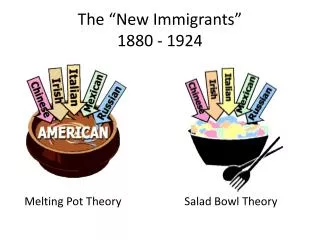
A Melting Pot • Many native-born Americans thought of their country as a melting pot – a mixture of people of different cultures and races who blended together to create one country. • Video: The Great American Melting Pot • However, many immigrants did not want to give up their own culture. • As immigration increased, strong anti-immigrant feelings emerged
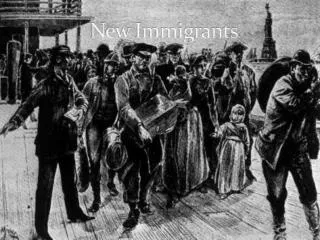
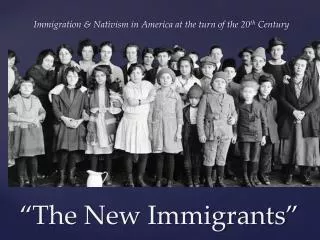
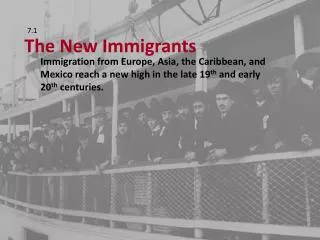
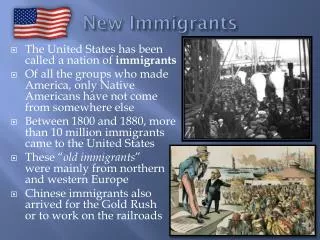
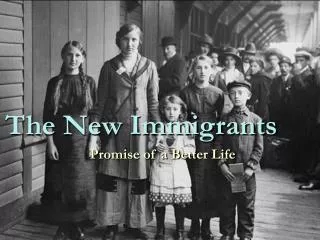
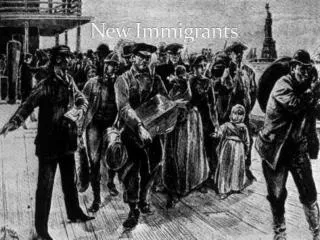
Coming to America • From 1880-1910 approximately 18 million immigrants came to the United States • Most came from southern and eastern Europe including Greece, Italy, Poland, and Russia • These new immigrants brought more religious diversity to the United States: Roman Catholics, Greek Orthodox, Russian Orthodox, and Jewish • By 1910 1 in every 7 Americans was foreign born
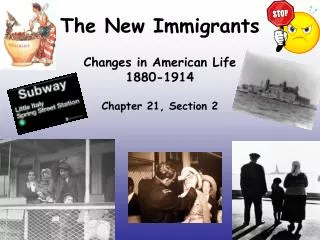
Coming to America • In 1892 the U.S. opened an immigration station on Ellis Island in New York City • Over the next 62 years 12 million Europeans passed through Ellis Island • Immigrants from Asia passed through a similar point at Angel Island in San Francisco • Many immigrants lived in crowded tenements and took low paying, unskilled jobs. • Many immigrants settled in areas with people from their same country of origin – Chinatown, Little Italy, etc.
Reactions to Immigrants • Nativists – Americans who blamed immigrants for increases in crime and poverty and believed immigrants were taking American jobs • Some nativists called for immigrants to pass a literacy test in order to vote • Americanization – a process in which native-born Americans attempted to help new immigrants assimilate into American society. • Schools and organizations taught literacy skills and other subjects needed for citizenship
Urban Life in America • Many immigrants, and other Americans, moved to large cities in the early 1900’s • They came to the cities looking for jobs in growing factories and businesses • This resulted in a growth of urbanization • Urbanization – the growth of cities and urban areas • Due to an increase in technology many farm workers lost their jobs and moved to the cities to find work. • Many of those workers were African-American. • Between 1890 and 1910 about 200,000 African-Americans moved from the South to cities in the North.
Urban Challenges • 1) A Shortage in housing • Many people lived in tenements – urban houses that housed many families and were overcrowded and unsanitary
Urban Challenges • 2) Transportation Challenges • During this time many cities developed mass transit systems – transportation designed to move a large number of people along fixed routes (subways, railcars, etc.)
Urban Challenges • 3) Providing safe drinking water • Some cities built public waterworks but many city residents still had no easy way to get clean water • 4) Sanitation • People threw garbage out their windows • Sewage flowed in the streets • By 1900 many cities had built sewers and created sanitation departments to fix these problems.
Urban Challenges • 5) Crime • Big cities were full of robberies, murder, and other crimes. • 6) Fire • Overcrowded and poorly built tenements and lack of water made the risk of fire great.
Reformers Help • Many people worked to improve life in the cities. • One early program was the Social Gospel Movement – movement that urged people to help the poor • Reformers also established settlement houses – community centers that addressed problems in slum neighborhoods
Reformers Help • One of the most well known social reformers of this time was Jane Addams • She helped establish the Hull House – a settlement house that helped the poor of Chicago.