Mitochondrial Oxidative Phosphorilation and Genetics
100 likes | 223 Vues
This presentation delves into the crucial role of mitochondria in energy production through oxidative phosphorylation, accounting for approximately 90% of ATP in eukaryotic cells. It explores the complex protein chains involved in electron transport and ATP generation, the unique mitochondrial genetic system, and how mitochondrial DNA is inherited. The implications of mitochondrial mutations, as well as the phenomena of homoplasmy and heteroplasmy, are discussed, emphasizing their impact on energy metabolism and disease inheritance patterns commonly passed through maternal lines.


Mitochondrial Oxidative Phosphorilation and Genetics
E N D
Presentation Transcript
Mitochondrial Oxidative Phosphorilation and Genetics Abigail Hardy
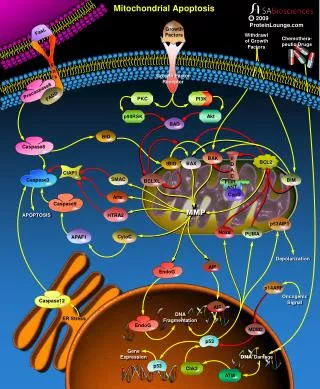
The Mitochondria • Thousands of mitochondria in high energy areas • Contact sites facilitate the entry of protiens into matrix • Produces ~90% of the cellular ATP in eukaryotic cells
Complexes I to IV, in addition to other components, act together as an electron transport chain Protons in intermembrane space form an electrochemical gradient, which provides potential energy used by complex V for the phosphorylation of ADP to ATP. Membrane channel protien (ANT) transports ATP out and ADP into matrix 1:1 ratio of transfer Both ADP and ATP move freely through the outer membrane Oxidative Phosphorylation
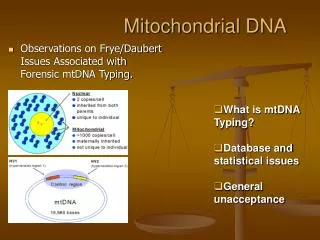
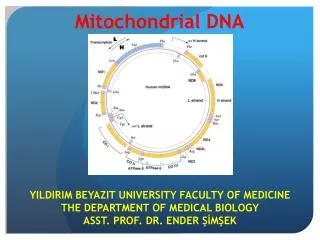
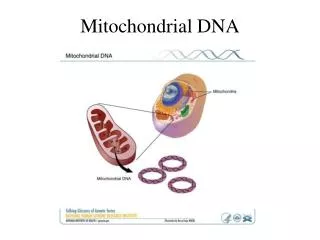
Mitochondria have their own genetic apparatus Circular (16,568 bp) 2-10 separate mitochondrial gemomes in matrix Carries information for: 2 rRNAs 22 tRNAs 13 proteins The 13 proteins encoded are involved in OXPHOS functions Nuclear genes encode about 70 additional protiens that make up the OXPHOS system A mitochondrion is the joint product of two different genetic systems Mitochondrial DNA
Mitochondrial Replication • During mitochondrial multiplication each genome is randomly distributed to a daughter mitochondrion • Does NOT follow the Mendelian pattern of inheritance b/c not part of chromosomal system • Details of mitochondrial reproduction are not known
Mitochondrial Genetics • Mitochondria of the zygote come from the oocyte (mother) and almost never the sperm (father) • If the same set of symptoms in a number of various multigenerational families is inherited only from affected females and almost never from affected males, then there is a strong likelihood that it is caused by a mutation in one of the mitochondrial DNA genes
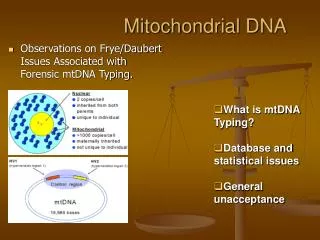
Human oocyte loses mitochondria as it matures through the genetic bottleneck Mitochondria are randomly distributed into daughter cells Mitochondrial Mutation Load= the ratio of mutated to normal mitochondrial DNA Homoplasmy= all mitochondria of a cell or tissue have the same genome Heteroplasmy= contains both mutant and wild-type genomes Proportion of mutant to wild-type M. DNA determines if energy shortage occurs Threshold for phenotypic expression Oocyte Mitochondria
Bibliography • Widmaier, E.P., Raff, H., Strang, K.T. Vander’s Human Physiology: The Mechanisms of Body Function. 10th ed. Boston: McGraw-Hill, 2005. • www.cbs.dtu.dk/staff/ dave/roanoke/bio101ch06.htm