Explore the intricate network of blood vessels in the cardiovascular system and learn about the functions and structure of the heart. Discover how diffusion and circulation of blood play a crucial role in maintaining cardiovascular health. Gain knowledge about common conditions such as atherosclerosis and hypertension, and understand the importance of maintaining a healthy lifestyle.
The Body's Transport System: A Closer Look At Blood Vessels
Une image / un lien ci-dessous est fourni (tel quel) pour télécharger la présentation
Politique de téléchargement : le contenu du site vous est fourni TEL QUEL pour votre information et votre usage personnel ; il ne peut être vendu, concédé sous licence ni partagé sur d’autres sites sans l’accord de son auteur.Le contenu vous est fourni TEL QUEL, pour votre information et votre usage personnel uniquement.Téléchargez la présentation en cliquant sur ce lien.Lors du téléchargement, si vous ne parvenez pas à télécharger une présentation, l’éditeur a peut-être supprimé le fichier de son serveur.Pendant le téléchargement, si vous ne parvenez pas à obtenir une présentation, le fichier a peut-être été supprimé par l’éditeur.
F I N
Plus de contenu associé
Transcription de la présentation
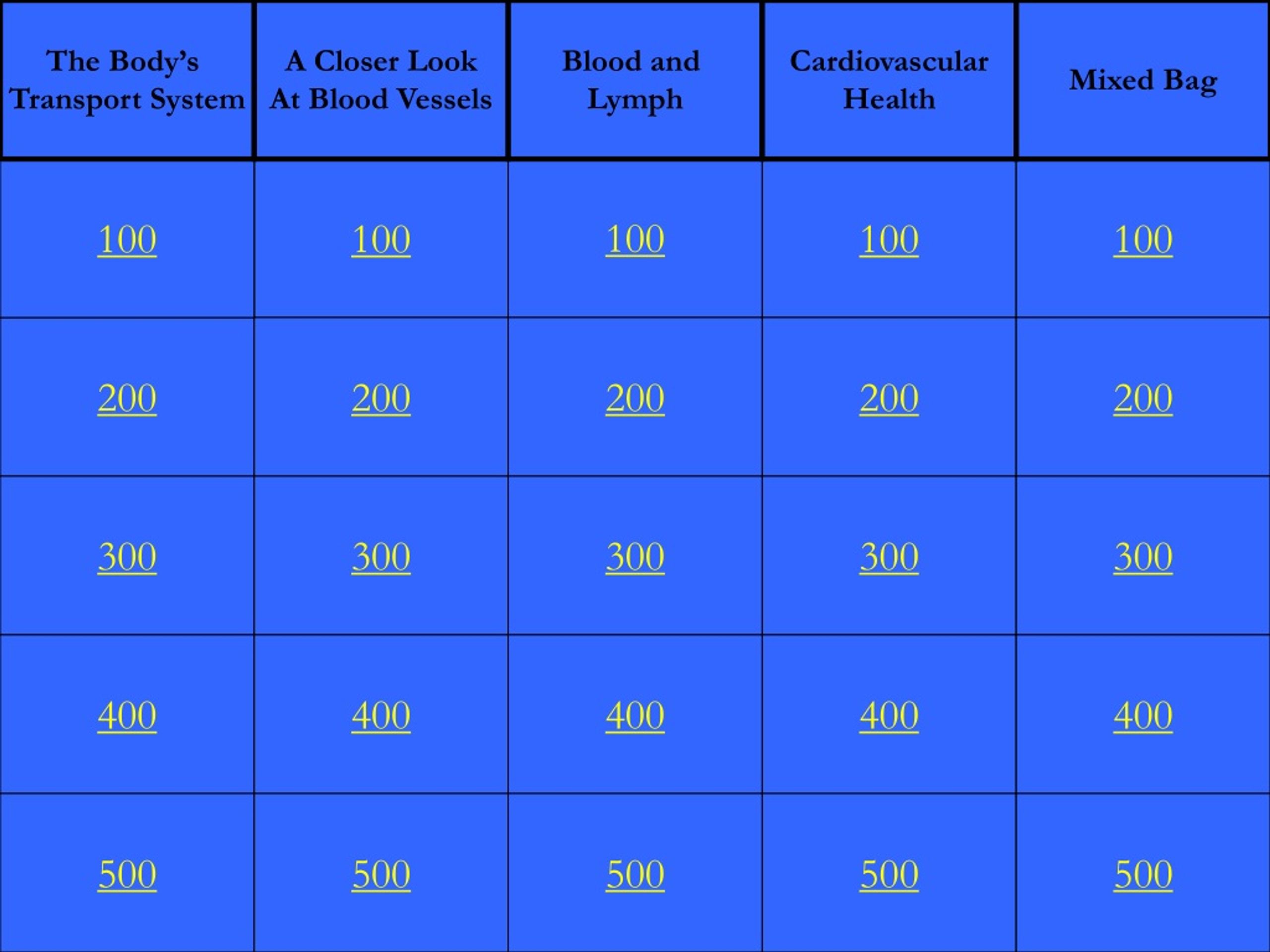
The Body’s Transport System A Closer Look At Blood Vessels Blood and Lymph Cardiovascular Health Mixed Bag 100 100 100 100 100 200 200 200 200 200 300 300 300 300 300 400 400 400 400 400 500 500 500 500 500
100 What is the name of the group of heart cells that sends out muscle contraction signals?
100 As blood moves away from the heart, does blood pressure usually increase or decrease? Why?
100 It decreases because the further the blood is from the pumping ventricles, the lower the force is.
200 What is the big difference between the structure (layers) of an artery and a vein?
200 They both have an inner layer of epithelial cells, a middle layer of smooth muscle, and an outer layer of connective tissue. The big difference is that arteries have a thicker layer of smooth muscle, thus making them thicker overall.
300 What is the name of the instrument used to measure blood pressure? (yes, the long one…)
400 Explain the process of diffusion. Don’t forget to also tell where it happens.
400 Diffusion is the process by which molecules move from an area of higher concentration to an area of lower concentration. It occurs in the capillaries.
500 Name three ways that veins help continue to move blood onward back to the heart.
500 • Contraction of skeletal muscles • Larger veins have valves • Breathing movements exert pressure against veins in the chest
100 If your lymph nodes enlarge, what does that indicate?
400 Discuss what happens when you get cut. Be sure to use the terms platelets and fibrin.
400 Once cut, platelets collect and stick to the blood vessel. The platelets then release chemicals that start a series of reactions that produce a protein called fibrin. Fibrin weaves a net of tiny fibers across the cut. This net traps blood cells, thus forming a blood clot.
500 It is an iron-containing protein that makes up most of the red blood cell. It’s job is to chemically combine with oxygen and carry it in the blood stream.
300 What is lymph? How does it return to the cardiovascular system?
300 Lymph is fluid inside vessels of the lymphatic system and consists of water, dissolved materials, and some white blood cells. It returns to the cardiovascular system through veins in the chest.
400 What is the universal blood donor? What is the universal blood recipient?