Download
1 / 12
120 likes | 235 Vues
Weather encompasses the atmospheric conditions at a specific time and location, influenced by factors such as humidity and the water cycle. This dynamic cycle describes how water moves in various states across Earth. Clouds, formed when air cools to its dew point, lead to different types of precipitation—rain, snow, sleet, and hail. Weather systems are characterized by air masses and fronts, with associated weather phenomena like cyclones and anticyclones. Severe weather events like thunderstorms, tornadoes, and hurricanes require vigilance and safety measures. Meteorologists use various tools like barometers and satellites to forecast these conditions.

E N D
Weather Ch. 16
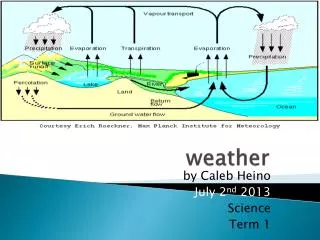
Weather is the condition of the atmosphere at a certain time and place. • It is affected by the amount of water vapor in the air. • The water cycle describes the movement of water above, on, and below Earth’s surface. • Water is continuously moving and changing state as it moves through the water cycle.
Humidity describes the amount of water vapor in the air. • Relative humidity is a way to express humidity. • When the temperature of the air cools to its dew point, the air has reached saturation and condensation occurs.
Clouds form as air cools to its dew point. • Clouds are classified by form and by the altitude at which they form. • 3 main types: • Cumulus • Stratus • Cirrus
Precipitation occurs when the water vapor that condenses in the atmosphere falls back to Earth in solid or liquid form. • Types of precipitation: • Rain • Snow • Sleet • Hail
Air Masses and Fronts • Air masses are characterized by their moisture content and temperature. • Air masses form over source regions. • Have similar temperature and moisture content throughout • A front occurs where 2 air masses meet. • Specific types of weather are associated with each front. • Four major types of fronts are: • Cold • Warm • Occluded • Stationary fronts
Difference in air pressure cause: • cyclones, which bring stormy weather • Anticyclones, which bring dry, clear weather
Severe Weather • Thunderstorms are intense weather systems that produce strong winds, heavy rain, lightening, and thunder. • Lightningis a large electrical discharge that occurs between 2 oppositely charged surfaces. • It releases a great deal of energy and can be very dangerous.
Tornadosare small, rotating columns of air that touch the ground and can cause severe damage. • Hurricanes are large, rotating tropical weather systems. • Cause strong winds and can cause severe property damage.
In the event of severe weather, it is important to stay safe. • Listening to your local tv or radio station for updates and remaining indoors and away from windows are good rules to follow.
Forecasting the Weather • Meteorologists use several instruments to forecast the weather. • Weather balloons • Thermometers • Barometers • Anemometers • Windsocks • Weather vanes • Radar • Weather satellites
Station models show the weather conditions at various points across he United States. • Weather maps show areas of high and low pressure as well as the location of fronts.