Radioactivity
This text explores the concept of radioactivity, defined as the spontaneous emission of particles or electromagnetic rays due to nuclear decay. It highlights the types of nuclear radiation and how different materials absorb them: alpha radiation can be blocked by paper, beta by wood, and gamma or neutron radiation by concrete or lead. The concept of half-life is introduced, explaining the time required for half of a radioactive substance to decay. For example, Cesium-137 has a half-life of 30 years, meaning when only 25% of it remains, it is 60 years old.

Radioactivity
E N D
Presentation Transcript
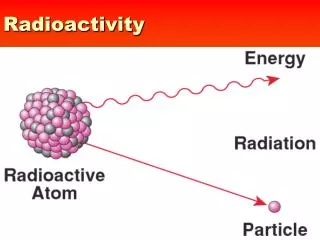
Radioactivity • The spontaneous emission of a stream of particles or electromagnetic rays in nuclear decay.
Nuclear Radiation • Spontaneous breakdown or decay of atomic nuclei
Nuclear Radiation • Absorption of nuclear radiation. Alpha radiation will be absorbed by a piece of paper, beta by a plank of wood and gamma and neutron radiation by a block of concrete or lead.
Half-life • The time required for ½ of any original number of parent atoms to decay.
Half-life • What is the half-life of Cesium-137? • 30 years • When 25% of the radioactive Cesium material remains, how old is it? • 60 years