Ch. 4 – Linear Motion
This guide focuses on key concepts in linear motion, including speed, velocity, and acceleration. Speed is defined as the change in distance over time, expressed as (v = frac{d}{t}) with units in m/s. Velocity includes direction and distinguishes between average and instantaneous speed. Acceleration is the change in velocity with the formula (a = frac{v_f - v_i}{t}), with units m/s². We also explore free fall, where all objects accelerate at 9.8 m/s² due to gravity, regardless of mass. Key equations and practical applications are discussed.

Ch. 4 – Linear Motion
E N D
Presentation Transcript
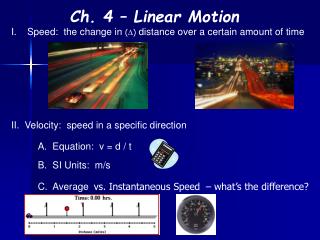
Ch. 4 – Linear Motion • Speed: the change in (D) distance over a certain amount of time II. Velocity: speed in a specific direction A. Equation: v = d / t B. SI Units: m/s C. Average vs. Instantaneous Speed – what’s the difference?
(vfinal – vinitial) over a certain time. III. Acceleration: D velocity A. Equation: a = vf – vi / t -or- a = Dv / t B. SI units: m/s2 C. Acc. due to gravity (g): 9.8 m/s2 (10 m/s2 for averaging)
IV. Free Fall: When air resistance is not a factor… All objects fall at the same rate (9.8 m/s2)!!! A. Speed and acceleration: v = g x t (Table 2.2) B. Distance fallen: uses average speed (Why?) 1. d = ave. speed x time (Table 2.3) 2. d = ½(beg. speed + final speed) x time 3. d = ½ (g x t) x t 4. d = ½ gt2