Memory
Memory. What is memory?. Memory is the process of encoding, storing, and retrieving information. Case Study on Memory. H.M. was suffering from severe epileptic seizures Doctors decided to perform a surgery on the temporal lobe of his brain to help control the seizures. Case of H.M.


Memory
E N D
Presentation Transcript
What is memory? • Memory is the process of encoding, storing, and retrieving information
Case Study on Memory • H.M. was suffering from severe epileptic seizures • Doctors decided to perform a surgery on the temporal lobe of his brain to help control the seizures
Case of H.M. • Doctors and scientists know now that the temporal lobes of the brain hold important functions in memory, speech, and hearing • Part of H.M’s hippocampus was removed • As a result of the surgery, H.M. lost the ability store new information • Testing revealed H.M. could remember verbal information for up to 15 mins
Classifications 3 kinds of memory • Episodic = memory of specific events • Example of explicit memory • Semantic= memory of facts, words, concepts • Most of what we learn in school is semantic memory • Also explicit memory • Implicit= implied or not clearly stated memory • Ex: learned habit or practiced skill
Memory Process • Encoding • Storage • Retrieval
1st Encoding Humans and computers both encode. Encoding is processing information into a format in which it can be used. In encoding we human convert sensory stimulus into psychological formats that can be represented mentally
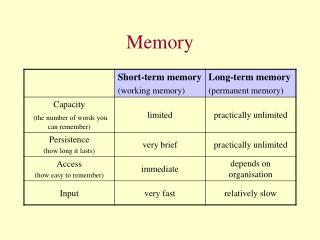
2nd Storage • Storage = the maintenance of encoded information over a period of time • Short-term • Long-term
How do we store information? • Maintenance Rehearsal-uses repetition to store information • An example of a time you’ve used repetition to learn something new? • Elaborative Rehearsal- fits new information into an organizational system • This is used in school and education usually • You may organize your knowledge by associated it with something else that reminds you of that information
3rd Retrieval • Locating stored information and returning it to conscious thought • Memory is “context-dependent”… • It can be retrieved more easily when the person is in a similar situation or environment as when they first learned that information • “State-dependent” • Information can be retrieved more easily when the person is in a similar emotional state as when the information was first learned