Download
1 / 11
110 likes | 242 Vues
This guide explores the intricate composition of soil, highlighting its formation from parent rock through weathering, organic matter accumulation, and particle size classification. It defines soil and its horizons—inclusive of topsoil, subsoil, and parent rock—while discussing the vital interactions between soil, roots, and living organisms within ecosystems. This knowledge sheds light on the importance of soil health and its role in sustaining diverse forms of life over centuries.

E N D
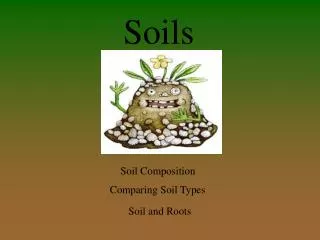
Soils Soil Composition Comparing Soil Types Soil and Roots
Ecosystem Living and non living things and their interactions Ecology The study of the Ecosystem
What is soil made of? Weathering of parent rock Organic material Open spaces Water
All soil originates from parent rock. Parent rock is broken down by weathering into small mineral particles. The sizes of the mineral particles determine the texture of the soil. One way of classifying soils is by their texture. Particles larger than 2 mm are called gravel. Particles between 2 mm and 0.05 mm are called sand. Particles between 0.05 mm and 0.002 mm are called silt. Particles less than 0.002 mm are called clay. Soil made up of a mixture of all three sizes of particles is called loam
Soil Defined: Soil is the total mixture of mineral particles of many sizes, organic matter, open spaces, water, and salt solutions in a defined structure.
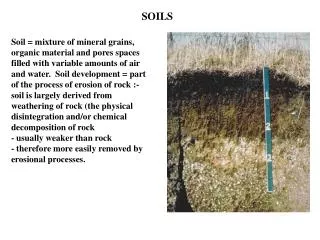
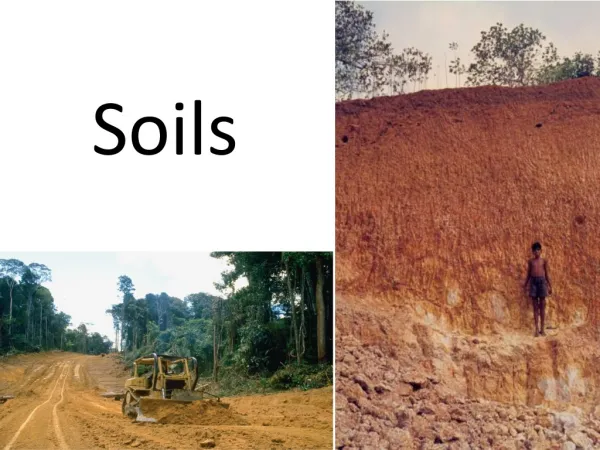
Formation of Soil Parent Rock begins to break down into smaller and smaller pieces. Organic matter (dead plant and animal material) accumulates at the surface Over time the weathering process forms soil at deeper levels and the layer of soil on the top becomes thicker. As separate layers of soils become identifiable they are known as Horizons Horizon A is known as topsoil Horizon B is known as subsoil Horizon C most closely resembles parent rock
Although different locations and types of parent material will form soils at varying rates, it is believed to take centuries to form a complete profile Some scientists believe that it takes 200 to 300 years to form one centimeter of soil form parent rock and some well formed soil profiles can be hundreds of centimeters thick.
Sources • Pictures provided by: Google Images • Fast 1 Curriculum; University Hawaii • General Science: A Voyage of Adventure, Chapter 20 Soils; Prentice Hall; 1989