Understanding the Demand Curve for Monopolistic Firms and Profit Maximization Strategies
120 likes | 259 Vues
This chapter explores the demand curve faced by monopolistic firms, emphasizing that the monopolist is both the single producer and the industry itself. It explains that the firm confronts a downward-sloping demand curve, which is critical for grasping profit maximization strategies. Unlike perfect competitors, a monopolist’s output decision influences price, leading to a marginal revenue (MR) that is consistently lower than the price. The relationship between total revenue (TR), average revenue (AR), and MR is discussed, highlighting how changes in output affect these revenue metrics.


Understanding the Demand Curve for Monopolistic Firms and Profit Maximization Strategies
E N D
Presentation Transcript
Monopoly Demand Curve Chapter 15-2
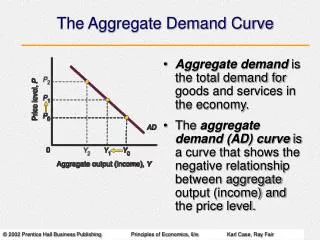
The Demand Curve Facing a Monopoly Firm • In any market, the industry demand curve is downward-sloping. This is the result of the law of demand.
Monopolist is the Industry • Critical to understanding the profit maximization of the monopolist is remembering that the monopolist is the industrybecause it is the sole producer. • Therefore the monopolist confronts a downward-sloping demand curve. The industry demand curve is the firm’s demand curve.
The Key Difference Between a Monopolist and a Perfect Competitor • A monopolistic firm’s output decision can affect price • There is no competition in monopolistic markets so monopolists see to it that monopolists, not consumers, benefit • A monopolistic firm’s marginal revenue is not its price • Marginal revenue is always below its price • Marginal revenue changes as output changes and is not equal to the price 15-4
Marginal Revenue • Recall that the marginal revenue (MR) is:
The Monopolist’s Price and Output Numerically • Remember is that marginal revenue is the change in total revenue that occurs as a firm changes its output. TR=P x Q MR = Change in Total Revenue/ change in output Another way to say it is: “how much does your Total Revenue changes as you increase output”
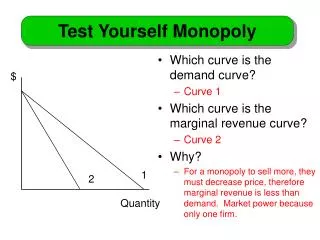
Marginal Revenue < Price • MR is less than price for a monopoly firm. • The MR is less than price and declines as output increases because the monopolist must lower the price in order to sell more units (because the demand curve slopes downward).
The Monopolist’s Price and Output Numerically • When a monopolist increases output, it lowers the price on all previous units. • As a result, a monopolist’s marginal revenue is always below its price.
Average Revenue • Whenever MR is greater than AR, AR rises. • Whenever MR is less than AR, AR falls. • Average revenue is:
Average Revenue > Marginal Revenue • Note that the AR is the same as price. In fact, the AR curve is the demand curve. • With a downward-sloping demand curve, prices fall as output increases. This means that AR falls. • MR must always be less than AR.