Gender in Society: Identity, Equality, and Social Change
Explore the complexities of gender, from biological and social identity to the impact of gender expectations on individuals and societies. Delve into theories, disparities, and legislative changes that shape our understanding of gender roles. Discover how gender equality can transform social dynamics and challenge traditional norms.

Gender in Society: Identity, Equality, and Social Change
E N D
Presentation Transcript
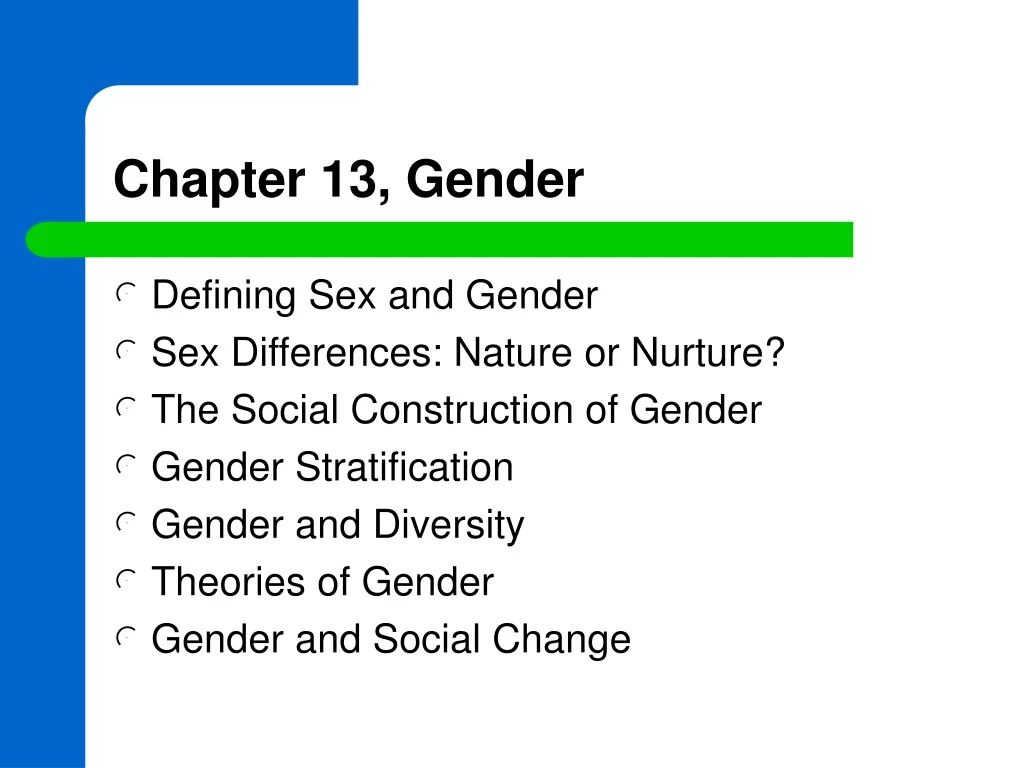
Chapter 13, Gender • Defining Sex and Gender • Sex Differences: Nature or Nurture? • The Social Construction of Gender • Gender Stratification • Gender and Diversity • Theories of Gender • Gender and Social Change
Defining Sex and Gender • Sex refers to biological identity. • Gender refers to the socially learned expectations associated with members of each sex.
Biological and Social Sex Identity • Biology alone does not determine gender identity. • When fetal sexual differentiation is compromised, biological sex identity is unclear. • Transgendered people indicate that there is no fixed relationship between biological and social outcomes.
Sources of Gender Socialization • Parents • Childhood play and games • Schools • Religion • Media
The Price of Conformity Conformity to gender expectations has negative consequences: • Women are denied access to power, influence, achievement, and independence. • Men are denied nurturing, emotional, and other-oriented world.
Characteristics of Societies With Gender Equality • Women’s work is central to the economy. • Women have access to education. • Ideological or religious support for gender inequality is weak.
Characteristics of Societies With Gender Equality • Men contribute to housework and childcare. • Work is not highly sex-segregated. • Women have access to formal power and authority.
Women’s Worth: Still Unequal • Women who work full-time earn on average 74% of what men earn. • Women’s labor force participation rate in 1997 was 60%, compared with 75% of men. • 2/3 of mothers are now in the labor force. • Women work to support themselves or their family or to bring in extra money.
Explaining the Pay Gap • Human capital theory - age, experience, education, marital status and hours worked influence worth in the labor market. • Dual labor market theory - women and men earn different amounts because they tend to work in different segments of the labor market.
Explaining the Pay Gap • Overt discrimination - white men use their power to perpetuate their advantage over women and racial minorities, through labor union practices, legislation, harassment, and intimidation.
Explanations of Gender Segregation • Gender socialization • Glass ceiling to advancement • Women’s family responsibilities
Theories of Gender • Functionalism - socialization into prescribed roles is the major impetus behind inequality. • Conflict theorists - women are disadvantaged by power inequalities that are built into the social structure. • Symbolic interaction theory - gender is produced through interaction and interpretations.
Feminist Theory: 4 Frameworks • Liberal feminism - gender socialization contributes to inequality because it is through learned customs that inequality is perpetuated. • Socialist feminism - the system of capitalism is the origin of women's oppression.
Feminist Theory: 4 Frameworks • Radical feminism - patriarchy is the primary cause of women's oppression. • Multiracial feminism - developed new avenues of theory for guiding the study of race, class, and gender.
Legislative Changes Legislation can promote change, but cannot guarantee change: • The Equal Pay Act of 1963 • Civil Rights Bill of 1964 • Title IX of the Educational Amendments of 1972