Exploring Sound and Waves: Concepts and Calculations in Physics
100 likes | 227 Vues
Join Mr. Vannucci and Mr. Henry as they delve into the fascinating world of sound and waves. In this series of physics exercises, students will investigate concepts such as sound delay, wave speed, frequency, wave harmonics, and graphical relationships between wavelength and anti-nodes. Through practical problems, ranging from the effects of distance on sound perception to analyzing the properties of vibrating strings and tuning forks, students will enhance their understanding of acoustics and wave behavior.


Exploring Sound and Waves: Concepts and Calculations in Physics
E N D
Presentation Transcript
Physics Review Game:Sound and Waves Mr. Vannucci and Mr. Henry
1.You seeJoe punch an anvil, and about 0.6 seconds later you hear the strike of the anvil. If the speed of sound is 343 m/s, about how far away is Mr. Vannucci? (Hint: You do not need reaction time at all, assume you have a perfect reaction time).
2. This time, Joe punches the anvil (like the Hulk, you see) but he’s right next to you! The sound bounces off a wall that is 75 m away, and you hear the echo of that sound. How much time will elapse between when Joe punches the anvil (SMASH!) and you hear the sound?
3. You and your lab partner stretch a string that is 2.3 m long. You pluck the string, and in 3 seconds you count 12 pulses that go back and forth along it. What is the period and the frequency of each of those pulses?What is the speed of the wave in that string?
4. Assume the pulse from the previous problem was the 1st harmonic wave. What is that wave’s wavelength?
5. Using Excel, draw a graph that shows the relationship between λ (wavelength) and number of anti-nodes (a.n.). You must have a properly labeled graph, with λ on the Y axis and a.n. on the X axis
6. Using a piece of graph paper (provided) draw the following wave:A = 0.4 mλ= 1 mWhat wave must you combine this with in order to increase the wave by 1.5x?
7. You have two tuning forks in hand, and they produce a beat frequency of 5 Hz. What are possible frequencies for these two forks? (Your answer must be two frequencies, ƒ1 and ƒ2)
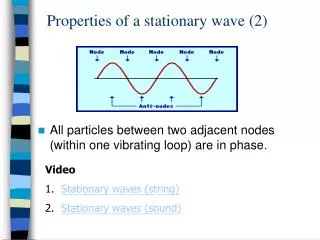
8. You are given a string that is vibrating at 70 Hz and has 5 a.n.A. Draw this wave on your handout. What harmonic is it?B. Find the next 3 harmonics going down, (draw them, find their f and λ)
Bonus: Your eyes are unable to see a wave when λbecomes smaller than 0.5 cm (that’s 0.005 m).A. How many anti-nodesis that wave? (easy)B. What is the highest frequency that you can crank your device to and still see each individual wave? (Harder)