SlideServe
Menu
Préférences
© SlideServe · v2026

Evolution

long avatar
22 diapositives · 732 Views · Jul 15, 2014

Evolution. Descent with Modification: A Darwinian View of Life. Evolution Defined . Evolution : gradual hereditary changes in groups of living organisms over time. . November 24, 1859. Lamarck’s Theory. Jean Baptiste de Lamarck , 1809
Evolution - slide 1
01 / 22Evolution
1 / 17

Télécharger la présentation

Evolution
Une image / un lien ci-dessous est fourni (tel quel) pour télécharger la présentation

Politique de téléchargement : le contenu du site vous est fourni TEL QUEL pour votre information et votre usage personnel ; il ne peut être vendu, concédé sous licence ni partagé sur d’autres sites sans l’accord de son auteur.Le contenu vous est fourni TEL QUEL, pour votre information et votre usage personnel uniquement. Téléchargez la présentation en cliquant sur ce lien. Lors du téléchargement, si vous ne parvenez pas à télécharger une présentation, l’éditeur a peut-être supprimé le fichier de son serveur.Pendant le téléchargement, si vous ne parvenez pas à obtenir une présentation, le fichier a peut-être été supprimé par l’éditeur.

F I N

Plus de contenu associé

Transcription de la présentation
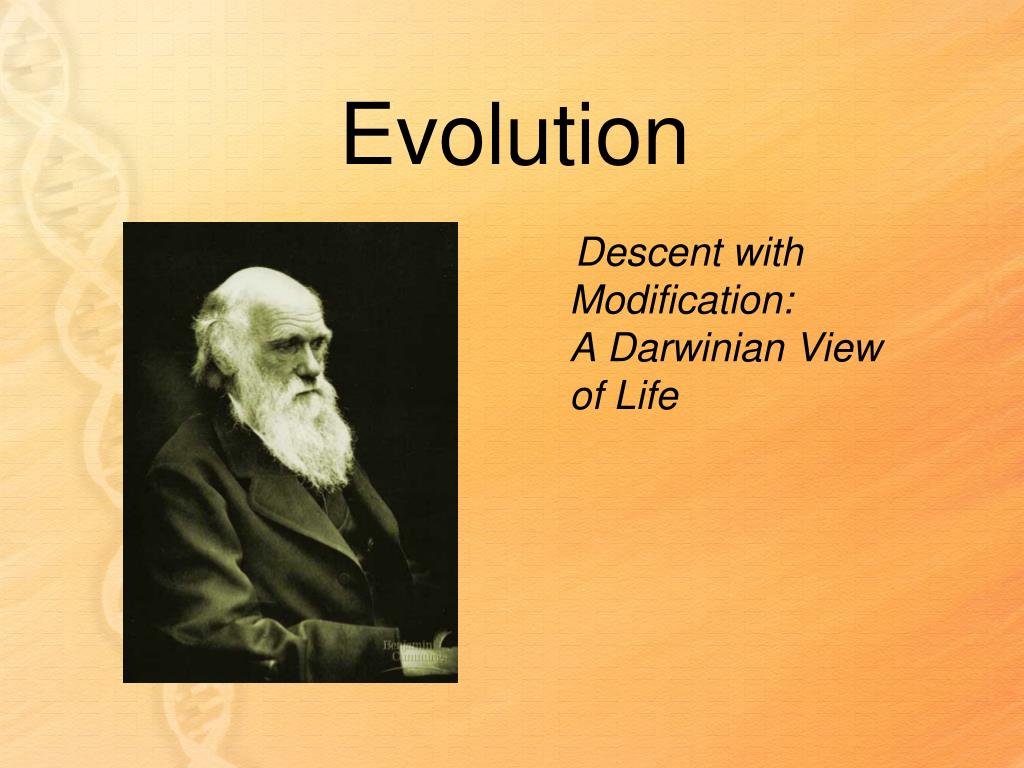
  1. Evolution Descent with Modification: A Darwinian View of Life

  2. Evolution Defined Evolution: gradual hereditary changes in groups of living organisms over time. November 24, 1859

  3. Lamarck’s Theory • Jean Baptiste de Lamarck, 1809 • First theory of evolution- how species change

  4. Lamarck’s Theory • **Inheritance of acquired characteristics-The changes acquired during an animals lifetime from use and disuse may be passed on to its offspring. • Law of use and disuse-parts used by animal become stronger, parts used less become weaker

  5. Darwin vs. Lamarck

  6. Charles Darwin • Father of Evolution • Developed the theory of evolution after his trip on the H.M.S Beagle • Published the Origin of Species on November 24,1859

  7. Darwin’s Finches

  8. The finches beaks were different based on the type of food they ate.

  9. Actual photos of the finches

  10. Niches of Darwin’s Finches

  11. Keep in mind…… • Populations or species evolve, not individuals

  12. Major pieces of Evidence for Evolution • Fossils • Comparative Anatomy (homologous structures) • Selective Breeding of Animals and Plants

  13. 1. Fossil Evidence Fossils: remains and traces left behind by organisms -most direct evidence for evolution -provides a record of ancient organisms that have existed -able to generate a timeline -ancestral descent and lineages can be generated Types of Fossils: imprints, hair, nails, tissue, and other remains Locations: sedimentary rock, ice, amber, tar, quicksand, petrification

  14. Evidence: 1. The Fossil Record • Shows succession of forms over time • Transitional links • Vertebrate descent

  15. Evolution Evidence: 2. Comparative Anatomy Homologous Structures Types of Structures: • A. Homologous structures (same structure, diff. use) • Shows possible descent from a common ancestor

  16. 6. Selective Breeding • We have bred various animals and plants for specific purposes, selecting the traits WE want them to acquire. • The process in which humans select which plants or animals to reproduce based on certain desired traits is called selective breeding. • Ex- horses, dogs, strawberries, corn • This is controlled evolution.

  17. Darwin’s Theory • Variation- There is a natural variation in any population. Every individual has its own combination of traits. • Overproduction- more offspring are born than survive. 3. Struggle to Survive- members of a species compete for food, habitat, etc. (limits population) 4. Reproduction- individuals that are best adapted to their environment are likely to have many offspring that survive. Natural selection- “survival of the fittest”- The species most fit for their environment will survive to pass on their traits.

  18. Darwin’s Theory of Natural SelectionWhat Is Natural Selection? Darwin proposed the theory that evolution happens through a process that he called natural selection. Individuals that are betteradapted to their environment survive and reproduce more successfully than less well adapted individuals.

  19. 7. Examples of Natural Selection • Peppered moth • antibiotic resistance

  20. Examples of Modern (Recent) Evolution • Peppered Moth- during day sits on tree trunk. More active at night. • Before 1850 tree trunks were light in color, and most moths were gray. • After 1850 (industrial revolution), the predominant color of moth was black, which matched the soot on the trees. peppered moth activity

  21. Key Points to Remember • A population evolves not an individual organism • The accumulation of small changes over long periods of time results in larger changes • A new species emerges with slightly different characteristics usually because of being isolated. • How and why organisms are able to transmit heritable traits to the next generation was not explained by Darwin. • Common Ancestry!

  22. Final words…... • “Absence of evidence is not evidence of absence.”