Language Acquisition Insights from Kanzi: Pygmy Chimpanzees and Their Communication Skills
This exploration into the language acquisition capabilities of Pygmy chimpanzees, specifically Kanzi, reveals fascinating insights into how non-human primates can grasp symbolic communication. Utilizing a lexigram keyboard, Kanzi demonstrated spontaneous symbol acquisition and communicative abilities akin to human language development. Drawing comparisons to language theories by B.F. Skinner and Noam Chomsky, the study underscores the nature vs. nurture debate in language learning. It also examines Kanzi's progress in semanticity, creativity, and displacement, as well as the implications for understanding human linguistic capabilities.

Language Acquisition Insights from Kanzi: Pygmy Chimpanzees and Their Communication Skills
E N D
Presentation Transcript
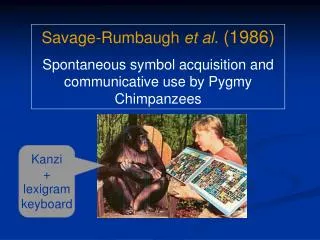
Savage-Rumbaugh et al. (1986) Spontaneous symbol acquisition and communicative use by Pygmy Chimpanzees Kanzi + lexigram keyboard
Thinking about human language • “Furious green ideas sleep peacefully” • “’Twas brillig and the slithy toves did gyre and gimble in the wabe” • Does these sentences make sense? • Can the word order be changed? • Are these sentences grammatical? • How did you make these decisions?
Thinking about human language • Acquiring human language • Is the ability to use human language learned or innate? • This is the nature or nurture debate
Language theories 1 • The behaviourist theory (B.F. Skinner) • Children learn by imitation (copying) and reinforcement (rewards/punishments) • Skinner calls this operant conditioning
Language theories 2 • The nativist theory (Noam Chomsky) • Children are born with an built-in Language Acquisition Device (L.A.D.) • The ability to learn/use language is hard wired into the human brain
Language theories: debate 1 • NATURE (Skinner) • This theory emphasises performance • A child imitates what she hears and is reinforced when correct • Gradually correct vocalisations are shaped and words are learned
Language theories…. • NATURE (Skinner) - criticisms • It would take too long to learn language this way • In fact, parents do not reinforce correct speech in a consistent way • (think: “baby talk”)
Language theories…. • The NATIVIST theory (Chomsky) • emphasises competence • using vs understanding • All humans are ‘prepared’ to learn language • Fact: normal children acquire language in similar stages • Linguistic universals exist in every language
LINGUISTIC UNIVERSALS • 3 COMPONENTS of language • PHONOLOGY - sound patterns • SYNTAX – word patterns (esp. word order – “dog bit man” does not mean the same as “man bit dog”) • SEMANTICS – meaning patterns
Characteristics of language use • SEMANTICITY - words have meanings • DISPLACEMENT - words can be used to refer to things that are not present in time/space • STRUCTURE DEPENDENCE - words can be ‘chunked together’ and moved around - • e.g. “dog bit man” vs “man bit dog” • CREATIVITY - each utterance might be unique, always creating new words or expressions • GENERALISATION - from one situation to another
Language - the great debate • Why teach language to apes? • If apes can learn language it supports Skinner (nurture) • If not perhaps Chomsky is right (nature)
Teaching language to apes • The earliest experiment (1930s) • Winthrop & Luella Kellogg and their chimp Gua • Brought up like human baby • Continually exposed to speech • ‘Understood’ 70 words but never spoke • NB. chimps have NO vocal chords
Sue Savage-Rumbaugh (Project Lana) • Keyboard with symbols linked to computer and a vending machine • If Lana requested ‘food’ she received it • Lana understood symbols like ‘more’ • YES - semanticity YES - displacement, • NO - structure dependence
Gardner & Gardner (Project Washoe) • A case study • Participant - a female chimp • Age - approx 1 year old • Procedure - Washoe lived in a caravan in the Allen & Trixie Gardner’s garden & was taught American Sign Language (ASL) • Language was reinforced with rewards
Washoe’s progress ... 1 • First SINGLE SIGNS • “come”, “gimme”, “hurry”, “sweet”, “tickle” • 34 signs after 21 months • by 4 years, over 100 signs • YES - SEMANTICITY • signed TOOTHBRUSH in bathroom • signed FLOWER in garden and when shown picture of flower
Washoe's progress ... 2 • YES - CREATIVITY • Washoe spontaneously used combinations of signs • GIMME TICKLE • OPEN FOOD DRINK - open the fridge • LISTEN EAT - listen to the dinner gong • GO SWEET - take me to the raspberry bushes
Washoe’s progress ... 3 • NO STRUCTURE DEPENDENCE • English children usually put the SUBJECT before the ACTION • Mummy come • Eve read • Car gone • Washoe did not do this • GO SWEET or SWEET GO both used for “take me to the raspberry bushes”
Savage-Rumbaugh et al (1986) Spontaneous symbol acquisition and communicative use by pygmy chimpanzees • Kanzi & Sue Savage-Rumbaugh • ‘having a chat’
Kanzi displays one of his paintings Research design • Research question: Can Kanzi learn symbolic language without training in the same way children do? • Method: Case Study - longitudinal design • The report of Kanzi’s language development (the findings) is described as ‘serendipitous’ – meaning it occurred by happy chance
Kanzi - the participant Swahili for treasure The participant: • KANZI born 28/10/80 in captivity, his mother was a ‘language chimp’ and infant Kanzi went to her lessons • Assigned to the language research centre at 6 months & reared in a language using environment with humans • When 2½ yrs old it was observed that he was using symbols spontaneously (perhaps because he had observed his mother) • Big surprise – shown no interest in language at his mother’s lessons…
Serendipitous Observation Kanzi • began to use symbols without training • identified symbols correctly and did not confuse them (e.g. apple, orange, banana) • understood spoken words
The Visual Symbol System Indoors: battery powered keyboard with geometric symbols that brighten when touched, then speech synthesiser ‘speaks’ the word • Outdoors: copy of keyboard as laminated pointing board • each symbol called a LEXIGRAM
Kansi’s Outdoor Environment • 55 acres forest; 17 food locations; must travel to ‘get food’ from each location for a specific food type e.g. bananas to treehouse, peaches to lookout • Kanzi learned where all the food was located • Could select a food from photos on the ground and could guide another person to his chosen location • Learned to use the symbols on the keyboard to indicate where he wanted to go
Data Collection Longitudinal case study • records kept of Kanzi’s language development (symbol use) for 17 months • From the age of 2½ • Computerised records from keyboard • Notes from observers when outside
Longitudinal Case Study The data (assessing Kanzi’s symbol use) • correct or incorrect (did he use the right lexigram?) • spontaneous (was it unprompted?) • imitation (had he seen someone else use it) • structured (e.g. responds to question) • also Behavioural Concordance… • … means did symbol-use match way Kanzi acted? • e.g. if request to ‘go to treehouse’, did he lead a person to the treehouse?
Controls • Analysis of videotape against real time coding of symbol use by 2 observers • 1 scored real time, 1 scored tape, real time observer did not know the record would be used for reliability check • 100% agreement on correct vs incorrect use of symbols • 1 disagreement over spontaneous use
Results – combining symbols 2530 correct combinations many were ‘two foods’ e.g. hotdog & coke 265 imitated person (g) chase Kanzi’ person (g) chase person (g) g = makes a gesture to indicate ‘who’ Indicates structure dependence / correct syntax
Testing Kansi • given lexigram and/or photo • asked to match to object • also match to spoken English • see example list • X = error • C = match • NP = Not Possible
Sherman & Austin • Kanzi & his sister Mulika were pygmy chimps (bonobos) • Researchers also had 2 common chimpanzees – Sherman & Austin • They were part of earlier training programme – trained in using symbols with rewards etc • Took 3 years for them to show behavioural concordance • Mostly used signs for food
Comparing with other apes 1 • Kanzi: comparison of imitated or spontaneous to ‘other ape learners’ • NB Kanzi & Mulika are bonobos; the others are regular chimpanzees
Comparing with other apes 2 • 1. The bonobos acquired language with greater ease – Sherman & Austin needed lots of training • 2. Kanzi & Mulika seem to understand spoken English words • 3. Bonobos can differentiate (eg juice vs coke) but chimpanzees use signs interchangeably • 4. Kanzi can direct others to do things – this is “a precursor to syntactical structure” (basic syntax = structure dependency)
Example of Kanzi • In an outing in the woods, Kanzi touched the symbols for marshmallows and fire. "Kanzi snapped twigs for a fire, lit them with the matches and toasted the marshmallows on a stick." • Blind test: stranger asked Kanzi for directions in the woods; Kanzi could choose symbols/photographs then guide to the right location; Kanzi could guide when visitor used spoken English too!
Bonobos & Children • Kanzi appeared to learn signs the way children acquire language • Starts with associations – Kanzi learned “strawberries” at mushroom site and at first used “strawberries” only there – later learned to use sign in wider context • Tend to generalise – used “tomato” for all round red fruits • Started to use multi-syllable expressions (“chase bit person”) • Imitated most often when learning new words
Conclusions • Kanzi learned to use the symbols spontaneously • Kanzi & the language universals? • semanticity - YES; creativity - YES; • structure dependence - YES; • Generalisation - YES; Displacement – YES • Compared to other species of chimps pygmy chimpanzees appear to be able to learn and use language more like a human child • Do bonobos have “untapped potential” to learn language? Perhaps one individual could push the behaviour of a group of wild apes towards language!
Evaluating this Study • Quantitative AND qualitative data • Were the measures VALID? Was Kanzi really using language or just “parrotting”? (Stephen Pinker) • Were the measures RELIABLE? Would researchers agree with each other? • How representative is Kanzi of bonobos? of other apes? (NB Kanzi is a particularly skilled tool user…) • How realistic was the study (ecological validity)? What are apes like “in the wild”? • What ethical issues does this study raise? • What differences are there between Kanzi & child learner? • Is this research useful?