Hypothesis
A hypothesis is a tentative assumption made to draw out and test its logical or empirical consequences. It serves as a testable statement that proposes possible explanations for phenomena or events, often including predictions. For instance, one might hypothesize that increased UV light exposure raises skin cancer rates or that more frequent watering prompts faster plant growth. A well-crafted problem statement contextualizes research, engaging the reader and setting the stage for exploration of pertinent questions.

Hypothesis
E N D
Presentation Transcript
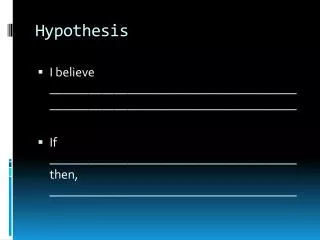
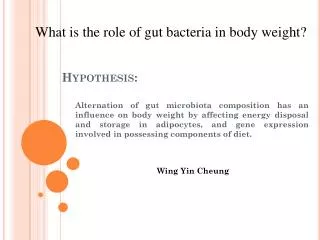
Hypothesis • “a tentative assumption made in order to draw out and test its logical or empirical consequences” (Merriam-Webster, 2008) • “A hypothesis is a tentative statement that proposes a possible explanation to some phenomenon or event. A useful hypothesis is a testable statement which may include a prediction.” (http://www.accessexcellence.org/LC/TL/filson/writhypo.html)
Continue • “An anticipated outcome of a study or experiment” (Thomas and Nelson, 1996).
Examples • If skin cancer is related to ultraviolet light , then people with a high exposure to uv light will have a higher frequency of skin cancer. • People with insufficient quad strength will increase their chance of ACL injuries. • If leaf color change is related to temperature , then exposing plants to low temperatures will result in changes in leaf color. • The plant will grow faster if the watering frequency is increased.
Problem StatementTaken from http://web.utk.edu/~wrobinso/540_lec_problem.html • The problem provides the context for the research study and typically generates questions which the research hopes to answer. In considering whether or not to move forward with a research project, you will generally spend some time considering the problem. • The problem statement should "hook" the reader and establish a persuasive context for what follows.